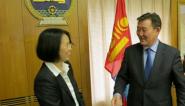
China's Xi meets Mongolian president in Shanghai

SHANGHAI, May 19 -- Chinese President Xi Jinping met with his Mongolian counterpartTsakhiagiin Elbegdorj in Shanghai on Monday.

Elbegdorj was here to attend the Fourth Summit of the Conference on Interaction andConfidence Building Measures in Asia scheduled for Tuesday and Wednesday in Shanghai.

Xi called on both countries to be good neighbors, good friends and good partners, andsupport each other on issues of core interest and major concern.

China respects Mongolia's sovereignty, security and territorial integrity, and respects thedevelopment path that Mongolia has chosen for itself in accordance with its nationalconditions, Xi said.

This year marks the 65th anniversary of China-Mongolia diplomatic ties as well as theYear of China-Mongolia Friendly Exchanges. Both sides held celebrations that receivedwarm responses from the two peoples, Xi said, hailing the sound momentum of bilateralties.

"I care very much about China-Mongolia ties and assign great importance to them," Xisaid.

He proposed both sides keep close contacts and strategic communication between topleaders and step up exchanges among legislatures, parties and armed forces.

Noting the two economies are highly complementary, Xi said China sticks to the principlesof win-win cooperation and mutual benefits in developing economic ties with Mongolia.

China will consider mining, infrastructure construction and finance cooperation withMongolia as one issue of three aspects and plan their advancement accordingly, Xi said.

He called on both sides to take the construction of a Silk Road economic belt as anopportunity to expand cooperation.

China will encourage companies to invest in Mongolia, Xi said, vowing support for Mongoliain global and regional affairs.

"We are willing to enhance cooperation with Mongolia in multilateral organizations such asthe United Nations and the Shanghai Cooperation Organization," Xi added.

Elbegdorj said China's policies in developing ties with neighboring countries put forward byXi have offered important guidance and opportunity for enhancing Mongolia-China ties aswell as regional cooperation.

The Mongolian side is committed to working with China to make Mongolia-China ties anexample for country-to-country relations in the region, he said.

Elbegdorj invited Xi to pay a state visit to Mongolia at an early date.

He praised China's support for Mongolia, vowing to firmly back China on issues regardingTaiwan and Tibet.

Mongolia will implement bilateral agreements in good faith and beef up cooperation withChina in such areas as minerals, power and infrastructure building, he said.

Elbegdorj also vowed closer coordination with China in global and regional affairs.

Source:Xinhua
Share:

HFA helps Mongolia reduce disaster deaths

By Andy McElroy

Ulan Bataar –
 Mongolia’s Deputy Prime Minister Dendev Terbishdagva today identified the pressing need to address escalating direct losses from disasters as vital to his country’s ambitions for sustainable development.

“Since implementing the Hyogo Framework for Action there has been some success in reducing the mortality rate from disasters but a new approach has to be considered because of the increasing economic and ecological losses we are experiencing,” Deputy Prime Minister Terbishdagva said.

“Within the Hyogo Framework the main principle is clear: if you invest one dollar on prevention ahead of disasters it is worth ten dollars after a disaster. Prevention is very important.”

Mr. Terbishdagva outlined Mongolia’s progress over the past decade: the amalgamation of disparate departments into one National Emergency Management Agency (NEMA), which reports directly to him, and a commitment to treat disaster risk reduction as a development issue.

“We have continued to reform the legal environment aimed at mainstreaming disaster risk reduction into our development policies,” the Deputy Prime Minister said. As part of this process, the Government is tabling updated disaster protection and fire safety laws for consideration by parliament.

“The world has identified the next ten years as crucial for international development and disaster risk frameworks and we are determined to adapt and mainstream these policies within our own national frameworks.”

Mr. Terbishdagva identified local capacity as a key constraint but said NEMA and government ministries were focusing their efforts on this area. To mark NEMA’s 10th anniversary in June, the government is commissioning a television series to highlight how community capacity and responsibility prevents and reduces disaster risk.

He called on the UN Office for Disaster Risk Reduction (UNISDR) to expand its partnership with Mongolia to help bridge this gap in local capacity.

The Head of UNISDR in Asia Pacific, Ms Feng Min Kan, pledged support and praised the “paradigm shift” in thinking and action: “Through such strong leadership and vision Mongolia is not just focusing on disaster response but is striving to achieve disaster risk sensitive development to protect its economic growth.”

Deputy Prime Minister Terbishdagva’s focus on disaster losses echoes UN Secretary-General Ban Ki-moon’s warning at the launch of the 2013 Global Assessment Report on Disaster Risk Reduction that “economic losses from disasters are out of control”.

Mongolia’s population of 2.8 million people is spread over a vast territory of 1,564,116 sq kms, two and a half times the size of France. About 40 percent live in the capital Ulan Bataar which continues to absorb a huge influx of migrants from the countryside. In so doing the city is grappling to address the principal drivers of disaster risk: including the need for stronger and enforceable urban planning, poverty reduction and environmental protection.

Mongolia experiences many recurrent, localized disasters as well as occasional severe disasters – mainly dzud (harsh winters that also hit animal food supplies), drought, steppe forest fires, settlement fires and animal disease – all of which the country’s herder populations are particularly vulnerable to. City inhabitants also suffer from severe winter air pollution.
Share:

Guildford Coal March 2014 quarterly report

Australian miner Guildford Coal operating in Baruun Noyon Uul mine in South Gobi region of Mongolia has released March 2014 quarterly report.

Highlights of the report include BNU North Coal Mine’s formally being commissioned for operations and sales by the Mongolian Government; continuing seeking approval for the haulage road permit to be the main focus of the company; successfully negotiated OCP Asia financing facility of AUD 10 million convertible notes and AUD 55 million amortising notes, in which proceeds used to repay existing debt; finishing due diligence on adjacent Noble Group owned Mongolian exploration lease 12,600 for which Guildford has an option to either operate or acquire; BNU North mine in cash preservation mode until haulage contractor permit approved and current coal market improves; an Asian based Financial Advisor’s appointment to help explore equity and debt financing options.

The report said that Mongolia BNU North coal mine owned by Guildford Coal’s subsidiary Terra Energy LLC has been successfully and formally commissioned for operations and sales by the Mongolian Government during the quarter.

The commissioning of the mine has enabled further overburden removal, whilst minimizing coal extraction to preserve coal quality. Coal via stockpile is ready for first sale.

Since early March, mine development has continued but reduced to one excavator on day shift only in order to conserve cash whilst waiting for the commission of the coal haul road. Considerable resource definition work has also been undertaken to improve the resolution of the coal quantity and quality forecasting.

The report added that every effort is being undertaken to obtain the contractor haulage permit to commence coal exports to the distribution hub located at the Ceke Border Port on the Mongolian–Chinese border.

During the quarter, activity centered on seeking further local government support and resubmission of certain aspects of the Environmental Management Plan and several meetings with the relevant departments of the Central government. Pursuant to an Option Agreement between the company and the Noble Group, the company is finishing due diligence on a Mongolian exploration lease (12,600), to help guide a decision whether to exercise an option to operate or acquire 12,600.

It concluded that this is an exploration license which is adjacent to our BNU North coal mine, which could result in operational synergies and would further reinforce the close working relationship we have with Noble.

Source - Strategic Research Institute
Share:

FLSmidth receives third large order from Mongolian customer

Company Announcement to the Danish Financial Supervisory Authority No. 11-2014, 7 May 2014. FLSmidth has received orders worth approximately USD 43m (approximately DKK 231m) from the Mongolian company, Mongolyn Alt (MAK) Group, to supply engineering, procurement and site construction services for the Tsagaan Suvarga copper-molybdenum concentrator project. This greenfield plant, with a capacity of 40,000 tonnes per day of ore, will be located in the central part of the proven Oyu Tolgoi south Gobi porphyry copper belt in southeast Mongolia. FLSmidth is currently supplying all the main process technology for the project under a separate, previously-awarded contract announced in 2011 (see Company Announcement No. 34-2011, 23 December 2011). MAK is the third largest company in Mongolia with diverse business activities, including coal and gold mining operations. This will be the Group's first copper concentrator. In February 2012, FLSmidth was awarded an order from MAK for supply of a greenfield cement plant (see Company Announcement No. 06-2012, 9 February 2012). "We are very happy to receive this third major order from MAK for their Tsagaan Suvarga copper-molybdenum concentrator project. It confirms our strategy of working closer with our customers, providing the support and services they need as a key to developing long-term partnerships," President of the Mineral Processing Division Peter Flanagan comments. The order will be booked by the Mineral Processing Division and contribute beneficially to FLSmidth's earnings until mid 2017.  
Share:

Mongolia’s summer salvage plan

Author Chris Cann

A 100-day ‘action plan’ designed to address the severe frailties that have emerged across the Mongolian economy over the past 18 months is a “very big deal for nearly all Mongolian equities”, according to Mongolian-based brokerage BDSec Joint Stock Company.

The prime minister announced the plan last week. It aims to move through a list of 50 issues over the summer parliamentary session to provide a comprehensive solution to the problems that have scared away all but the most determined foreign investors; pushed the local currency to levels lower than those that previously prompted an IMF bail-out; and forced the government to take on more debt to maintain GDP growth.

The headlining problems from a mining perspective have been the stalled development of the Oyu Tolgoi copper-gold operation, the revocation of 106 exploration licences as part of a corruption investigation, a controversial foreign investment law (since revised), and a high profile law suit worth US$326 million brought by a uranium explorer that had its licence invalidated.

A key component of the government’s plan is to increase mineral production by amending the Mineral Law and lifting the moratorium on exploration licences; starting operations at the Asgat silver mine; taking complex measures to lift coal exports; supporting gold mining; starting oil factory operations; completing coal-to-liquid factory preparations with Chinese cooperation; establishing a council dedicated to economic strength to be managed by the prime minister; and resolving issues holding back the second phase of development at Oyu Tolgoi.

Significantly, it is the first time any government-led initiative has mentioned Oyu Tolgoi, which many still regard as the single most important barometer for mining investment and future prospects in Mongolia.

“While the mention is very brief, locally it is viewed as a meaningful indication we’re in the eighth or ninth inning of this dispute,” BDSec chief operating officer Nick Cousyn said in a note.

“We think the prime minister wants to signal that Oyu Tolgoi is a very important priority, but saying too much on the subject is dangerous. Be it the opposition, the press, [Oyu Tolgoi majority owner] Rio Tinto plc, or us for that matter, his comments are under such scrutiny he can’t risk sending the wrong message at this juncture.”

Though only local press were allowed to attend the prime minister’s address, Cousyn’s contacts had indicated there was a high level of confidence within the government that the measures to be put in place would give investors the necessary assurances that the ship was to be righted and that Oyu Tolgoi would move forward without further delays.

Separately, Toronto-listed junior explorer Kincora Copper Ltd issued a press release outlining the “win-win” solution that the government had proposed for the 106 licences in limbo, of which Kincora has two.

The proposed solution includes compensation for lost time due to judicial processes and returning licences to “compliant licence holders” – a criteria Kincora clearly feels it meets.

“This case has had a major negative impact on investor sentiment towards Mongolia,” Kincora chief executive Sam Spring said.

“The way in which the government responds to investor concerns about the revocation of licenses, we hope, will set a positive and visible precedent as to how future investors will be treated.”

Contrary to the political situation leading in to the most recent elections, Cousyn said the government and opposition were today in agreement that the country’s economic health was the priority. Nationalistic rhetoric had been shelved.

“Political cartoons appear almost daily, portraying the government as dysfunctional and average citizens suffering greatly as a result,” he said. “Mongolia’s largest companies have been laying off workers, including APU, the country’s largest beverage and alcohol company – if Mongolians are drinking less alcohol, you know things are bad.

“It seems the opposition supports the idea of government stability [as opposed to] risking economic crisis by opposing Oyu Tolgoi or trying to bring down the current government.

“Positive implications for shareholders of [Oyu Tolgoi holding company] Turquoise Hill Resources Ltd are quite clear, but this comprehensive solution is a very big deal for nearly all Mongolian equities.

“We think specific actions will also address government overhangs at SouthGobi Sands and Centerra’s Boroo gold [operation], among others.”

Source:Mining Journal
Share:

Mongolia set to end dispute with investors over mining licenses

By James Wilson, Mining Correspondent

Mongolia is trying to recover confidence in its mining industry amid a serious downturn, by making conciliatory noises in a stand-off with its biggest investor Rio Tinto and proposing to end a dispute over more than 100 exploration licences suspended during a corruption investigation.

The central Asian country also expects to resolve arguments with Rio Tinto , its largest foreign investor, over a delayed investment to expand the country’s largest copper mine, according to a member of the government.

“Mongolia has learnt a good lesson . . . the important thing for us is to create good jobs and good revenues.” Ochirbat Chuluunbat, the deputy minister for economic development, acknowledged that Mongolia had made mistakes in its dealings with investors. “It is time for us to recover confidence,” he said during an interview in London.

Mongolia is seen as one of the most interesting countries for mining exploration, combining good geology with a strategic location next to China, the world’s largest user of commodities . But investors have been losing confidence in the country amid a series of legal disputes and stalled developments.

Foreign direct investment halved last year and the country’s economic growth, government budget and currency – which has fallen 8 per cent this year against the dollar – have all come under pressure.

Last year some 106 exploration licences held by foreign and local investors were revoked, after their award was called into question amid a corruption case involving former government officials.

Mr Chuluunbat said the government now intended to ask Mongolia’s parliament to approve a return of the licences to holders that had complied with their terms, without requiring new tenders as a court ruling had suggested.

Kincora Copper , a Toronto listed explorer that had two licences revoked, welcomed the proposed resolution. Sam Spring, chief executive, said Mongolia appeared to have made a “step change” in its approach to mining in recent weeks. “This issue has been up there with Oyu Tolgoi as an issue of concern,” Mr Spring said.

Oyu Tolgoi is the large copper mine that Rio Tinto opened in Mongolia last year. An expansion of the project, in which the government is a shareholder, has been delayed amid a dispute between the company and the state over how to share costs and profits.

Mr Chuluunbat acknowledged that the project had become “the main barometer of investment in Mongolia” but said he was confident a deal could be struck by September. “Mongolia is ready to strike a deal,” the deputy minister said.

Rio has sounded a cautious note until it can agree a feasibility study for the mine’s development. The study is expected to be presented to the mine’s partners within the next two months.

Oyu Tolgoi’s investors have already asked banks to extend a project finance deadline until September.

Source:FT
Share:

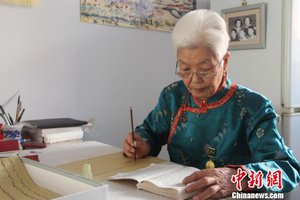
Mongolian Grandmother Transcribes Mongolian Epic with Ink Brushes

Mongolian Grandmother Transcribes Mongolian Epic with Ink Brushes
Erdengsubuda, a 78-year old Mongolian woman, transcribes a book with an ink brush at her home in Abag Banner, a county under the administration of Xilin Gol League in north China's Inner Mongolia Autonomous Region. [chinanews.com]
In her late 70s, a Mongolian grandmother called Erdengsubuda has recently completed transcribing The Secret History of the Mongols, a Mongolian epic chronicle of the 13th century, with ink brushes that are often used in Chinese calligraphy, utilizing painting and descendant brush painting styles.
The Secret History of the Mongols is the oldest surviving Mongolian-language literary work originally written in the Uyghur script, also known as classical Mongolian script, for the Mongol royal family some time after the death of Genghis Khan (1162-1227), the founder and Great Khan (emperor) of the Mongol Empire, which became the largest contiguous empire in history after his demise.
Linguistically, The Secret History of the Mongols provides the richest source of pre-classical Mongolian and Middle Mongolian, and is regarded as a piece of classic world literature.
"I have raced against time to transcribe the great work. It's a big deal for me to have made it," said the 78-year-old who lives in Abag Banner, a county under the administration of Xilin Gol League in north China's Inner Mongolia Autonomous Region.
Since September 2013, Erdengsubuda, who was engaged in education for 35 years before her retirement, began to transcribe The Secret History of the Mongols with ink brushes.
In late February 2014, Erdengsubuda completed her transcription of nearly 700 A4 pages of xuan paper, a high-quality paper made for traditional Chinese painting and calligraphy in Xuancheng, east China's Anhui Province.
Then, Erdengsubuda duplicated them, bound them together into book form and presented her transcribed The Secret History of the Mongols to the Genghis Khan Museum.
Grey-haired Erdengsubuda also plans to work on another copy, hoping to present it to the Abag Banner Museum in the future.
At the mention of her original reason for the transcription, Erdengsubuda said: "I transcribed the book in order to get people to cherish the time-honored Mongolian cultural heritage, love their ethnic culture, and contribute their efforts to protecting and carrying forward Mongolian culture for later generations."
"I just contributed my bit of effort. As long as it does some good to others, I'm ready to take it up again," she added.
Those days, Erdengsubuda got up early every morning and worked on her transcription, stroke by stroke and page by page. In winter, she still woke up on time, turned on the lights and bended over her transcription.
When Erdengsubuda seated herself at the desk for long periods of time, her right hand became limp and numb and her eyes also hurt, compelling her to put down her ink brush.
Later, Erdengsubuda made a rule: writing for one to two hours to complete three to four pages each day. This way, her calligraphy manuscripts accumulated day by day and month by month.
It's a serious thing for her to transcribe the Mongolia epic. "The Secret History of the Mongols is a piece of classic literature in the world with significant academic value. It has been translated into many languages, and experts and scholars of different countries have studied it for 600 years," said Erdengsubuda.
"I must keep a calm heart, hold the ink brush tightly and sit up straight to do the transcription. In addition, the brush, ink and paper should match well to do it well," she added.
As she couldn't find any upside-down xuan paper for Mongolian characters, Erdengsubuda had to use checkered paper for Chinese characters. The ink stone should be kept flat and clean without dry ink marks. "If a single Mongolian character was transcribed wrongly, I had to throw away the whole paper," said Erdengsubuda.
Sadly, Erdengsubuda is not in good health. She underwent several major surgeries in 2013, and had a colostomy bag fitted.
Despite her health problems, Erdengsubuda made it her routine to start her day transcribing the literary work. "I live alone, but I have a lot of things to busy myself with, such as cooking and washing, cleaning the house, reading newspapers and chatting with my friends via WeChat (a mobile text and voice messaging communication service developed by Tencent in China.)"
When she completed her calligraphy manuscripts, Erdengsubuda felt quite satisfied and often looked through them. "There are few other nomadic peoples, like the Mongolian people, who have kept such a systematic, complete and clear classic work to record their history," she said with a sense of excitement and pride.
"I may do some transcribing in the future, but I don't think I can do such a large work due to my ill-health," said Erdengsubuda.
(Source: chinanews.com/Translated and edited by Women of China)
Share:

Facebook page

Powered by Blogger.

Categories

Advertising in Mongolia An Asian Development Bank Culture Editorial of the Mongolianviews education Environmental protection Famous Mongolians Foreigners in Mongolia Inner Mongolia Ivanhoe Mines Mongolia Adventure Mongolia agriculture Mongolia air pollution Mongolia analysis Mongolia and Armenia Mongolia and Asian Development Bank Mongolia and Australia Mongolia and Azerbaijan Mongolia and Belorussia Mongolia and Bulgaria Mongolia and Cambodia Mongolia and Canada Mongolia and central Asia Mongolia and China Mongolia and Cuba Mongolia and Czech Mongolia and donors Mongolia and EU Mongolia and Germany Mongolia and Hongkong Mongolia and Hungary Mongolia and IFC Mongolia and IMF Mongolia and Ind Mongolia and India Mongolia and Indonesia Mongolia and Inner Mongolia Mongolia and Iran Mongolia and Israel Mongolia and Italy Mongolia and Japan Mongolia and Kazakhstan Mongolia and Korea Mongolia and Kuwait Mongolia and Kyrgyzstan Mongolia and Malaysia Mongolia and Nato Mongolia and North Korean Mongolia and Poland Mongolia and Qatar Mongolia and Russia Mongolia and Russia and Mongolia and China Mongolia and Singapore Mongolia and South Korea Mongolia and Taiwan Mongolia and Thailand Mongolia and the world Mongolia and Tibet Mongolia and Turkey Mongolia and UK Mongolia and Ukraine Mongolia and UN Mongolia and US Mongolia and USA Mongolia and Vietnam Mongolia Banking Mongolia blind Mongolia Cashmere Mongolia Christianity Mongolia civic society Mongolia Corruption Mongolia crime Mongolia diplomacy Mongolia Economy Mongolia Education Mongolia Energy Mongolia environment Mongolia Finance Mongolia Health Mongolia History Mongolia holiday Mongolia in international media Mongolia Industries Mongolia investment Mongolia Joke Mongolia law Mongolia LGBT Mongolia medical Mongolia military Mongolia Mining Mongolia Mining Developments Mongolia Mortgage Mongolia natural disaster Mongolia news media Mongolia Nuclear Mongolia Petroleum Mongolia Politics Mongolia Poverty Mongolia public announcements Mongolia railways Mongolia Religion Mongolia slums Mongolia society Mongolia Sports Mongolia Stamp Mongolia Sumo Mongolia telecommunication Mongolia tourism Mongolia trade Mongolia Transportation Mongolia Urbanization Mongolia Wild Life Mongolian Agriculture Mongolian and Cuba Mongolian Archeology Mongolian Climate Mongolian Food Mongolian Gay Mongolian Government news Mongolian History Mongolian Kazakh Mongolian Meat Mongolian Military Mongolian Mining Development Mongolian Movie Mongolian News Mongolian Parliament Mongolian Political news Mongolian Press Mongolian Songs Mongolian Sumo Mongolian Women Mongolian Youth Mongolians abroad Moninfo Opinion Oyu Tolgoi Investment Agreement Photo news Press Release Rio Tinto Tavan Tolgoi coal mine Ulaanbaatar development Weird expatriates in Mongolia World bank and Mongolia

Blog Archive

Followers