Some 1,000 Soldiers Will Participate in Joint Russian-Mongolian Exercise

According to the Russian Eastern Military District, around 1,000 servicemen will take part in joint Russian-Mongolian drills this summer.

KHABAROVSK (Sputnik) — About 1,000 soldiers of the Russian and Mongolian armed forces will participate in the joint Russian-Mongolian Selenga-2016 military exercise to be held in the Republic of Buryatia this summer, the head of Russia’s Eastern Military District press service said Monday.


"In the first round of consultations held in the capital of Buryatia, Ulan-Ude, representatives of the Eastern Military District and the Mongolian Armed Forces agreed that Selenga will be held at the Burduny training range on August 29 — September 7, 2016. It is planned that some 1,000 soldiers from both sides will be involved," Alexander Gordeev told reporters.
He added that during the drills, soldiers will practice tactical tasks as part of a simulated anti-terrorist operation to create a security zone in a designated area, as well as training exercises to block and destroy illegal armed groups.
The Selenga exercise has been carried out annually since 2008.


Share:

MHPS to refurbish eight units at Ulaanbaatar thermal power facility in Mongolia

Mitsubishi Hitachi Power Systems (MHPS) has secured an order for a refurbishment of eight units at fourth thermal power plant in Ulaanbaatar, Mongolia.
The company will carry out refurbishment work at the country's largest coal-fired thermal power generation facility, with support of engineering firm MCS International.
MHPS plans to complete the refurbishment work at the thermal power plant by October 2018.
Japan International Corporation Agency (JICA) has financed the project, which will help to enhance the facility's power generation efficiency and service life.

The refurbishment will include the addition and renewal of related equipment on eight power generation units at the thermal power plant.
The firm will renew the core components of the coal pulverisers from units No. 5 to No.8 to extend their service life.
"The refurbishment will include the addition and renewal of related equipment on eight power generation units at the thermal power plant."
It will also add soot blowers to all units to prevent fall-off in heat-exchange efficiency.
According to MHPS, the refurbishment will help in the realisation of a stable power supply.
Coal pulverisers will be used to grind coal into fine particles, in addition to removing coarse-grained particle for high thermal efficiency of boiler units. These will also allow in reducing NOx (nitrogen oxides) and other emissions.
Soot blowers enable in removing soot and dust from boilers and other equipment, helping to enhance efficiency of heat exchangers.
Share:

Indian PM Modi greets China, Korea, Mongolia, Vietnam, on lunar New Year

New Delhi, Feb. 8 (ANI): Indian Prime Minister Narendra Modi on Monday greeted people of China, Korea, Mongolia and Vietnam, as the nations celebrate the Lunar New Year.
"A very Happy New Year to Chinese friends around the world. May the Year of the Monkey bring joy and prosperity in your lives. Dear Korean friends, Seollal greetings to you all. Have a great year ahead," the Prime Minister said in a series of tweets.
"To the wonderful people of Mongolia, Happy Tsagaan Sar. Praying for a year filled with joy, good health and prosperity. T?t greetings to the people of Vietnam. May this year be full of joy and prosperity", the Prime Minister added.
Monday marks the first day of the Chinese Lunar New Year, China's biggest and most ceremonious holiday.
Though China officially operates on the international Gregorian calendar, the traditional lunisolar calendar maintains ceremonial significance, and so every year, around the new moon closest to the beginning of spring. (ANI)
Share:

IN MONGOLIA, BEWARE OF THE DZUD

No, that’s not a typo. It’s a rather dramatic weather event.
People in Mongolia are used to harsh winters. But this year the winter is even worse than usual: the country is in the grip of a ‘dzud’ (pronounced zood) – a hot, dry summer followed by a freezing, windy and snowy winter.
Temperatures average lower than -40° Celsius at night. Can you imagine?
The dzud is a double blow for Mongolians, who rely mostly on raising livestock. First, the grass and wheat that their cattle depend on dry up in the summer drought. Herders cannot collect and store enough food for their animals, leaving them weak and vulnerable.
Then in winter, the animals are unable to dig through the hard frozen snow to get enough to eat and, finally, die.
Problems for people follow – families run out of food, lose their livelihoods and use up their savings to survive.
Since January, the Red Cross has delivered food parcels, warm clothes and to people caught in the dzud to help them cope. Today I am here to observe the distribution.
“WINTER STARTED IN AUGUST”
Oyunbatt - 600x400
Oyunbatt lives just 30 kilometres from the nearest ‘soum’ (town) centre. But the wintry conditions and frozen rivers mean that it takes over an hour to reach the soum even in a 4×4.
Oyunbatt hasn’t visited the soum centre for over ten years because he is the only carer for his sister, who has severe physical and learning disabilities. In fact, he can barely leave his home to tend to his small herd of 20 animals.
Despite this, Oyunbatt welcomes the Red Cross when we visit to deliver food parcels for him and his sister.
“This winter’s dzud has been a challenge”, he said.
“Winter started almost on 20 August: the entire area was covered by snow at that time. We have enough food for the animals to last until February, but it is of low quality because last summer there was no green and mature grass.”
BURNING RUBBISH TO SURVIVE
Many herders lose all their animals during a dzud and their only option is to move their families to towns and search for casual labour. Many hope that, against the odds, they will earn enough money to buy new animals and resume their lives as herders.
In Darkhan, Mongolia’s second largest city, many such migrants live in the ‘ger’ district, a slum area of traditional round Mongolian tents known as ‘gers’ or ‘yurts’.
To support older people, single parent households and people with disabilities in the area, the Red Cross runs a social care project.
Batbukh, a 53-year-old man who lost his arm at 47, has been unable to find work since. He lives in a ger, heated by a small stove in the centre.
When we visit to deliver warm clothing, the heat from the stove is inviting but this is relative – a bucket of water is frozen at his feet.
Batbukh’s disability benefits – around £56 monthly – don’t cover his basic needs and in the winter buying fuel is critical. Some people have to resort to burning rubbish they have collected in the streets and suffer respiratory illness or worse.
He tells us that he goes to the Red Cross’ social care centre, which provides a refuge from the cold.
People can wash and do other personal tasks there, with assistance if needed. They also have the chance to learn vocational skills or simply to sit and talk to a friendly volunteer.
TRANSFORMING A GER
Batbukh 600x400
Today, however, Batbukh is getting felt insulation for his ger along with his regular food parcel and warm clothes.
He is keen to assist the volunteers in fixing the insulation to his ger’s roof and quickly begins giving them instructions. This kind of work is something he knows well from his life as a herder turned industrial worker – a common narrative in Mongolia.
As we get ready to leave, I am struck by how well the project is run. Then I see my Mongolian Red Cross colleagues’ frostbitten cheeks. They serve as a stark reminder of how harsh life in the dzud can be.
This blog is by Pete Jones, disaster management co-ordinator at the British Red Cross
Share:

Global Economic Volatility Poses Challenges for Mongolia

World Bank Report Calls for Sound Economic Management
ULAANBAATAR, February 3, 2016—Mongolia’s economy faces growing headwinds from a continued slump in the minerals market and heightened global financial volatility, according to the World Bank’s Mongolia Economic Brief for January.
“Slower global demand and weaker prices of major commodities are dampening growth and exports of mineral-rich economies including Mongolia,” said World Bank Senior Economist Taehyun Lee. “A sharp rise in Mongolia’s external borrowing costs in January reflects a tighter financing environment for emerging economies as well as elevated Mongolia-specific risks perceived by the international financial market.”
The report noted that the second phase development of the Oyu Tolgoi copper and gold mine would help support investment needed to reignite growth momentum against weakening external demand. 
“Restoring sound macroeconomic management and attracting foreign investment remain essential for strengthening the resiliency of the economy in the face of global financial volatility,” said James Anderson, the World Bank Country Manager for Mongolia.
The report welcomed a proposal to transfer the Bank of Mongolia’s subsidized mortgage program to the government. According to the World Bank, the subsidized mortgage program now needs to be implemented through the government budget without further central bank financing, so that it competes with other spending priorities. The report also called for attention to the sustainability of the program considering its fiscal costs.
Share:

London court rejects Mongolian company's lawsuit against Kazakh gov’t

On February 2, 2016 the English Commercial Court in the High Court of Justice in London found in favor of the government of Kazakhstan by dismissing a claim brought by Mongolian company Erdenet Mining Corporation against the government of Kazakhstan, the Kazakh Ministry of Justice said.
“Erdenet brought a claim in relation to a debt allegedly owed to Erdenet by “Balkhashmys” JSC under contracts entered into force in 1995 and 1996,” said the ministry. “Despite the fact that “Balkhashmys” JSC was a private legal entity which was liquidated in 1999, Erdenet argued that the government of Kazakhstan was liable for the alleged “Balkhashmys” debt.”
In December 2014, Erdenet sued the government of Kazakhstan in the English Commercial Court claiming that the government of Kazakhstan agreed to the jurisdiction of the English courts during a series of discussions between Kazakhstan and Mongolia. The government of Kazakhstan challenged the jurisdiction of the English courts.
On February 2, 2016, the English Commercial Court found in favor of the government of Kazakhstan that it had no jurisdiction to hear Erdenet’s claim. The Judge said that the government of Kazakhstan “had the much better of the argument” that no jurisdiction agreement had been reached between the parties and that it was “inherently unlikely” that such an agreement had been reached.
The Court ordered Erdenet to pay 200,000 pounds (1.45 pounds = $1) for the government of Kazakhstan’s legal costs and Erdenet’s application for leave to appeal was rejected by the Judge on the ground that there were “insufficient prospects of success on appeal”.

Source:Trend News agency
Share:

Canada's Centerra given go-ahead to mine Mongolian gold deposit

Feb 4 Canada's Centerra Gold Inc has been given the go-ahead from Mongolia's lawmakers to mine the Gatsuurt Gold deposit after a five-year delay, as the resource-rich country looks to bolster its economic activity and gold reserves.
Mongolia's once-booming economy has taken a steep slide, with the Asian Development Bank estimating growth in 2015 at less than 3 percent compared with 17.5 percent in 2011. Mongolia hopes to rake in greater revenue this year and stimulate growth by green lighting projects such as Gatsuurt, despite a backlash from some citizens.
The parliament passed a bill granting the country 34 percent ownership of the mine with 1.6 million ounces of probable gold reserves, a government website says. Centerra, which also owns the Boroo mine in Mongolia, will hold the remaining 66 percent of equity.
With the parliament's approval, the government can now negotiate the final conditions for mining with Centerra.
Approval comes a year after legislators rejected the first deal proposed with a smaller stake holding for the government in return for larger royalty fees. It also follows an agreement signed last May to relaunch an expansion project at Mongolia's Oyu Tolgoi copper mine, owned by Rio Tinto with a price tag of $4-6 billion.
Centerra has been waiting since 2010 for a decision from the government on whether it could go ahead after a law banned mining at certain areas near forests and water sources, including the Gatsuurt deposit.
In December 2014, Gatsuurt was included in a list of strategic deposits that is exempt from the restrictions but requires government ownership.
The deposit has attracted opposition from environmentalists and conservationists concerned about sites where historical artefacts have been discovered at the Noyon Uul mountain, located seven km away from where Centerra plans to mine.
The government led by Prime Minister Chimed Saikhanbileg ramped up efforts to reach a deal when artisanal miners began mining the area for themselves illegally.
The legislation establishes special protected areas that includes Noyon Uul where mining will not be permitted. A spokesperson from the mining ministry could not confirm that the specially protected areas did not include Gatsuurt, but said that would be the likely result. 
Source:Reuters
Share:

Centerra Gold Reports on Mongolian Parliamentary Resolution on Gatsuurt

TORONTO, ON--(Marketwired - February 04, 2016) -  Centerra Gold Inc. (CG.TO) announced that the Mongolian Parliament has passed a resolution setting the state ownership interest in the Gatsuurt Project at 34% and authorizing the government to complete negotiations with Centerra on the terms of such ownership. In October 2015, the Company and the Government agreed to a 3% special royalty in place of the state 34% ownership interest in the project (such royalty being in addition to the existing Mongolian mineral royalty and tax regime). Based on our discussions with the Government, Centerra understands that the resolution is a mandate to the Government to implement such agreement between Centerra and the Government.
Scott Perry, Centerra's Chief Executive Officer stated, "The parliamentary resolution is a very important next step in advancing the Gatsuurt Project. The Gatsuurt Project represents an exciting opportunity to use Centerra's existing Boroo mill and other infrastructure to develop the 1.6 million ounce Gatsuurt deposit with very modest initial capital investment. The Company will now focus on finalizing the investment agreements with the Government of Mongolia. We look forward to developing Gatsuurt so we can continue to operate in Mongolia for many more years to come."
The Company expects to proceed with negotiating definitive agreements (including a deposit development agreement and an investment agreement) with the Mongolian Government. Following the successful completion of such agreements, the Company will undertake economic and technical studies to update the existing studies on the project, which were completed and published in May 2006. As part of such work, the Company will undertake a program of exploration drilling, aimed at substantially expanding the Gatsuurt oxide resource, and additional hydrogeological drilling. Following completion of definitive agreements the Company expects to provide an update on the timeline for completion of such studies and drilling and for the start of project development.
The Gatsuurt Project is located approximately 55 kilometres by road from the Company's Boroo mine and is expected to be developed in accordance with applicable Mongolian environmental regulations and international standards, consistent with the standards adopted by the Boroo mine. The Gatsuurt Project's estimated mineral reserves as at December 31, 2014 were 17.1 million tonnes at an average grade of 2.9 grams of gold per tonne containing 1.6 million ounces of gold using a cut-off grade of 1.4 grams per tonne. Mineral reserves have been estimated based on a gold price of US$1,300 per ounce. For further information, please refer to Centerra's 2014 Annual Information Form dated March 31, 2015.
The Company plans to mine the ore at Gatsuurt and truck it approximately 55 kilometres to the existing Boroo mill to be processed. The current Gatsuurt plan is to process approximately 3.6 million tonnes of CIP ore (oxides) with an average grade of 2.86 grams of gold per tonne through the existing Boroo facility in the first two and a half operating years of the Gatsuurt Project. During this time, a BIOX® facility is planned to be added to the existing Boroo facility to be used for processing the remaining sulfide ores totaling approximately 13.5 million tonnes with an average grade of 2.92 grams of gold per tonne.
Qualified Person
The reserve and resource information and related scientific and technical information in this news release were prepared in accordance with the standards of the Canadian Institute of Mining, Metallurgy and Petroleum and National Instrument 43-101 and were prepared, reviewed, verified and compiled by Centerra's geological and mining staff under the supervision of Gordon Reid, Professional Engineer and Centerra's Vice-President and Chief Operating Officer, who is the qualified person for the purpose of NI 43-101.
Further information concerning the Gatsuurt deposit, including key assumptions, parameters and methods used to estimate mineral resources and reserves, as well as legal, political, environmental and others risks are described in Centerra's 2014 Annual Information Form dated March 31, 2015 and the Technical Report on the Gatsuurt Gold Project, Northern Mongolia prepared for Centerra Gold Inc. dated May 9, 2006, each of which have been filed on SEDAR at www.sedar.com.
Cautionary Note Regarding Forward-looking Information
Information contained in this news release which is not a statement of historical facts, may be "forward-looking information" for the purposes of Canadian securities laws. Such forward-looking information involves risks, uncertainties and other factors that could cause actual results, performance, prospects and opportunities to differ materially from those expressed or implied by such forward looking information. The words "intends", "continue", "may", "will", and similar expressions identify forward-looking information. These forward looking statements relate to, among other things, negotiation of agreements and receipt of required permits, regulatory approvals and regulatory commissioning; reserve and resource estimates; plans for the future development of the Gatsuurt Project; estimates of future production, mining haulage and processing; and the Company's future operations in Mongolia.
Forward-looking information is necessarily based upon a number of estimates and assumptions that, while considered reasonable by Centerra, are inherently subject to significant political, business, economic and competitive uncertainties and contingencies. Such factors include, among other things: political and regulatory risks in Mongolia; resource nationalism; the impact of changes in, or more aggressive enforcement of; laws, regulations and government practices in Mongolia; the sensitivity of the Centerra's business to global financial conditions, including the future price of gold; the potential for imprecision in the estimation of mineral reserves and resources; the Company's ability to obtain all the required approvals, permits and regulatory commissioning for the Gatsuurt Project from the Mongolian Government; the ability of the Company to negotiate a deposit development agreement and an investment agreement, ore haulage and BIOX® agreements and other agreements necessary for the Gatsuurt Project; the ability of the Company to complete and obtain positive results from exploration drilling, hydrogeological drilling and other works at the Gatsuurt site, the Company's ability to carry out economic and technical studies in a timely manner and that the results of such studies are positive; the impact of continued scrutiny of Mongolian regulatory authorities on the Company's operations in Mongolia; risks related to operational matters, including the ability of the Company to construct the necessary mining and processing infrastructure for the Gatsuurt Project; and such other factors as described under the heading "Risk Factors" in Centerra's most recently filed annual information form available on SEDAR at www.sedar.com.
There can be no assurances that forward-looking information and statements will prove to be accurate, as many factors and future events, both known and unknown could cause actual results, performance or achievements to vary or differ materially, from the results, performance or achievements that are or may be expressed or implied by such forward-looking statements contained herein or incorporated by reference. Accordingly, all such factors should be considered carefully when making decisions with respect to Centerra, and prospective investors should not place undue reliance on forward-looking information. Forward-looking information is as of February 4, 2016. Centerra assumes no obligation to update or revise forward-looking information to reflect changes in assumptions, changes in circumstances or any other events affecting such forward-looking information, except as required by applicable law.
About Centerra
Centerra is a Canadian-based gold mining company focused on operating, developing, exploring and acquiring gold properties in Asia, North America and other markets worldwide. Centerra is the largest Western-based gold producer in Central Asia. Centerra's shares trade on the Toronto Stock Exchange (TSX) under the symbol CG. The Company is headquartered in Toronto, Ontario, Canada.
Additional information on Centerra is available on the Company's web site at www.centerragold.com and at SEDAR at www.sedar.com.
Attachment Available: http://www.marketwire.com/library/MwGo/2016/2/4/11G081482/4-Gastuurt-Approval-Final-f85f4542bdf3ad13a10e02d60b833107.pdf
Contact:
For more information:
John W. Pearson
Vice President, Investor Relations
(416) 204-1953
Email contact
Share:

Mongolia OKs Centerra’s Gatsuurt project, takes 34% stake

TORONTO (miningweekly.com) – The Mongolian Parliament on Thursday passed a resolution giving the green light for TSX-listed Centerra Gold’s Gatsuurt project to be developed, ending a five-year impasse on the project’s permitting, and authorising the government to complete negotiations with Centerra on the terms of project ownership.

 “The parliamentary resolution is a very important next step in advancing the Gatsuurt project. The Gatsuurt project represents an exciting opportunity to use Centerra’s existing Boroo mill and other infrastructure to develop the 1.6-million ounce Gatsuurt deposit with very modest initial capital investment,” Centerra CEO Scott Perry stated. In March 2010, Centerra received a letter from Minerals Resource Authority of Mongolia (MRAM) stating that certain of its mining and exploration licences, including the Gatsuurt mining licences, could be revoked under the water basin and forestry law, which was enacted by the Mongolian Parliament in July 2009. 
Under the Water and Forest Law, mineral prospecting, exploration and mining in water basins and forestry areas in Mongolia would be prohibited, and the affected licences would be revoked. The legislation provided a specific exemption for “mineral deposits of strategic importance”, which would exempt the Boroo mining licences from the application of the legislation. 
However, Centerra’s Gatsuurt licences and its other exploration licence holdings in Mongolia, were not exempt. Under the minerals law of Mongolia, Parliament on its own initiative or, on the recommendation of the government, could designate a mineral deposit as strategic. Such designation could result in Mongolia receiving up to a 34% interest in the deposit. As such, the Gatsuurt project had been designated a project of strategic importance early last year, with the Parliamentary resolution confirming state ownership at 34%. 

Nevertheless, Centerra on Thursday said that it had reached an agreement with government in October last year that the government would instead take a 3% special royalty in place of the state 34% ownership interest, in addition to the existing Mongolian mineral royalty and tax regime. Centerra advised that it understood that the Parliamentary resolution was a mandate to government to implement this agreement between the two parties. 
“The company will now focus on finalising the investment agreements with the government of Mongolia,” Parry said. Centerra advised that it now expected to proceed with negotiating definitive agreements (including a deposit development agreement and an investment agreement) with the Mongolian government, after which it would undertake economic and technical studies to update the existing studies on the project, which were completed and published in May 2006. 
The company would also undertake an exploration programme with the aim of expanding the existing resource and start additional hydrogeological drilling. The Gatsuurt project was located about 55 km by road from the company’s Boroo mine. As at December 31, 2014, the deposit held reserves of 17.1-million tonnes at an average grade of 2.9 g/t gold, containing 1.6-million ounces when using a cut-off grade of 1.4 g/t. Centerra planned to mine the Gatsuurt ore and truck it to the existing Boroo mill to be processed. 
The current Gatsuurt plan was to process about 3.6-million tonnes of oxide ore with an average grade of 2.86 g/t through the existing Boroo facility in the first two-and-a-half years of operation. During this time, a Biox plant would be added to the existing facility to be used for processing the remaining sulphide ores totalling about 13.5-million tonnes, with an average grade of 2.92 g/t gold. 
Meanwhile, news agency Reuters on Thursday reported separately that a Kyrgyz representative on Centerra's board said the Central Asian country of Kyrgyzstan might sue the Centerra over its plans to issue additional shares, which would dilute the country’s stake in the flagship Kumtor gold mine somewhat. 

Share:

Global Economic Volatility Poses Challenges for Mongolia

Mongolia’s economy faces growing headwinds from a continued slump in the minerals market and heightened global financial volatility, according to the World Bank’s Mongolia Economic Brief for January.

Mongolia’s economy faces growing headwinds from a continued slump in the minerals market and heightened global financial volatility, according to the World Bank’s Mongolia Economic Brief for January.
“Slower global demand and weaker prices of major commodities are dampening growth and exports of mineral-rich economies including Mongolia,” said World Bank Senior Economist Taehyun Lee. “A sharp rise in Mongolia’s external borrowing costs in January reflects a tighter financing environment for emerging economies as well as elevated Mongolia-specific risks perceived by the international financial market.”
The report noted that the second phase development of the Oyu Tolgoi copper and gold mine would help support investment needed to reignite growth momentum against weakening external demand. 
“Restoring sound macroeconomic management and attracting foreign investment remain essential for strengthening the resiliency of the economy in the face of global financial volatility,” said James Anderson, the World Bank Country Manager for Mongolia.
The report welcomed a proposal to transfer the Bank of Mongolia’s subsidized mortgage program to the government. According to the World Bank, the subsidized mortgage program now needs to be implemented through the government budget without further central bank financing, so that it competes with other spending priorities. The report also called for attention to the sustainability of the program considering its fiscal costs.
Share:

Inner Mongolia former police chief charged with murde

Zhao Liping, former police chief and senior political advisor of Inner Mongolia, has been charged with murder, bribery and possession of fire arms and explosives, said the Supreme People's Procuratorate (SPP) Wednesday.
Zhao was suspected of "intentionally causing the death of a person" and taking advantage of his posts to seek benefits for others, in addition to accepting large bribes, said the SPP in a press release.
Zhao had been police chief of the Inner Mongolia Autonomous Region before becoming vice chairman of the regional committee of the Chinese People's Political Consultative Conference (CPPCC).
Prosecutors also charged him with illegal possession of fire arms and explosives.
Zhao was expelled from the Communist Party of China (CPC) and handed over to prosecutors in July after investigation by the CPC Central Commission for Discipline Inspection (CCDI).
Share:

Petro Matad Delays Survey And Drilling Plans At Mongolia Project

LONDON (Alliance News) - Petro Matad Ltd shares fell on Wednesday after the company said it had suspended its seismic data acquisition at its project in Mongolia and said its drilling plans for the site have been pushed back.
Petro Matad said it has completed its seismic data acquisition for Block IV at the project, but will now postpone collecting data for Block V and will start again in May.
Due to that delay, it now plans to start drilling two exploration wells at the project in 2017, rather than in 2016, as had been previously planned.
Shares dropped 20% to 2.5 pence on the news, the worst performer in the AIM All-Share.
Petro Matad said it remained confident in the project and said drilling the two wells back-to-back in 2017 will result in operational efficiencies for the business. It also said the availability of drilling rigs, amid the slowdown in activity in the oil and gas industry following the oil price plunge, makes it likely it will be able to secure drilling rigs for the project at a lower cost than had previously been envisaged.
The company said the collapse in the oil price had not hit its operations overall, and it remains confident on the Mongolia project.

By Sam Unsted; samunsted@alliancenews.com; @SamUAtAlliance
Share:

Why Did Russia Just Write Off 97% of Mongolian Debt?

Vladimir Putin signed into law an agreement between the two countries settling outstanding debt obligations.

Last week, the Russian Federation Council, the upper house of Russia’s bicameral parliament, ratified a government-to-government agreement between Russia and Mongolia that would result in a settlement of the vast majority of Mongolia’s outstanding debt to Russia. On Sunday, Russian President Vladimir Putin ratified the legislation to put the debt forgiveness into effect.
According to Russia’s state-run Tass news agency, Mongolia’s unsettled debt with Russia came to a total of $174.2 million.  The Russian law forgives 97 percent of Mongolia’s outstanding debt to Russia.  “It should be noted that the sum involves the debt denominated in the non-existing currency. Actually, the debtor always has a possibility to formulate the issue like this: no currency, no obligations. In this case, we agreed on recalculating the amount into the really existing monetary unit,” remarked Russia’s deputy finance minister, Sergei Storchak, referring to the difficulties of negotiating a debt agreement after the collapse of the Soviet Union and the conversion of the rouble in 2006.
The debt forgiveness has been a long time coming and has roots in the bilateral relationship between the two neighbors dating back to the early 1990s. Mongolia had borrowed heavily from the Soviet Union. In the early 2000s, its debt burden stood at around $10 billion, as estimated by Standard and Poor’s. In 2004, Russia and Mongolia had worked out a deal that would allow Ulanbataar to pay off 11.4 billion in convertible rubles of debt from the Soviet era for a payment of “less than $300 million.”
A bilateral agreement in July 2010 offered a simple tit-for-tat where a one-time payment for $3.8 million from Mongolia to Russia would resolve all outstanding debt issues and lead to Russian investment inflows.  “As a result of bilateral negotiations held in July 2010, the sides managed to reach an agreement, under which Mongolia undertook to repay financial obligations worth 163.7 million convertible rubles and 10.5 million clearing US dollars with a lump sum payment of $3.8 million,” an explanatory note, cited by Tass, explains.
The settlement of Soviet-era debt has been a major issue for the Russian Federation over the past two years. Russia has addressed similar issues concerning outstanding debts with several Cold War-era client states and partners, including Syria, Cuba, Iraq, North Korea, Libya, and Afghanistan. The resolution of the debt issue now with Mongolia is particularly significant given growing strategic and commercial ties between the two neighbors. Mongolia, sandwiched geographically between Russia and China, attaches great importance to commercial ties with Russia.
Bilateral ties between Moscow and Ulanbataar had been steadily improving and the implementation of the debt forgiveness deal, which was agreed to over half-a-decade ago, should accelerate additional convergence. Notably, Russia had agreed to the debt forgiveness arrangement with Mongolia at a time of higher global oil prices and less pressure on its own budget.  With sagging, negative quarterly growth rates and a stressed budget throughout 2015 and likely throughout 2016, the debt forgiveness arrangement may look less favorable from Moscow’s perspective in retrospect.
The debt write-off does open interesting opportunities for Moscow as well. Mongolia is a major importer of refined petroleum, which comprises 22 percent of its overall imports as of 2013. 76 percent of Mongolia’s imported petroleum comes from Russia. Additionally, Mongolia runs a negative trade balance with Russia, exporting just $56.2 million in goods in 2013 while importing $1.54 billion. For Russian state and private firms, Mongolia will continue to be seen as an opportunity.

Source:Diplomat
Share:

The Politics of the Mortgage Market in Mongolia

By Bumochir Dulam, on 29 January 2016

In the beginning of December 2015, news headlines declared that commercial banks would stop providing housing mortgages at a favourable 8 % interest rate. The “8 % interest housing mortgage” (8 huviin oron suutsny zeel) is a nation-wide programme initiated and implemented by the government through commercial banks.  The government started the programme in 2013 as a means to increase the affordability and accessibility of apartments for urban residents, particularly young families and those living in the ger districts.  The news of the repeal was shocking for many because it froze people’s ability to acquire apartments while also signalling a wider crisis in the national financial system.
Social demand for housing
A friend of mine, B, was planning to sell his flat to his friend in order to buy a larger flat from a different friend. The friend who was planning to buy B’s flat was about to receive a bank-approved mortgage.  Because he was very certain to get a loan from the bank, and since the selling and buying arrangements were between friends, they decided to exchange apartments before getting all the paperwork finalised.  B moved into his friend’s flat while his friend who had the mortgage approved moved into his former flat. A few days afterwards they all heard the news  that banks would no longer be offering mortgages with 8% interest rates. All of them went into a panic and they sought advice from friend who works in the banking industry to find out whether the repeal was a temporary or a permanent policy decision.  They asked two friends, one working  in the Khan Bank and another working in the State Bank (Toriin Bank), and both assured based on internal bank information that the repeal would not last long.
There is a widespread belief that mortgages allow people who live in ger districts to purchase apartments with low-interest loans, thereby decreasing air pollution in the whole city. However, this does not seem to be the main trigger.  The economist Batsuuri, for example, has claimed that people living in ger areas are not the major purchasers of apartments. So while such programmes appear to address social problems, they are also a business opportunity for others.
Monopoly of mortgage market
According to the employee at the State Bank, the bank is the most important, largest, and dominant bank constituting part of Mongolia’s financial system. There are no other major institutions that compete with banks in the whole financial system in Mongolia. Moreover, in the bank, the major financial activity is mortgage loans. According to him, banks cannot function without mortgages. Consequently, stopping the 8% mortgage program might further cause collapse in the ‘financial system’ (sankhuugiin togtoltsoo), because people would not be able to afford to purchase apartments at higher interest rates. Not only him, but many other professionals working in Mongolian banks were very certain that the repeal would not last long for the sake of the sustainability of the financial system.
As I am not an expert on banking and financial systems, I am not in a position to comment in detail here. However this repeal creates an impression that commercial banks profit from mortgage loans and are protected by the existing financial system and high social demand for housing. It is in fact a consequence of the capitalist system brought up in Mongolia since the 1990s that exploits debtors and protect creditors.  Bank monopoly was one of the two major arguments the constitution court developed and it became a trigger for the association of banks to decide to repeal the 8% mortgage loan scheme.
In fact the repeal of the 8% mortgage was not an immediate decision. Before it was publicly revealed in the news there was a discussion that occurred in the constitutional court. Civilians D. Yanjinkhorloo and B. Enkhbayar made complaints against some articles in the law regarding bank and non-bank financial service centres (NBFS) mortgage agreements. The complaints address how contracts based on the existing law regulates real estate (flat, house and land) mortgage does not permit civilians to go to court in the case when they are not able to pay loans and dispossesses mortgage property without having judicial decision.
The constitutional court discussed the case, concluding that some articles in the law of real estate mortgage violated a clause in the constitution regarding rights to possess real estate. According to the constitution, any cases of dispossession of real estate property should go through a court decision. Therefore, the constitutional court meeting announced that the law of real estate mortgage violates basic human rights, as declared in the constitution. The constitutional court asked parliament to amend the law and fix the violation. This decision was made on the 9th of December. It required the Association of Commercial Banks to react quickly, indefinitely stopping such mortgages. The constitutional court also raised other issues why the law around mortgages needed to be amended. The court considered that bank and NBFS loans and mortgages violated articles in the law against unfair competition. 17 commercial banks and NBFS dominate loan and mortgage services in Mongolia, by occupying more than the 1/3rd of the mortgage market. According to the law against unfair competition, article 5.1., defines any case of sales and services of more than 1/3rd of the market to be dominating it and, therefore, should be stopped.
For example, commercial banks gain profit from the interest gained on mortgages. As MP S. Ganbaatar puts it in his numerous public talks and parliament speeches: ‘dogs get fat when zud comes’ (zud bolohod nohoi zoolno), – i.e. dogs get fat when there has been a severely cold winter from feeding on the carcasses of dead livestock.  This alludes to the profits banks are making when normal people are suffering, and is a reason why he comments that all banks should be called ‘pawn shops’ (lombard).[1]  It is indeed noticeable that many Mongolian and foreign business people, including some politicians, have opened banks or NBFS in Mongolia.
Political immunity of mortgage business
The above-mentioned friend who works in a bank further explained that a well-known national company, Bodi International, owns a certain percentage of shares of Golomt Bank. Lu. Bold who is the founder and owner of this company is also an MP and a minister. A news articlefrom 2010 revealed some of the owners of this bank, but many are not known.
The banker further revealed that a very large national company, the Tavan Bogd Group, and other foreign companies, such as ‘Savada Holdings’ from Japan, are owners of the Khan Bank (the latter owns the largest portion at 53%).  Another article from 2014 refers to bank owners as usurers (mongo huulegchi). The same term was used in the early 20th century to identify Chinese and Manchu high-interest money-lenders. The article reveals that ‘Global Investment and Development’ owns the largest share of 65 % of the Trade and Development Bank. The article speculates that the ex-President N. Enkhbayar and MP J.Battulga, who owns the ‘Jenko’ company, also have shares in the bank. These are the largest three banks in Mongolia.
It is not only professionals working in the banking sector and journalists who try to find out who are the owners of these large banks  and accuse them of being usurers. Many others in fact have the same opinion. Around the time when I was conducting field research in Dundgovi aimag, Batbayar, a young man who worked in Turkey, told me about Islamic Banks that allow loans with no interest. Batbayar, suggested that this is what Mongolia currently needs if the state is truly attempting to support housing and small- and middle-range enterprises, rather than allowing commercial banks to ‘spin money’.
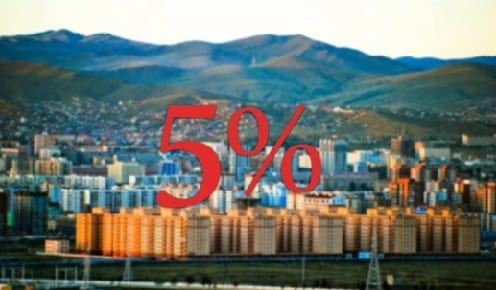
As we can see mortgages are highly politicised and are not simply economic or social, especially at the moment when Mongolia is only a few months away from the next parliamentary elections in June. As Kh. Batsuuri states: ‘mortgage problem is becoming an advantage for rulers near the election’.  Alongside amendments to the Mortgage Law, ruling Democratic Party leaders have decreased mortgage interest rates from 8 % to 5 %. Not long after, in the start of January 2016, this news received favourable comments from the public in the media. Some even openly declared that they would now vote for the Democratic Party, while others commented that this is rather a temporary ‘electioneering show’ (songuuliin show).
5percent
Source: http://www.hunnu.mn/content/75214.htm

Absence of long-term policy making
On the 19th of January 2016, after about a month since the 8% mortgage loan was stopped, the Parliament of Mongolia approved an amendment to the Mortgage Law (Ul khodlokh ed khorongiin baritsaany tukhai khuuli). The amendment in article 27.1 now enables owners to have the right to issue permission to the mortgagee in cases when the mortgagees change ownership. This is not the only amendment. Interest rates have also decreased from 8 to 5 %, bringing possible future risk to the economy at large. As some economists, such as  Kh. Batsuuri and J. Ganbaatar (PhD candidate at the American University)[2] explain, the mortgage loan should have financially supported itself without becoming a burden to the national economy if it had worked according to the original plan. Indeed, considering the current weak economic situation in Mongolia, Kh. Batsuuri questions whether the 3 % decrease in mortgage interest rates actually puts more pressure on Mongolia’s economy. According to his elaboration, the 8 % interest rate influenced the current economic crisis. For instance, the Mongolian government had to print more national currency in order to supply mortgage loans, which brought 13 % inflation, plus the price of flats dramatically increased.
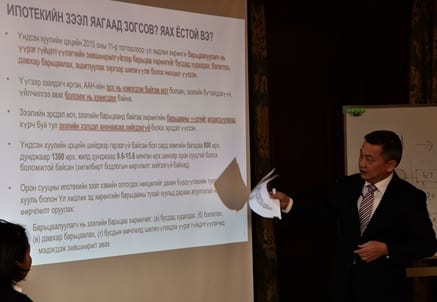
The same critique has also been made by another economist, de Facto Jargalsaikhan. In his latest post he comments that ‘the technology to print more currency to develop the country is vigorously increasing in Mongolia’. Maybe there are many more economist who consider the 5 % interest mortgage a serious threat to the already weak national economy. It will possibly bring with it more currency printing, more inflation, more cheap mining deals, and more external debt, in addition to the existing more than 20 billion USD debt.
Enkhbold
Speaker of Parliament Z. Enkhbold explains “why mortgage was stopped and what should be done”. Speaker of Parliament Z. Enkhbold explains “why mortgage was stopped and what should be done”. Source: http://economy.news.mn/content/232023.shtml
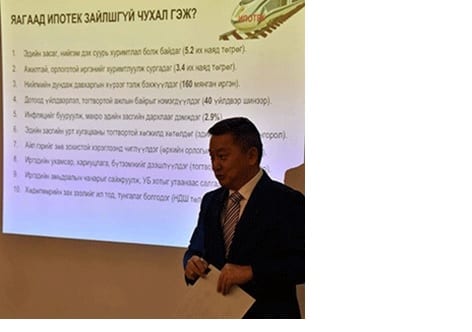
Enkhbold 2
Speaker of Parliament Z. Enkhbold explains “why mortgage is crucial”. Source: http://sodon.mn/news/16035

According to the media, the decreasing interest rate of mortgages and their availability again, serves to satisfy those wanting to purchase an apartment, construction companies struggling to sell apartments, and commercial banks who make massive profits from mortgage interest rates. Passing this policy does not serve the potential damages that it might incur on the national economy. The only agent that consistently profits and is safely protected, by society, politics and the economy, are the commercial banks, owned by foreign investors and Mongolia’s oligarchs. They are indeed safely protected, firstly by the social demand for housing, and secondly by political decisions that meet public demands in order to receive more votes for the up-coming election, and thirdly the unstoppable financial system dominated and monopolized with loans.
The question that remains is; what was the politics behind changes to mortgages? Why were they stopped? Was it because of the constitutional court decision regarding the violation of basic human rights and monopolisation in the national economy? Or, was it actually the outcome of a genuine fight against the politically-empowered dominant business for the sake of fair competition? Or, further, was it in fact due to the political conflicts between large business owners and their political allies? Is the 5 % interest mortgage another short-term political play to gain support prior to elections? In this fractious political climate, who is actually taking care of  the long-term interests of the national economy?
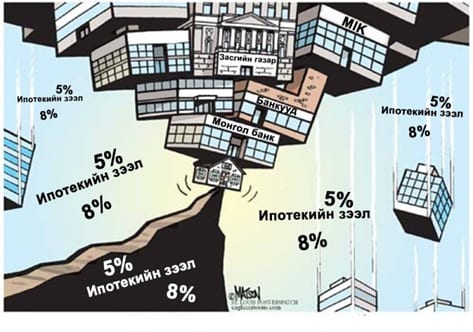
5 and 8 percent
Mongolian banks teetering on the edge, with 5 and 8% mortgages crashing.  Source: http://www.trends.mn/n/4709 (Original source: Modkraft)


For soyoljson lombard “culturalised pawn shops” also see http://www.fact.mn/204265.html

[2] Rebecca Empson and D. Bumochir’s skype interview with Ganbaatar Jambal, January 2016.

Source:http://blogs.ucl.ac.uk/
Share:

Hong Kong and Mongolia sign Agreement on Transfer of Sentenced Persons

Hong Kong (HKSAR) - The Secretary for Security, Mr Lai Tung-kwok, and the Minister for Justice of Mongolia, Mr Dambii Dorligjav, today (February 1) represented the Governments of the Hong Kong Special Administrative Region (HKSAR) and Mongolia respectively in signing the Agreement on Transfer of Sentenced Persons (TSP).

"The transfer of sentenced persons to their place of origin, by returning them to an environment free of language and cultural barriers and where their friends and relatives can visit regularly, is conducive to their rehabilitation. It is the HKSAR Government's policy to facilitate such transfers between the HKSAR and other places," Mr Lai said at the signing ceremony held at the Central Government Offices.

Under the Basic Law, the HKSAR Government may, with the authorisation of the Central People's Government, make appropriate arrangements with foreign states for reciprocal juridical assistance, which include, among others, the transfer of sentenced persons.

This is the 16th TSP Agreement the HKSAR has signed with other jurisdictions. The other 15 jurisdictions that already have TSP Agreements with the HKSAR are Australia, Belgium, the Czech Republic, France, India, Italy, the Republic of Korea, the Macau Special Administrative Region, the Philippines, Portugal, Spain, Sri Lanka, Thailand, the United Kingdom and the United States.

"The signing of the Agreement signifies another step forward in the legal co-operation between Mongolia and the HKSAR," Mr Lai said.


Share:

Moody's: Near-term external pressures weigh on Mongolia's credit profile

ingapore, February 01, 2016 -- Moody's Investors Service says that Mongolia's (B2 negative) credit profile will come under pressure over the next 12 to 18 months, due to a combination of falling commodity prices and lower growth in China (Aa3 stable).
Mongolia's slim reserve buffers, which are insufficient to cover its short-term external and maturing long-term debt over the next two years, exacerbate this situation.
Over time, however, Moody's expects growth and inward investment flows will reduce these domestic and external pressures. This expectation underpins Moody's recent affirmation of the country's B2 government bond rating and negative outlook.
Moody's analysis is contained in its just-released report entitled "Government of Mongolia -- Near-Term External Pressures Weigh on Credit Profile."
Since Moody's downgraded the government's bond rating from B1 in July 2014, some of the strains on its credit profile have abated.
Specifically, the central bank has reversed monetary and quasi-fiscal stimulus measures that contributed to a rapid build-up in credit growth and inflation through 2011 and 2012. Moreover, the resolution in May 2015 of a three-year dispute over the Oyu Tolgoi mining project will unlock foreign investment and export revenues over the rating horizon. And while Mongolia's external liquidity position had deteriorated for some time, it has now stabilized. However, this stabilization has occurred at relatively weak levels, at a time when the external environment has become more challenging. Low commodity prices are creating near-term liquidity pressures that could turn particularly acute when bond repayments come due in 2017, 2018 and 2022.
Beyond 2021, Moody's expects growth and inward investment flows will resume to adequate levels to address Mongolia's vulnerabilities, led by foreign direct investment in large mining projects -- in particular Oyu Tolgoi. Although the external liquidity position will remain strained for some time, future export and investment revenue streams from the Oyu Tolgoi project should result in credit risks moderating towards the end of the decade.
Moody's report further highlights that Mongolia's credit profile and the challenges that it faces are closely comparable to several B2-rated Sub-Saharan African economies that, like Mongolia, are prominent commodity exporters.
NOTE TO JOURNALISTS ONLY: For more information, please call one of our global press information hotlines: London +44-20-7772-5456, New York +1-212-553-0376, Tokyo +813-5408-4110, Hong Kong +852-3758-1350, Sydney +61-2-9270-8141, Mexico City 001-888-779-5833, São Paulo 0800-891-2518, or Buenos Aires 0800-666-3506. You can also email us at mediarelations@moodys.com or visit our web site at www.moodys.com.
This publication does not announce a credit rating action. For any credit ratings referenced in this publication, please see the ratings tab on the issuer/entity page on www.moodys.com for the most updated credit rating action information and rating history.
Anushka Shah
Asst Vice President - Analyst
Sovereign Risk Group
Moody's Investors Service Singapore Pte. Ltd.
50 Raffles Place #23-06
Singapore Land Tower
Singapore 48623
Singapore
JOURNALISTS: (852) 3758 -1350
SUBSCRIBERS: (852) 3551-3077
Anne Van Praagh
MD - Sovereign Risk
Sovereign Risk Group
JOURNALISTS: 212-553-0376
SUBSCRIBERS: 212-553-1653
Releasing Office:
Moody's Investors Service Singapore Pte. Ltd.
50 Raffles Place #23-06
Singapore Land Tower
Singapore 48623
Singapore
JOURNALISTS: (852) 3758 -1350
SUBSCRIBERS: (852) 3551-3077
Share:

Putin Ratifies Law to Write Off Mongolia’s $174Mln Debt

President Vladimir Putin has ratified a law to write off Mongolia’s $174-million debt to Russia, according to a document published on the official Russian website for legal information on Sunday.

MOSCOW (Sputnik) — The bill was signed in Moscow in December 2010 and took six years to go through all stages of pre-legislative scrutiny.
Mongolia’s outstanding debt to Russia was a major hurdle for deeper investment cooperation between the two nations.
Russian companies seek to increase their presence in Mongolia’s construction and mineral production markets. The July 2010 deal between Moscow and Ulaanbaatar cleared the way for Russian business and guaranteed $3.8 million as a one-off repayment from Mongolia.


Source:Sputnik News agency
Share:

Facebook page

Powered by Blogger.

Categories

Advertising in Mongolia An Asian Development Bank Culture Editorial of the Mongolianviews education Environmental protection Famous Mongolians Foreigners in Mongolia Inner Mongolia Ivanhoe Mines Mongolia Adventure Mongolia agriculture Mongolia air pollution Mongolia analysis Mongolia and Armenia Mongolia and Asian Development Bank Mongolia and Australia Mongolia and Azerbaijan Mongolia and Belorussia Mongolia and Bulgaria Mongolia and Cambodia Mongolia and Canada Mongolia and central Asia Mongolia and China Mongolia and Cuba Mongolia and Czech Mongolia and donors Mongolia and EU Mongolia and Germany Mongolia and Hongkong Mongolia and Hungary Mongolia and IFC Mongolia and IMF Mongolia and Ind Mongolia and India Mongolia and Indonesia Mongolia and Inner Mongolia Mongolia and Iran Mongolia and Israel Mongolia and Italy Mongolia and Japan Mongolia and Kazakhstan Mongolia and Korea Mongolia and Kuwait Mongolia and Kyrgyzstan Mongolia and Malaysia Mongolia and Nato Mongolia and North Korean Mongolia and Poland Mongolia and Qatar Mongolia and Russia Mongolia and Russia and Mongolia and China Mongolia and Singapore Mongolia and South Korea Mongolia and Taiwan Mongolia and Thailand Mongolia and the world Mongolia and Tibet Mongolia and Turkey Mongolia and UK Mongolia and Ukraine Mongolia and UN Mongolia and US Mongolia and USA Mongolia and Vietnam Mongolia Banking Mongolia blind Mongolia Cashmere Mongolia Christianity Mongolia civic society Mongolia Corruption Mongolia crime Mongolia diplomacy Mongolia Economy Mongolia Education Mongolia Energy Mongolia environment Mongolia Finance Mongolia Health Mongolia History Mongolia holiday Mongolia in international media Mongolia Industries Mongolia investment Mongolia Joke Mongolia law Mongolia LGBT Mongolia medical Mongolia military Mongolia Mining Mongolia Mining Developments Mongolia Mortgage Mongolia natural disaster Mongolia news media Mongolia Nuclear Mongolia Petroleum Mongolia Politics Mongolia Poverty Mongolia public announcements Mongolia railways Mongolia Religion Mongolia slums Mongolia society Mongolia Sports Mongolia Stamp Mongolia Sumo Mongolia telecommunication Mongolia tourism Mongolia trade Mongolia Transportation Mongolia Urbanization Mongolia Wild Life Mongolian Agriculture Mongolian and Cuba Mongolian Archeology Mongolian Climate Mongolian Food Mongolian Gay Mongolian Government news Mongolian History Mongolian Kazakh Mongolian Meat Mongolian Military Mongolian Mining Development Mongolian Movie Mongolian News Mongolian Parliament Mongolian Political news Mongolian Press Mongolian Songs Mongolian Sumo Mongolian Women Mongolian Youth Mongolians abroad Moninfo Opinion Oyu Tolgoi Investment Agreement Photo news Press Release Rio Tinto Tavan Tolgoi coal mine Ulaanbaatar development Weird expatriates in Mongolia World bank and Mongolia

Blog Archive

Followers