Mongolia Copper Mine at Oyu Tolgoi Tests Water Supply and Young Democracy

Mining boom in South Gobi influenced by local and global citizen activism

By Keith Schneider
Circle of Blue
KHANBOGD, Mongolia – Though it is well before noon, the hot light of the South Gobi desert sun punches through the ventilation openings at the peak of Byambasuren’s white ger.
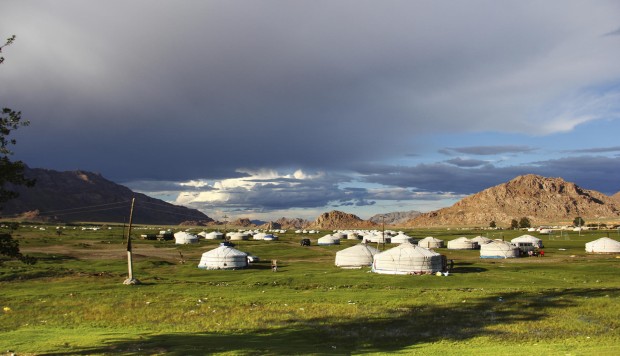
The door of her teepee-like home, a single round room built of felt and canvas, is open to a dirt compound surrounded by a fence made of rough-cut wood. Beyond that, cattle and horses churn a small grid of unpaved streets to powder. Herders on foot follow behind, their features obscure in yellow clouds of dust.
Byambasuren’s ger lies 700 kilometers (434 miles) from Ulaanbataar, Mongolia’s capital. The trip overland is mostly on hard-packed dirt roads and takes 15 hours across treeless steppes and sand. Much of the world’s second largest desert remains remote from the world, even forbidding.
“Before Oyu Tolgoi came here, we had enough water for our animals. Now we don’t. Things are different.”
–Byambasuren
That is not the case for Byambasuren, a young herder and mother, or for Khanbogd, an expanding livestock and desert town in Omnogovi, Mongolia’s largest province, which lies along the border with China.
Not far away, about 40 kilometers (25 miles) south, mining giant Rio Tinto and Mongolia’s young, free market government are developing one of the planet’s sizable reserves of copper and gold. The $6.6 billion, 80-square-kilometer (30-square-mile) Oyu Tolgoi mine is the largest industrial enterprise ever constructed in Mongolia, and, with 7,500 workers, the nation’s largest employer.
Along with the oil-producing tar sands mines in Alberta, Canada, Oyu Tolgoi also is among the most thoroughly scrutinized resource extraction projects on Earth. The reason: It’s located in one of the most water-starved regions of Mongolia.
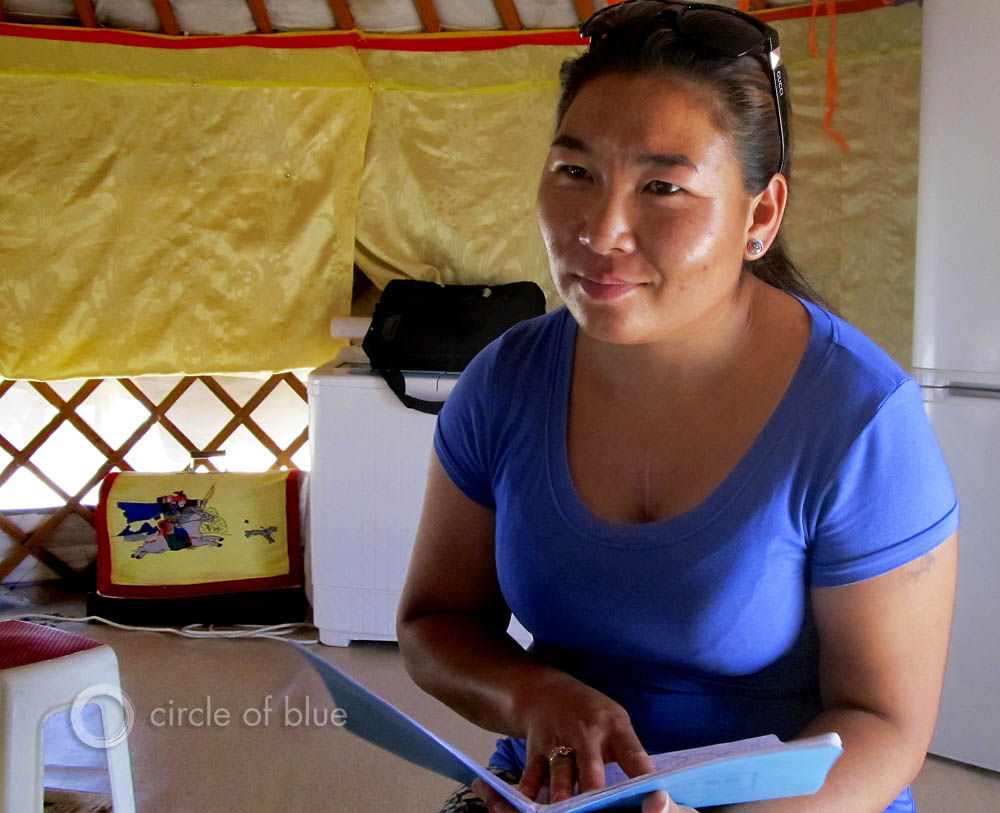
Singing well, South Gobi, Khanbogd, Coal, water scarcity, South Gobi, Mongolia, Omnogovi, Tsogttsetsii, Oyu Tolgoi. Rio Tinto. copper mine, gold, water, food, energy, choke point, circle of blue wilson center, Keith Schneider
Image © Keith Schneider / Circle of Blue
Byambasuren, a young herder and mother, and an activist in Khanbogd, Mongolia who’s work is influencing Rio Tinto’s copper and gold mine in the South Gobi Desert. Click image to enlarge.
Unlike earlier eras, when industrial companies descended on unwary regions to mine and log and drill with scant resistance, resource development in the 21st century faces new operating rules, many of them imposed by people like Byambasuren.
Timeline: Democracy, Mining Transform Mongolia
1990: Mongolia transitions from a single party socialist system, with ties to the Soviet Union, to a multi-party democracy.
1997: Mongolia’s authorities enact the Mineral Law and opened most of the country to mineral development. More than 6,000 licenses were approved, including those for the big copper and coal mines in Omnogovi.
2003: BHP, an Australian company, drills water monitoring wells in anticipation of developing the Oyu Tolgoi mine.
2007: A Mongolian herder named Tsetsegee Munkhbayar wins the Goldman Environmental Prize, a prestigious American public service award for his work to organize opposition to mining pollution in the Onggi River.
2009: Major construction begins on Oyu Tolgoi. Rio Tinto assumes primary management and ownership of the mine.
2009: Mongolia enacts the Law on the Prohibition of Minerals Exploration in Water Basins and Forested Areas, which outlawed many forms of placer mining — the extraction of mineral deposits from streams, rivers and protected wild lands.
2010: A World Bank study warns that unchecked water use by mines in Omnogovi and two neighboring South Gobi provinces could deplete the region’s groundwater supplies by 2022.
2010: The Mongolian government suspends almost 2,000 mining licenses and tightens provisions for securing licenses.
2011: Mongolia starts work to overhaul its mining law.
December 2012: The government circulates a draft mining law that alarms industry executives because new provisions called for higher financial returns for the Mongolian government and heightened scrutiny of licenses.
June 2013: Mongolians re-elect President Tsakhiagiin Elbegdorj of the Democratic Party, who campaigned on attracting foreign investment and heightening environmental oversight of the mining industry.
July 2013: First shipments of copper concentrate are shipped from Oyu Tolgoi to Chinese processors and markets.
She and seven other herders, who have access to cell phones and the Internet, belong to Gobi Soil, a year-old environmental group. Byambasuren and her colleagues are the on-the-ground local hub of a national and global network of policy strategists, environmental scientists, and communications specialists that elevated Oyu Tolgoi and Mongolia’s capacity to manage its mining sector to the nation’s top political issue.
In June, Mongolians re-elected President Tsakhiagiin Elbegdorj of the Democratic Party, who campaigned on attracting foreign investment and strengthening environmental oversight of mining.
There are two big ecological issues. The first is preventing water pollution, principally in northern and central regions of the country caused by gold mining practices that use mercury and cyanide.
The second is sharing the South Gobi’s limited water supply between livestock herders and the country’s biggest hard rock and coal mines. “We need water,” Byambasuren, who like most Mongolians uses only one name, says through an interpreter. “Before Oyu Tolgoi came here, we had enough water for our animals. Now we don’t. Things are different.”

High Stakes, Major Players

Several big players, including Mongolia’s government, the World Bank and Rio Tinto, the world’s second largest mining firm, have a stake in the mine’s development. Rio Tinto, based in London, is well aware that its record of environmental management at a number of its mines is routinely criticized by prominent international environmental groups as abusive.
One example is the company’s big and closely scrutinized Grasberg copper and gold mine in West Papua, Indonesia, which it operates jointly with Freeport McMoran. The mine uses more than a billion gallons of water a month and unloads 230,000 metric tons of waste into the Ajkwa river daily, which kills plants and contaminates drinking water, according to Corporate Watch, a London-based investigative oversight group.
Among its many objectives, Oyu Tolgoi represents a new opportunity for Rio Tinto to introduce Mongolia and the world to state-of-the-art mining practices, including water use and recycling techniques that conserve water and limit pollution. The international mining sector, mindful of its global reputation, regularly commends Rio Tinto, which last year earned total revenue of US $55.6 billion, for responding to technological trends and heightened civic expectations here.
The Mongolian government, which owns slightly more than one third of Oyu Tolgoi, counts on the mine to finance its ascent to economic and political influence in Asia. The country’s newly elected Democratic Party leaders also want to prove they have the smarts and moxie to manage Mongolia’s mineral treasures and work as an equal partner with a global industrial giant.
The World Bank and its affiliated financial institutions, which helped to fund Oyu Tolgoi, weigh new loan requests to expand the mine against Rio Tinto’s record in the South Gobi in achieving the United Nation’s Millennial Development goals. And environmental and human rights organizations, with offices networked from Ulaanbataar to Beijing to New York to London, make a strong case that the Manhattan-size mine, tearing a big hole in the South Gobi, is producing permanent damage to land and water, and eroding the region’s irreplaceable culture of tiny human outposts, livestock herding, and seasonal wandering.
Oyu Tolgoi, in effect, is at the center of a globe-circling vortex of competing ambitions. It’s more than the mine’s location in a mineral rich and environmentally sensitive, water-scarce region or its immense dimensions. It’s more than the huge price tag and the mine’s prominent and stubborn developer. It’s more than a young government’s insistence on oversight and fair economic returns, or the substantial pressure from the world’s environmental community to restrain damage.
It’s all of these facets, mixed and modulated on a global motherboard, that have amplified Oyu Tolgoi into an internationally significant case study of the fierce and increasingly transparent civic conflict over tapping the earth’s natural resources.
Little more than a decade ago, this was territory so vacant it rivaled Antarctica, Siberia, and the Australian outback as places farthest removed from the global mainstream. Now there’s an airport outside Khanbogd. The money to be made here lures thousands of workers and attracts regular convoys of television producers, magazine writers, and documentary film crews.
Mongolia, Ulaanbataar, mining, South Gobi desert Mongolia Khanbogd Oyu Tolgoi Rio Tinto copper mine gold water food energy choke point circle of blue wilson center J. Carl Ganter
Image © J. Carl Ganter / Circle of Blue
The population of Ulaanbataar, Mongolia’s capital, has nearly tripled since 1990 and is almost half of the national population of 2.9 million. Click image to enlarge.
Oyu Tolgoi’s executives are sensitive to the attention. “We are very aware of almost everything that’s said about this mine, wherever it comes from,” says Mark Newby, Oyu Tolgoi’s 42-year-old environmental manager, in an interview with Circle of Blue. “You have to listen. You have to respond. You can’t go eye to eye with the country or the community. A number of large mines worldwide did that, and they lost their mines as a result.”

‘Singing Well’ Sounds Alarm

Along the west wall of Byamba’s ger is a display cabinet with glass doors. Looseleaf notebooks, standing on end like encyclopedia volumes, occupy one shelf. They are sections of the mine’s environmental and social impact statement produced under contract for Rio Tinto.
Joining her are: Battsengel Lkhamdoorov, a 40-year-old herder who founded the Gobi Soil environmental group; Paul Robinson, a mining reclamation expert from New Mexico; and Batnasan Damdinsuren, a travel industry manager and interpreter who’s toured mining regions in Russia, Mongolia, and the United States.
“It was like bells ringing, it was a sound that you never forget.”
–Byambasuren
Byamba rises from a stool at the center of a room that is getting steadily warmer and draws a binder from the case. It contains maps of the area with an assortment of red, blue, green, orange and pink dots. Each dot designates a well that supplies water to Oyu Tolgoi, or a well that monitors levels in underground water reserves close to the surface or 60 meters (180 feet) deep. The wells were drilled by Rio Tinto, or by Oyu Tolgoi’s previous managers, BHP and Ivanhoe Mines.
Byamba is particularly interested in one map with pink dots. She points to a well designated GHW4X6. “Here it is,” she says, “This is the problem.”
The day before, in a meeting in a local government office, Byamba told this story about the well. It is, she said, the “singing well” discovered by camels sometime in 2008 or 2009. She wasn’t sure. With their hooded eyes and dual humps, the big ungulates huddled day after day around a brown length of steel well casing, about eight inches in diameter, a foot tall, and open at the top.
Their behavior was so unusual, and so persistent, that some of Byamba’s neighbors rode into the desert on motorcycles and small trucks to investigate. The men didn’t see anything wrong with the pipe — no holes, no cracks. But when they dropped to their knees and put their ears to the well what came back wasn’t the drip, drip of a leak. What they heard was the unmistakable sound of a stream flowing deep underground. It was a cascade of water, startlingly loud in a land so dry that even when rain or snowmelt caused springs or streams to flow, it hardly made any sound at all.
“It was like bells ringing,” Byamba says. “It was a sound that you never forget.”
There are many places in southern Mongolia — a nation larger than Spain, France, Germany and Britain combined — where economic intent and water scarcity converge. None, though, illustrates the confrontation with more clarity or urgency than in Omnogovi, where Mongolia’s largest and thirstiest hard rock and coal mines are located. For several years Mongolia’s economy has grown more than 15 percent annually, faster than all but a handful of countries, largely due to the mineral exploration and development in this province so close to China’s steel and coal-fired power plants.
West of Oyu Tolgoi, hundreds of trucks loaded with coal from mines in and around Tsogttsetsii head to China on a two-year-old paved highway. In July, Oyu Tolgoi began its first shipments of copper concentrate to China. A 250-kilometer rail line (155 miles) from the Omnogovi mines to China is planned.
Omnogovi also is a place where domesticated camels outnumber people, where springs are rare, and rivers run intermittently. Just as gas prices in the United States serve as either a measure of national well being or a gauge of societal stress, water supply serves as a meter for uneasiness between Omnogovi herders and mining companies, and as a proxy for a range of other concerns.
The story of the singing well is illustrative. It was one of a group of production and monitoring wells drilled in 2003 by Ivanhoe Mines, a Canadian company, in anticipation of developing Oyu Tolgoi. Marked in white paint — GH4X6 — the well is surrounded by much older wells, dug by hand and no deeper than 20 feet, to tap what herders call “soil water,” the moisture stored closest to the surface and used to water livestock.
Coal, water scarcity, South Gobio, Mongolia, Omnogovi, Tsogttsetsii, Khanbogd Oyu Tolgoi Rio Tinto copper mine gold water food energy choke point circle of blue wilson center, Keith Schneider
Image © Keith Schneider / Circle of Blue
For several years Mongolia’s economy has grown more than 15 percent annually, faster than all but a handful of countries, largely due to the mineral exploration and development in Omnogovi, the country’s largest province. Trucks loaded with coal make their way out of a mine in Tsogttsetsii. Click image to enlarge.
Byambasuren says she is one of the herders who were forced to reduce the number of animals they cared for because some of those hand-dug wells dried up. Nobody knew why until camels discovered the singing well. Byambasuren and her neighbors suspect the cascade they heard was soil water somehow pouring into the deeper aquifer and drying out their wells.
Robinson, a mining expert and research director at the Southwest Research and Information Center in Albuquerque, New Mexico, inspected the singing well and explains to Byamba that GHW4X6, as constructed, is different than what was described on the well’s technical document. “This picture shows only one pipe,” Robinson says. “The actual well has two. The second serves as an outer casing. What we saw is different than what’s shown here in important ways. This picture doesn’t show the outer ring.”
“We do acknowledge that the well wasn’t installed in the best manner possible”
–Mark Newby, Evironmental Manager, Oyu Tolgoi
Robinson explains in English as Batnasan, who was raised in the South Gobi, translates for the two herders. Robinson concludes that the actual construction of the monitoring well is flawed. It was built with a sleeve of rock and gravel packed alongside the well’s steel casing that may be allowing soil water to drain from the surface to the deeper underground reservoir. “This is the low point,” he tells them. “It’s like a bathtub drain.” Robinson, an exacting professional, cautions that his view is a thesis based on his visual inspection and the document.
Mark Newby, the mine’s environmental manager, is well aware of GHW4X6. He says it is theoretically possible that it could drain the soil and shallow surface wells close to it. But that seems unlikely, he says. He says the company monitors the shallow wells in the area closest to GHW4X6, which was drilled before Rio Tinto took over the mine, and they aren’t losing water.
“We do acknowledge that the well wasn’t installed in the best manner possible,” Newby says. “But the effects that people think are going on wouldn’t be expected. And we haven’t seen anything like that in shallow wells.”

Mongolia by the Numbers

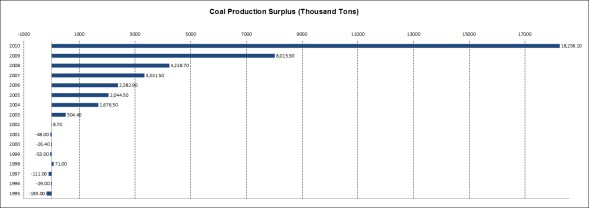
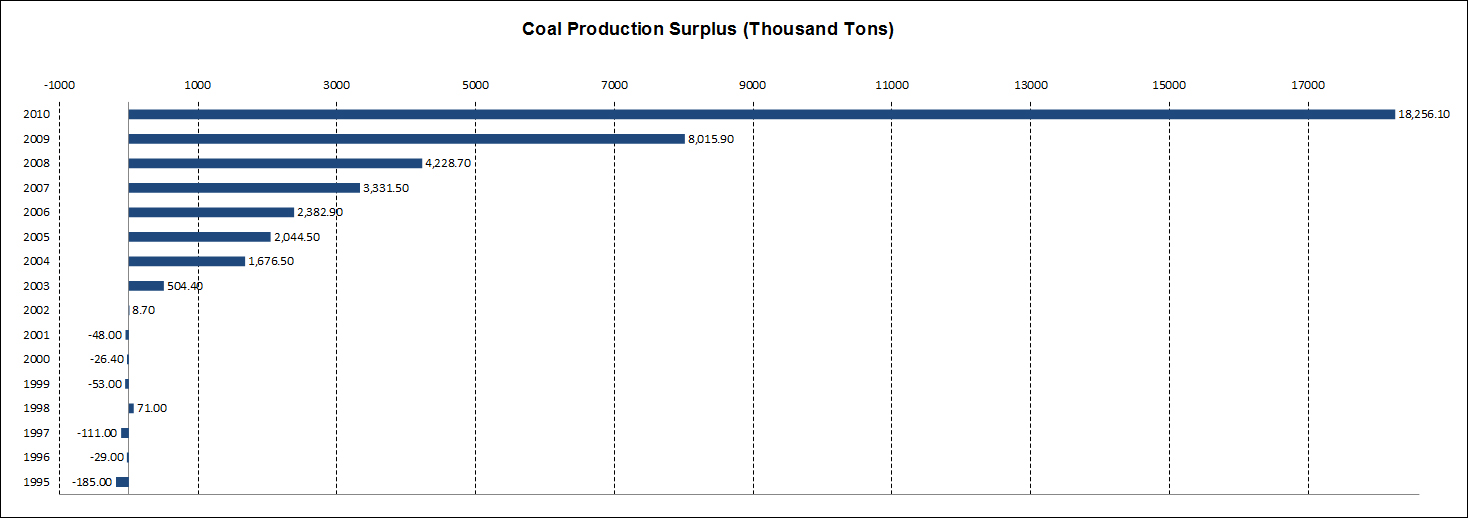
Coal Production Mongolia

With ample reserves and China's world-leading market right next door, Mongolia's coal production is soaring.
With ample reserves and China’s world-leading market right next door, Mongolia’s coal production is soaring. Click image to enlarge.

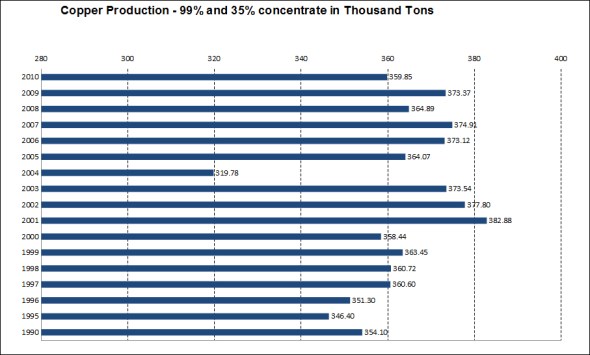
Copper Production Mongolia

Oyu Tolgoi, one of the largest copper mines in the world, started marketing copper concentrate in July, 2013, an event that will prompt sharp increases in Mongolia's copper production.
Oyu Tolgoi, one of the largest copper mines in the world, started marketing copper concentrate in July, 2013, an event that will prompt sharp increases in Mongolia’s copper production. Click image to enlarge.

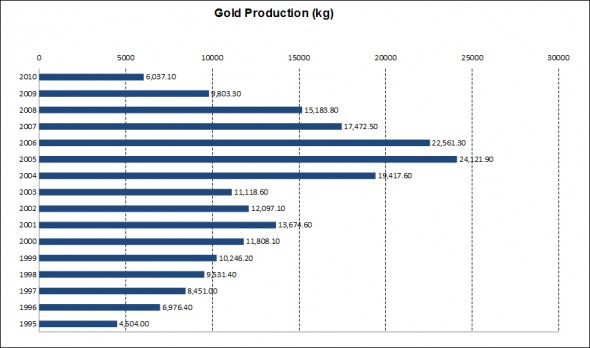
Gold Production Mongolia
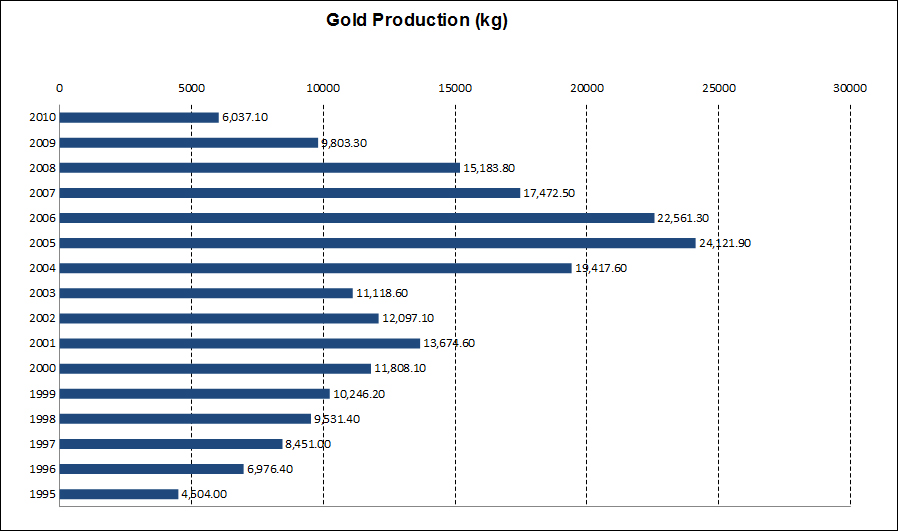
Unregulated wildcat placer gold mines produced a treasure in gold early in the 2000s, and a mess of Mongolia's rivers. In 2009, Mongolia enacted a law to protecti rivers and forests, which outlawed the harmful practices and limited gold  production.
Unregulated wildcat placer gold mines produced a treasure in gold early in the 2000s, and a mess of Mongolia’s rivers. In 2009, Mongolia enacted a law to protecti rivers and forests, which outlawed the harmful practices and limited gold production. Click image to enlarge.

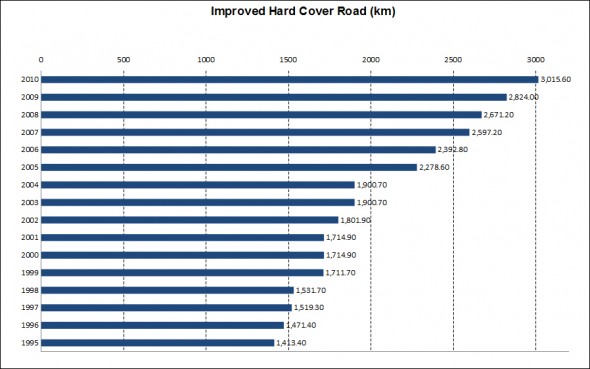
Improved Roads Mongolia

Mongolia expanded its paved highway network by roughly 130 kilometers (81 mlles) annually in the first decade of the century, twice the annual increase in paved highway in the 1990s.
Mongolia expanded its paved highway network by roughly 130 kilometers (81 mlles) annually in the first decade of the century, twice the annual increase in paved highway in the 1990s. Click image to enlarge.
Graphs © Luke Gehrke / Circle of Blue.
In September, Rio Tinto posted online a mass of new environmental studies that noted what it called “cascading behavior” in GHW4X6 and five other nearby wells, “indicating possible cross-connectivity of aquifers at these locations.” The new data pointed to a drainage problem with six wells that was stronger than Rio Tinto has acknowledged previously.
Regardless, in 2010, a year after Rio Tinto assumed primary management and ownership of Oyu Tolgoi, the company proposed pouring grout into GHW4X6 and the surrounding monitoring wells in a project to decommission the wellfield, he says. The regional government, which has jurisdiction for projects outside the mine’s perimeter, wouldn’t issue a permit for the work.
Instead, the local government turned to a citizen-government working group, which was established at the direction of the World Bank to oversee aspects of Oyu Tolgoi’s operations, including the decommissioning project, which still hasn’t happened.
The back and forth exemplifies most of the interactions between mine executives, local government officials, and herders. Newby asserts that Rio Tinto operates Oyu Tolgoi with exceptionally ambitious standards of water conservation, safety, and pollution prevention. Critics say the company can do much better.

A Contentious Project

Everything is an issue at Oyu Tolgoi. Robinson notes, for example, that Rio Tinto was exceptionally late in preparing a mine reclamation plan to secure overburden and rock wastes during the mine’s operating life, and after Oyu Tolgoi closes. Rio Tinto finally introduced the plan in late September, years after the first ridges of mine spoils appeared at the edges of the open pit.
Herders complain that dirt roads constructed by the mine owners are barriers to their animals and cause excessive levels of dust. Oyu Tolgoi excutives say the issue is exaggerated. Rio Tinto is building a new 107-kilometer highway (66.5 miles) from the mine to the Chinese border. Company executives, mindful of the civic distress about dust, said in October said the first 80-kilometers of the new highway will be paved by the end of the year. The final 27 kilometers will be paved by the end of 2014.
Most significantly, herders worry that Oyu Tolgoi is draining the region’s water supply and making it difficult for their animals to find water. The steel fence that surrounds the gaping mine has blocked traditional herding corridors. Oyu Tolgoi also cut off a freshwater spring within the fenceline that herders used for generations.
Singing well, South Gobi, Khanbogd, Coal, water scarcity, South Gobi, Mongolia, Omnogovi, Tsogttsetsii, Oyu Tolgoi. Rio Tinto. copper mine, gold, water, food, energy, choke point, circle of blue wilson center, Keith Schneider
Image © Keith Schneider / Circle of Blue
The South Gobi’s famous singing well. When herders dropped to their knees and put their ears to the well what came back wasn’t the drip, drip of a leak. What they heard was the unmistakable sound of a stream flowing deep underground. Click image to enlarge.
The company substituted a manmade spring for the natural spring and installed it along the mine’s southern fenceline. Water bubbles from two pipes there, pools in mud, flows to a shallow pond, then vanishes into the dry sand of the Undai riverbed. Rio Tinto executives said the two pipes are temporary measures to keep water flowing past the mine’s boundaries so that livestock can drink. The project’s completion, they said, has been held up by local officials who want a review by the citizen committee.
On the afternoon that Robinson and two herders visit the artificial spring, they express skepticism that it will be as effective in watering livestock as the natural spring. “Just moving water to a new place won’t serve the need,” he says. “You can’t create a spring without the right geologic conditions. Oyu Tolgoi can’t just move water to a place that is convenient. They have to move the spring to a place that holds the water or it will become soil water, not surface water. “

Democracy Driving Growth

In the summer of 1990, as its Soviet neighbor to the north slowly collapsed, Mongolians held their first free election, a signal act that ended 70 years of socialist control. Almost nothing in this big country of surpassing vistas, a huge southern desert, and a treasure chest of mineral and energy resources has been the same in the 23 years since.
Skycranes hoist men and materials to the summits of new office towers in the capital city, where 1.4 million people live. The population of Ulaanbataar has nearly tripled since 1990 and is almost half of the national population of 2.9 million. Outside Ulaanbataar, across the green steppes, cell phones and solar panels connect and power the country’s rural herding families.

Visualizing Mongolia

Mongolian Population 2011

Map created by Andrea Zheng/ Circle of Blue
Shades of brown represent the population (in thousands), with darker shades representing larger populations. To see the population in each province, click on the map.

Surface Water Inventory (Rivers, Springs, Mineral Water, Lakes) 2007.

Map created by Andrea Zheng/ Circle of Blue
Shades of blue represent the total number of surface water sources, with darker shades representing higher quantities. The surface water sources include rivers, springs, mineral water, and lakes. To see the total number of surface water sources in each province, click on the map. Note that the last water census was conducted in 2011, but the data for each province of Mongolia does not seem to be published anywhere online.

Number of Livestock (Horse, Camel, Cattle, Sheep, Goat) in Thousand Heads 2010.

Map created by Andrea Zheng/ Circle of Blue
Shades of red represent the total number of livestock (in thousand heads), with darker shades representing higher quantities. The number of livestock includes horses, camels, cattle, sheep, and goats. To see the total number of livestock in each province, click on the map.
 
As the U.S. and much of the developed West experience a damaging unraveling of institutional capacity and public confidence, Mongolia is ambitiously pursuing an economic development strategy that is founded in modern goals of environmental sustainability, income growth and nation building.
“We are a large country with a small population,” said Chuluunbat Orchibat, the 55-year-old deputy minister for economic development, in an interview with Circle of Blue. “Our economic goals are very high. We are working to improve the quality of life here. We also are trying hard to establish environmental standards that are high. We’ve had difficulties. But we know both can be done.”
In interviews with herders and shopkeepers, activists and executives, Mongolians expressed similar views of the country’s potential. Two clear advantages make the economic formula possible: Copper, gold and coal lie beneath Mongolia’s South Gobi desert — hard rock and energy wealth that international mining companies are tapping; and Mongolia shares a border with China, the world’s largest processor and consumer of such materials.
Tsakhiagiin Elbegdorj, Mongolia's Ministry of Environment and Economic Development, Mongolia, World Economic Forum, water scarcity, Ulaanbataar, mining, South Gobi desert Mongolia Khanbogd Oyu Tolgoi Rio Tinto copper mine gold water food energy choke point circle of blue wilson center J. Carl Ganter
Image © J. Carl Ganter
In June, Mongolians re-elected President Tsakhiagiin Elbegdorj of the Democratic Party, who campaigned on attracting foreign investment and strengthening environmental oversight of mining.  In September the World Economic Forum,  Mongolia’s Ministry of Environment and Economic Development, the International FinanceCorporation’s Water Resources Group 2030 brought together conservation leaders, business executives and members of parliament to discuss the implications of demands on Mongolia’s water resources. Click image to enlarge.
There is, though, considerable skepticism among environmental specialists in and outside Mongolia that an economy dependent on mining can marshal the policymaking and enforcement apparatus to reach its environmental goals. Mining industry executives also are growing deeply suspicious of the Mongolian government’s ability to oversee their sector’s operations with consistency and fairness.
Just as in the other nations Circle of Blue has reported from in recent years — China, India, Qatar, Australia, and the western United States — some of the most significant issues center on water supply. The overriding concern: Can Mongolia safeguard its fresh water and grow the hard rock and coal mining sectors in a region of the country where water is in short supply?
“People care about this. Actually, young people are eager to make sure we have enough water. They want to protect the motherland,” said Bailgalimaa Nyamdawa, a 25-year-old lawyer at the Center for Human Rights and Development, a Ulaanbataar-based legal group that prosecutes civil cases against water polluters in the mining sector, most of which are owned by the Chinese.
“We need good regulations,” Nyamdawa said through an interpreter. “We need good enforcement. We need more people who know how to influence good policy. Before the mining started we didn’t have such problems.”

Growing Pains

In the first years after throwing off socialism in 1990, Mongolia’s rush to generate hard currency from mining was a familiar story of boom and pollution. While converting from a centralized economy to the free market, Mongolians suffered through dire seasons of food shortages, energy shortages, hunger and joblessness.
Desperate to generate revenue, Mongolia’s authorities in 1997 enacted the Mineral Law and opened most of the country to mineral development. More than 6,000 licenses were approved, including those for the big copper and coal mines in Omnogovi.
Camels, singing well, South Gobi, Khanbogd, Coal, water scarcity, South Gobi, Mongolia, Omnogovi, Tsogttsetsii, Oyu Tolgoi. Rio Tinto. copper mine, gold, water, food, energy, choke point, circle of blue wilson center, Keith Schneider
Image © Keith Schneider / Circle of Blue
Camels outnumber people in Omnogovi, Mongolia’s largest province in the South Gobi desert along the border with China. Click image to enlarge.
The first mineral mining boom occurred in northern and central Mongolia, where rivers and streams were colonized by gold miners and companies, many from Russia and China. They dropped backhoes and pumps into waterways, turned high pressure hoses on river banks, and used mercury and other toxic substances to separate gold from mud and sand. In short, they made a colossal mess.
Mongolians fought back at the grassroots. As a herding culture, Mongolians understood the ties between their well being and the health of water and land. Local non-profits allied themselves with international environmental organizations. Mongolia’s news media, aided by video and photographs taken by citizens and posted on the Internet, turned the damage into a national and international story.
In 2007, Tsetsegee Munkhbayar, a herder, was awarded the Goldman Environmental Prize, a prestigious American public service award, for his work to organize opposition to mining pollution in the Onggi River, one of the country’s longest and largest.
Mining and environmental damage also became an election issue. In 2009, Mongolia enacted the Law on the Prohibition of Minerals Exploration in Water Basins and Forested Areas, which outlawed many forms of placer mining — the extraction of mineral deposits from streams, rivers and protected wild lands. In 2010, the government suspended almost 2,000 mining licenses and tightened provisions for securing licenses.
Mongolia Khanbogd Oyu Tolgoi Tsogt Tsetsii
Map © Jordan Bates / Circle of Blue
Map of Mongolia including Tsogt Tsetsii, Khanbodg, and Oyu Tolgoi. Click image to enlarge.
In 2011, Mongolia began to overhaul its mining law. In December 2012, the government circulated draft rules that alarmed industry executives. The new provisions called for higher financial returns for the Mongolian government and greater scrutiny of mining licensees.
The proposed regulations also offered greater security for water resources. The justification, say most industry executives and environmental authorities, is sound. Though smaller gold mining operations in the wet North and central regions led Mongolia’s mining boom in the first decade of the century, the country’s development authorities anticipate that the big and thirsty coal and hard rock mines in the South Gobi will generate the huge revenue streams, and employment, that will drive Mongolia’s economy.

Water Supply At Risk

Water supply is an impediment to increased mining. In 2010, the World Bank published a study of water use in Omnogovi and two neighboring South Gobi provinces. The study said that 3.8 million head of livestock consumed nearly 32,000 cubic meters (8.3 million gallons) of water daily. That was less than a fifth of the almost 100,000 cubic meters (26.4 million gallons) of water used daily by coal mines around Tsogttsetsii, and the nearly 70,000 cubic meters (18.5 million gallons) that was consumed daily by Oyu Tolgoi during its construction. At that rate of consumption, the bank estimated, the region’s groundwater supplies would last 10 to 12 years.
Rio Tinto reached different conclusions in its environmental studies. Oyu Tolgoi’s water source, explains Mark Newby, is an aquifer called Gunii Hooloi, near Khanbogd, that is 300 meters to 400 meters deep (1,000 to 1,300 feet). The aquifer was discovered by the Rio Tinto’s hydrologists and contains tens of billions of gallons of saline water, according to the company.
Mongolia, Ulaanbataar, mining, South Gobi desert Mongolia Khanbogd Oyu Tolgoi Rio Tinto copper mine gold water food energy choke point circle of blue wilson center J. Carl Ganter
Image © J. Carl Ganter / Circle of Blue
As the U.S. and much of the developed West experience a damaging unraveling of institutional capacity and public confidence, Mongolia is ambitiously pursuing an economic development strategy that is founded in modern goals, supported by young people, of environmental sustainability, income growth and nation building. Click image to enlarge.
The Mongolian Water Authority permit allows Oyu Tolgoi to use 870 liters of water per second (20 million gallons daily), which is pumped to the surface and transported by pipeline 35 kilometers to serve mining operations. Newby says the mine recycles 80 percent of its water and uses under 500 liters per second (11.5 million gallons daily), far less than the permitted amount. Even at the higher permitted level of water use, he says, Oyu Tolgoi will consume about 20 percent of the water contained in Gunii Hooloi.
Rio Tinto’s study conservatively estimated that aquifers in the South Gobi were capable of supplying 500,000 cubic meters (132 million gallons) of water daily. A cubic meter is 264.4 gallons. That level of consumption, according to the company study, could be reached by 2020 as more mines open in the region, and more people arrive in Khanbogd and other towns to work and live.
Like the U.N. report, the Rio Tinto study concluded that water shortages are a barrier to mineral development in the South Gobi. The company study said “there may eventually be a need for the construction of water pipelines from the Kherlen or Orkhon rivers.” Those are two of Mongolia’s largest rivers and lie 1,000 kilometers (621 miles) away in the country’s forested North.
South Gobi, Khanbogd, Coal, water scarcity, South Gobi, Mongolia, Omnogovi, Tsogttsetsii, Oyu Tolgoi. Rio Tinto. copper mine, gold, water, food, energy, choke point, circle of blue wilson center, Keith Schneider
Image © Keith Schneider / Circle of Blue
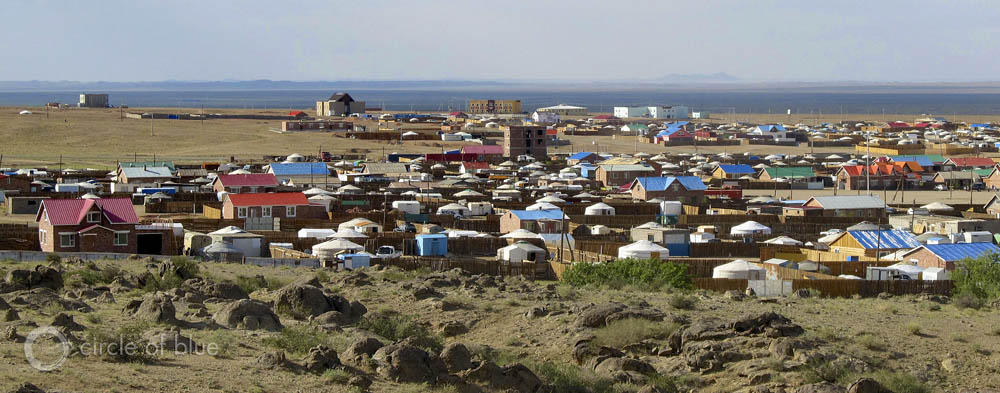
Khanbogd, Mongolia, a growing livestock and mining town in the South Gobi Desert, where water scarcity and mineral development are colliding. Click image to enlarge.
Proposals to pipe water from the North to the South have popped up periodiocally in Ulaanbataar since construction of Oyu Tolgoi began in earnest in 2009. But they aren’t generally taken seriously.
The cost of a building and operating a lengthy water pipeline would be enormous. Tthe Kherlen River flows into China, and Orkhon’s waters reach into Russia. Both countries would be expected to exert significant diplomatic opposition to such large water diversion projects.
What’s more, by the time water shortages become an emergency in the South Gobi, climate change may well have dried up enough of the nation’s surface water to significantly deplete the supply carried by the Kherlen and Orkhon rivers.

Climate Change Hotspot

A 2010 United Nations report found that since 1940, average annual temperatures in Mongolia increased 2.14 degrees Celsius (4.42 degrees Fahrenheit), a rate of increase that is higher than almost any other country. The number of droughts in Mongolia has increased 95 percent since 1950, and 680 rivers and 760 lakes have dried up since 2006, according to the U.N. study.
The drying trend is most pronounced in the South Gobi, according to the U.N. report. That’s also where the Oyu Tolgoi mine is located.
“In southern Mongolia, characterized by Gobi desert, the impact of climate change is expected to be extremely challenging. It will be in the form of extreme events — sand and dust storms, flash floods or heavy snowfalls, droughts, desertification, land cover changes and water stress.”
–United Nations Report, 2010
“In southern Mongolia, characterized by Gobi desert, the impact of climate change is expected to be extremely challenging,” according to the report. “It will be in the form of extreme events — sand and dust storms, flash floods or heavy snowfalls, droughts, desertification, land cover changes and water stress.”
In Ulaanbataar, Deputy Economic Minister Chuluunbat Ochirbat described the cross-cutting economic and environmental trends, unfolding in multiple dimensions, that confront his young nation. National ambition, he said, is expressing itself in new public pressure to gain more control of foreign industrial projects. The country’s mineral abundance can be developed with stricter environmental oversight and enforcement, which he said is occurring. But he acknowledged that the one big barrier that has not been adequately recognized or addressed is water scarcity.
“We’ve taken some actions,” Ochirbat said. “We suspended mining leases to control water pollution. We approved a new law four years ago to protect rivers and forests. I think what’s important right now is that our mentality has been upgraded. But we know we aren’t using our water resources properly.”

Tough Choices Ahead

Heading south to the Gobi Desert, and not far from Ulaanbataar, the sole paved two-lane highway dissolves into multiple hard-packed, single lane dirt roads. They criss-cross each other and from a distance resemble braided strands that rise to the peak of wind-tossed ridges and fall to treeless green valleys. Every now and again lone dirt roads peel off to the East or West, their destination known to local residents and expert drivers who are familiar with the territory.
The multi-tracked roads, unique in the world, form a powerful metaphor for Mongolia’s national development. The sheer mass of unmarked roads that bound across the grasslands and desert reflect the fast-growing number of drivers and vehicles, and rising personal incomes fostered by a free market economy and just two decades of mineral development.
South Gobi, ger, herders, livestock, Khanbogd, Coal, water scarcity, South Gobi, Mongolia, Omnogovi, Tsogttsetsii, Oyu Tolgoi. Rio Tinto. copper mine, gold, water, food, energy, choke point, circle of blue wilson center, Keith Schneider
Image © Keith Schneider / Circle of Blue
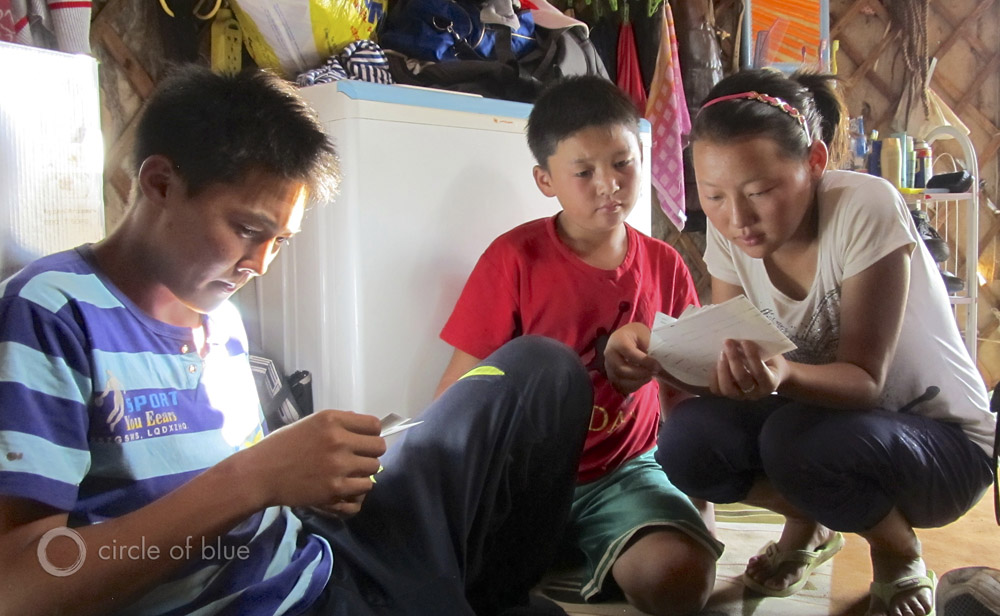
The children of a herding family near Oyu Tolgoi spend the afternoon in the shelter of their ger. They are (l. to r.) 17-year-old Batbayar, 11-year-old Gurragchaa, and 15-year-old Odgerel. Click image to enlarge.
Multi-tracking also represents the complexity of Mongolia’s choices. Follow the tracks and eventually they lead to Khanbogd, a desert town that is both enthused about mineral development and concerned sufficiently about dust, water, and the durability of a generation’s old herding culture to support Gobi Soil, an activist citizens group.
The South Gobi is a frontier of economic development and a laboratory of environmental consequences and social responses. It’s the sort of place that attracts people like Sara Jackson, a young American who is a human geographer and doctoral candidate at York University in Toronto. Jackson has traveled often to the South Gobi to study the effect of Oyu Tolgoi on the region’s residents. “I spend time thinking about how people feel,” she said in an interview with Circle of Blue.
In preparing her dissertation, Jackson conducted 80 interviews and held five focus groups to understand how Mongolians in Ulaanbataar, Khanbogd, and several more communities perceive Oyu Tolgoi. The idea, she said, is to promote communication between stakeholders.
In a draft report she wrote earlier this year, Jackson found persistent distrust among the stakeholder groups: Citizens felt they were being ignored and Rio Tinto officials felt their work to support independent review groups at Oyu Tolgoi was not appreciated. Dust from new roads and a dwindling water supply are viewed by stakeholders as chronic problems that haven’t been addressed to the extent that residents feel their complaints produce actual results.
Jackson’s conclusion: “Without resolution of the issues discussed above, feelings of marginalization and exclusion will continue to cause local, regional, and national tensions about Oyu Tolgoi and mining development in general. However, mining has had the positive effect of politicizing citizens, who are now more aware of and active in local politics.”
“I’ve spent a lot of time thinking about what I learned in Mongolia,” Jackson added in the interview. ”Cautiously, what can be said is that what’s happening in the South Gobi is different than in other developing places. Oyu Tolgoi is a big target. They do get picked on more than other companies. But at the same time, if they are pushed that raises standards. And they are being pushed.”
Author: Keith Schneider is a Traverse City-based senior editor for Circle of Blue. He has reported on energy, water, and climate change from four continents.

Email: Keith Schneider  :: Follow on Twitter :: More Articles

Share:

Crossing the Mongolian steppe

The last leg of a London to Ulan Bator road trip is as unpredictable as it is wonderful. Words and pictures by Robin Ewing

ada9a8316f26347acb987771bd2bd36b.jpg


Ablond border guard wearing long braids waves us out of Russia - and the road immediately turns to dirt. Our van shudders through a barren no-man's-land deep in the rocky Altai Mountains, but on our arrival, we find that the gate to Mongolia is locked.
The country is closed for lunch.
Thirty-nine days and 14,500 kilometres after having left London as a participant in the Mongolia Charity Rally, our once shiny, finely-tuned van is covered in mud and sounding like the automotive equivalent of a 90-year-old smoker. There are still another 1,800 kilometres to go to our destination, the Mongolian capital, Ulan Bator, across some of the harshest and least-populated land in the world. I'm worried our van isn't going to make it - but first, someone needs to unlock the gate.
The remote Tashanta-Tsagaannuur border lies in the region where Russia, Kazakhstan, China and Mongolia converge. The highway on the Russian side of the border rises steadily to this point, the pine trees and wooden farmhouses of Siberia giving way to the golden grassland of the mountain steppe. It's Mongolia's only western border with Russia, and cars are lining up behind us.
At 2pm, the gates open. Importing a car into Mongolia takes a lot of paperwork. I've heard it can take five days, so we stocked up on vodka in the only store in Tashanta. But just after 6pm, a border guard beckons us over and accepts US$10. We're in.
The far western Bayan-Olgii province is majestic, high and cold, the vast steppe stretching to glacier-topped mountains that rise like jagged shark teeth. Skittish goats and shaggy baby yaks wobble past. Men and women in traditional deel, worn like thick bathrobes, bounce by on motorbikes. Massive golden eagles, their wingspan up to 2½ metres, perch like sentinels, some on rocks, some on the road and others - those owned by people - chained to posts or tyres. As Genghis Khan did before them, the eagle hunters of Mongolia train their birds to hunt wolves.
A local wearing a traditional deel.
We pull over and make camp on the steppe. There are no fences; the land is owned by the state and used by the nomads. Their small horses and white gers (tents) dot the horizon. The sweeping expanse and the tiny funnels of smoke drifting from the tents' domes are disorienting; it feels as though there are more than 360 degrees here.
As dusk falls, other travellers join our camp; some Mongolians roar over on motorbikes, the vodka comes out and suddenly it's a party. The Mongolians challenge us to an impromptu wrestling match - the first to touch the ground loses. Of course, the locals win; wrestling has been a national sport here for 2,000 years. Eventually, the Mongolians roar off across the dark steppe, back to warm, felt-linedgers.
It's August and night temperatures drop to about nine degrees Celsius. In winter, though, they regularly fall to minus-30. And then there are the dzuds, winter storms so brutal they each decimate millions of head of livestock and leave entire families destitute. The nomads, who have lived here for thousands of years, are supernaturally tough.
The next morning we head into the provincial capital, Olgii. Low-rise brick buildings and ramshackle concrete structures line dirt roads filled with motorbikes, old Russian 4x4s and plastic bottles. Two boys in shower slippers walk a calf down the middle of the road.
Having a small airport, Olgii sees a trickle of tourists, mostly in summer and during October's Golden Eagle Festival. Many head for glacier valleys high in the Altai Tavan Bogd National Park, where thousands of prehistoric petroglyphs depict 12,000 years of hunting and herding, and include representations of mammoths, rhinoceros and ostriches. The park is only 180 kilometres from Olgii, but that's a full day's drive.
The roads are tough. Sand becomes dirt becomes mud becomes rock. Multiple tracks all go in roughly the same direction. We use the compass and look for tiny dust clouds on the horizon: evidence of a road. Often, a track goes straight into a river.
Nevertheless, there is immense freedom driving on your own out here among all this wild beauty.
Unfortunately, our van is sounding worse by the minute. A few hours outside of Olgii, we bottom out hard and the van gives up altogether.
We are given a tow by another rally team into the little Kazakh settlement of Tolbo. It's a high and lonely place, near the large Tolbo Lake, with a single dirt road running past the only store, a few houses and a blue-domed mosque. I pay a woman named Janis, who runs the store, to park my van in her backyard until a mechanic from Ulan Bator can come and rescue it (the van will be donated to the charity Go Help once it has been taken back to the capital). It will be safe here from the drunks, she says. Almost on cue, a man lurches past, moaning.
"Drunk," Janis says, looking at me knowingly.
We hitch a ride out with the other rally team. The night is cold and clear. I've never seen so many stars. One shot across the black sky while we were in Janis' backyard. Mongolians say it's not good to see a shooting star; it means someone is dying. I, however, couldn't have felt more fortunate.
It takes six more days to cross Mongolia. We camp in places so stunningly beautiful they seem unreal, get lost (apparently, there are four towns named Altay), nibble on hard cheese made from dried sour milk, pay a dollar to hold a huge golden eagle and play card games by flashlight in a muttony ger.
Driving into Ulan Bator is anticlimactic. On the fringes sprawl the ger districts, low-income areas in which most of the city's population live. In the centre, the money pouring in from the mining boom is obvious. Expensive cars plug streets lined with Irish pubs, European bakeries and pizza joints. There is even a North Korean restaurant. A 70-million-year-old dinosaur skeleton stands in the main square, next to a statue of Genghis Khan. Ulan Bator is an odd but intriguing city.
On my last night, I go out for Mongolian dumplings and farewell margaritas. If someone were to give me a car to drive back, I would gladly do it all again. I would, though, take Mongolia at a much slower pace.
The next day, 51 days after leaving London, I fly to Hong Kong. It takes less than five hours to get home. Driving is a lot more fun.

Source:South China Morning Post

Share:

Open letter by a Mongolian lawmaker to the Board of Directors of Oyu Tolgoi LLC

Ganbaatar Sainkhuu, Member of Parliament. October 23, 2013


I AM NOT AGAINST THE “INVESTORS” OF OYUTOLGOI PROJECT. I ONLY
QUESTION FOR THE PUBLIC INTEREST AND FOR THE BENEFITS OF ALL
MONGOLIANS. THEREFORE, I AM RESENDING YOU AGAIN THE SUMMARY OF
ALL THE LETTERS AND ENQUIRIES, WHICH I SENT YOU SINCE 2006. PROVE
US THAT YOU ARE RESPONSIBLE AND ETHICAL MINING COMPANY.

THE MAIN REASONS FOR THE REQUEST FOR THE RE-NEGOTIATION OF
THE INVESTMENT AGREEMENT OF 2009, OF OYU TOLGOI COPPER/GOLD
MINE PROJECT
The subject Agreement between the Government of Mongolia (GOM) and Rio Tinto/
Ivanhoe Companies (the Investor), was negotiated ‘’not in good faith’’ by the Investor, as listed
below.
Due to the above, the GOM has the right to demand the re-negotiation of the Agreement
with the Investor. The re-negotiation should cover the major Clauses listed below, and other
major Clauses negotiated not in good faith, in GOM’s opinion.
The following are the major Clauses of the Agreement, referred to above, which are not in
accordance with normal international standards & practices:
1. The Duration of the Project
a. 70 years – Initial 30 years+two automatic extensions of 20 years each
b. There is no option by GOM to re-negotiate and/or to terminate the Agreement, if the
Investor is in violation of the Agreement (see Item 2 below).
2. The Lack of a List of Material (Major) Clauses, if Breached, are subject to re-negotiation
and/or termination of the Agreement. For example:
a. The Feasibility Study (including the 5 & 10 Years Projected Production Plan)
b. The Training Program by the Investor of Mongolian workers (construction &
production)
c. The Environmental and Social Impact Assessment
d. With the lack of the list of material clauses, the Investor is entitled to dispute any Notice
by the GOM on termination of the Agreement, and to refer it to an international arbitration – see
Clause 14 of the Agreement.

3. The Failure to include Items 2.a, 2.b. & 2.c, as attachments to the Agreement, being an
integral part of the Agreement
4. 5% Royalty, fixed for the full duration of the project - 70 years
a. In large (similar to the capital investment amount of Oyutolgoi project) and risky project,
as natural gas, the royalty is over 10%
5. The lack of an ‘’Excess Profit’’ tax, on relatively high profits(after the return of the
capital investment)
a. This Excess Profit is to be applied only after the Investor has recovered its capital
investment+bonus (for example, 50% of the capital investment)
6. The Investor’s Management Fee During the Construction & Production periods
a. 3% of the total capital investment, during the construction period
b. 6% of the total of capital and production costs
7. The purchase by GOM of 34% of the project’s shares (with an option to buy additional
shares in the future)
a. There was no need to purchase the shares. This project is a partnership between GOM &
the Investor, where the GOM provides the project site with the copper & gold deposits, and the
Investor provides the capital investment, expertise, & the needed machinery & equipment.
b. For the reasons in Item 2 above, there was no need also to take a loan from the Investor
for the purchase of the shares, carrying an interest charge.
c. As the % of shares is applied on the total capital investment, any increase in the capital
investment (as it already happened, rising from approx. US$ 4 billion to US$ 7.1 billion), beyond
the control of the GOM, will result in additional cost in the purchase of shares.
d. The loan+interest for the purchase of the shares, have to be paid back to GOM from
the initial revenues received from the Investor, resulting in a big delay of using these revenue
money for the national development programs of Mongolia
e. Based on the above, the agreement on the purchase of the shares from the Investor, should
be cancelled, and the already paid money returned to GOM.
On behalf of Mongolian citizens, I demand open and transparent meeting between the GOM
and the Investor.


This letter is a ‘paid-for’ announcement
Share:

Mongolian Transgender woman Ana finally living a life that is true to herself

Mongolian Transgender woman Ana came to Hong Kong from Mongolia to seek refuge from persecution and violence and to make a bid for asylum

Mongolian transgender woman Ana's asylum application took just eight months


All her life, Ana was forced to live a lie until a trip to Hong Kong three years ago set her free.
Born a boy in Mongolia, Ana (not her real name) knew from an early age that she wanted to be a girl, but her choice meant years of physical and verbal abuse from family and society.
"My childhood was spent surrounded by violence and discrimination," Ana said.
Now 25 and living in the Netherlands after her bid for asylum was granted by the UNHCR in Hong Kong, she no longer fears for her life and freely lives as a woman.
Ana's successful asylum bid is one of four known cases where a transgender person has come to Hong Kong to seek safe refuge from persecution and violence.
"Everyone has the right to live and to be free, to feel safe here," she said.
Throughout her childhood, she struggled with her gender identity, until one day, when she was 20, she went out in public dressed as a woman. "It was wonderful to be seen as a woman; that was the true me," she said.
However, after a series of violent attacks which led to a local newspaper publishing photos of her as a man and as a woman, she fled to Hong Kong in 2010. She was 22 at the time.
"Hong Kong was the nearest and most safe place," Ana said.
"I had thought of going to Beijing and seeking asylum there, but there are a lot of Mongolian people studying and working there which meant it would be more difficult to keep my privacy."
Five days after she arrived in Hong Kong, Ana handed her application for asylum to the UNHCR. "Emotionally, I felt really down because I had left everything I had and was asking for refugee status which was really painful," she said. "But on the other hand, I was trying to see my transition, my new life, where I could finally live as who I want to be."
UNHCR staff warned her that the application could take years. "At first, they told me it would take a long time to assess, but luckily, after eight months, my case was approved," Ana said.
"I cried my heart out. I was super happy and couldn't believe that they gave me an opportunity to go on living."
The UNHCR, which can fast track cases where sexual or gender-related violence is key to an asylum bid, sent her to the Netherlands because it would provide a safe haven for her.
"Discrimination is everywhere and even though I've had bad experiences here, too, I feel safe and I have legal rights," she said.
"If someone hurts me, I can go to the police and tell them what happened. In Mongolia, I can't go to police and complain, even if someone has tried to kill me."
She has struggled to find a job but does some part-time modelling. "They pay me a small amount of money which is really useful for my daily life, but in the modelling industry, I also face discrimination because I am transgender woman," she said.
Ana's family no longer talks to her, but she hopes this will change one day. "They need time to accept me. I have to have a lot of patience," she said.

Source:South China Morning Post
Share:

Mongolian Parliament approves adjustments to the 2013 State Budget

Expenditures cut by Tgs 814.8 billion

On October 25, parliament approved a law to revise the Budget Law for 2013 and cut investment
expenditures by Tgs 425.7 billion. In total, the sum of 2013’s budget income was disrupted by Tgs1.8 trillion and the budget balance deficit was going to reach 6.8 percent of GDP. In this situation, the government presented parliament with a draft budget adjustment for this year. According to the adjustment, the 2013 budget was cut by Tgs799.2 billion; total expenditures by Tgs814.8 billion; and thus the budget deficit will be
Tgs340.8 billion, equaling 2 percent of GDP.

“The adjustment made to the budget is more realistic. In order to ensure 2 percent of GDP, there is no
other way but to cut expenditures. Investment expenditures will be cut by Tgs425 billion. About Tgs280 billion will be saved from current expenditures. We are working to save money and not create new debt. We
decided to cut unnecessary, unplanned and uncontrolled budgeting. The budget adjustment lays the basis for
the 2014 budget to be more realistic,” declared Finance Minister Ch.Ulaan. He underlined that buildings, the
completion of which were not clearly defined, the drafting and projecting of which were not ready and will
not be implemented this year, will be postponed. “The world economic situation is not stable, internal reserves are not steady and the market situation of our two big neighbors is not clear enough. This unfavorably affects our economy. We made adjustments to improve the budgeting. Introducing
a budget adjustment at the time of income abundance makes the budget worse, but in difficult situations,
the adjustment makes the budget improve,” reiterated Ch.Ulaan.

In the first nine months of this year, budget income shortage reached Tgs1.2 trillion, Tgs150 billion was
not provided to budget due to the deficit of export production. The price of Mongolia’s export products
such as copper, gold and coal on the global market dropped which influenced the budget income.
“Breaking off a significant amount of income was caused by the foreign market environment. Income worth
Tgs350 billion was cut due to import shortage and this is related to mining investment. With regards to the
Tavan Tolgoi mine, coal sales for some period stopped as there was no possibility to sell it for the devalued
price made according to the previous contract. It was planned in the 2012 budget that the Oyu Tolgoi agreement would be revised with an intention to introduce Tgs445 billion income injection. But this income failed to be realized. 

The Oyu Tolgoi agreement was signed at a time when windfall tax became invalid and incremental
taxation was imposed. Oyu Tolgoi did not pay royalty tax. Now, talks  are underway to get this tax from
Oyu Tolgoi. As a consensus was not reached, budget income was disrupted by Tgs445 billion. However budget income deficiency was caused mostly due to outside factors. We are pursuing an aim to mobilize our home reserves, generate income domestically and surpass income by Tgs200 billion,” commented the Finance Minister.

As budget income was disrupted, the government proposed to withdraw 265 projects from the list of planned investment projects to be financed in 2013. This was the major reason for making the budget adjustment. In his report to parliament, Prime Minister N.Altankhuyag reprehended the growing number of unfinished, cost growing construction projects and reminded them to terminate this situation in the future. 

There were two major deficiencies in the construction projects that were built from the state
fund. First, most construction remained unfinished for years, some for even 6 years but continued to receive money from the budget. The budgetary cost for this period grows ten and even a hundred times. We have plenty of these kinds of construction projects,” said Ch.Ulaan.

Removing the construction objects from the list of the 2013 budget investment was at the focus of MPs
attention. The members supported the proposal to include and implement more than 100 construction projects in the 2014-2015 State Budget and terminate some projects. The members agreed to investigate the reasons for the growing budget cost of some construction projects and programs in cooperation with the State Auditing Authority and the government, and submit them for parliament’s consideration. It was decided to study and assess every unfinished construction of buildings. It was decided to finance road and
energy projects from the Development Bank. The majority MPs welcomed the proposal to set up a state authority to be responsible for building and construction projects from budget funds and start operating in 2014.

Source:Mongol Messenger
Share:

Mongolian opposition party changes its leadership

M.Enkhbold elected as MPP’s new leader
M.Enkhbold accepting his party’s leadership position

On October 26-29, MP M.Enkhbold was elected as the MPP leader. The Mongolian People’s Party, eldest political party that became an opposition force after the 2012 parliament election, called its 27th Congress and elected its leader.

There were 1,078 party delegates participating in the election to support their new leader. M.Enkhbold, Vice
Parliament Speaker, won the vote with 988 supporters and became the 29th leader of the MPP. N.Enkhbold, chief of the MPP parliamentary group, MPs O.Enkhtuvshin and J.Enkhbayar withdrew their names.

T.Ayurzana, coordinator of the ‘Innovation’ movement who contested with M.Enkhbold for the position of
the MPP leader got 88 votes. The ‘Innovation’ committee was formed when the MPP lost in the Presidential election demanding to call the party leadership to responsibility and the party leaders to resign. The MPP
Conference met at the beginning of August and decided to reshuffle MPP’s leadership at the party Congress.

Outgoing MPP leader O.Enkhtuvshin made a political report on the work executed by the party
after the 26th Congress. The Congress heard a report of the Control general committee, discussed revision of MPP rules, the goals of Mongolia’s development to 2021, party innovation activities, and appointment of the party’s new leadership. The Congress elected 310 delegates as party Conference members. The conference will elect the party general secretary from candidates.

The Congress introduced revisions to the party rule. The revision working group was set up at the previous MPP Conference. Aside from drafting a party rule, the revision working group proposed to introduce more than 80 principle revisions to the party rule with wording and formulation changes that were discussed and approved by Congress delegates. For example, participation of Conference members in party activities will be more distinct and clear-cut, changes related to the activities of the party leader, governing council and secretaries were decided to be included in the revised party rule.

Source:Mongol Messenger
Share:

South Africa to share mining experience with Mongolia

Deputy President of South Africa pays visit to Mongolia

PM N.Altankhuyag welcomes H.E. Mr. Kgalema Motlanthe on Chinggis Khaan Square

From October 30 to November 1, Mr. Kgalema Motlanthe, Deputy President of South Africa is paying
an official visit to Mongolia at the invitation of Prime Minister N.Altankhuyag.

Mongolia and South Africa established diplomatic ties in 1994 and the upcoming visit is the first ever
top visit of South Africa to Mongolia. During the visit, Mr. Kgalema Motlanthe holds official talks with
Mr. N.Altankhuyag. The visit of the Deputy President of South Africa is the first top-level visit after establishing diplomatic relations between the two countries in 1994. 

Prime Minister of Mongolia N.Altankhuyag and Deputy President of South Africa Kgalema Motlanthe held talks. The sides agreed to popularize under the framework of the 20th anniversary of Mongolian-
South African diplomatic relations the present stage of relations between the two countries, organize sport and cultural events,, support and develop relations and cooperation between state organizations and private sector, collaborate in mining, energy, sports, travel and tourism, and environmental spheres, facilitate to supporting inter-civil communication, study and investigate technology of producing liquefied fuel, and develop multilateral cooperation between Mongolia and South Africa.

After the talks the two high-ranking officials met with press and media representatives. The Mongolian
Premier expressed satisfaction with the visit of the Deputy President of South Africa, the country that initiated
the African Union and leads the continent by its development today, when Mongolia is striving to boost
cooperation with the African states. “The present visit will be an access to develop cooperation with Africa, said N.Altankhuyag. 

The year 2014 will be the the 20th anniversary of African democracy and the 20th jubilee of the
establishment of diplomatic relations with that country. As two democratic states, we have much in common to share experiences. South Africa leads the mining branch with good mining technology, with experience in holding talks and agreements in mining, and with rich reclamation experience.

Mongolia strives to learn South Africa’s experience. South Africa occupies a deserving place on the
African continent and in the UN. The present visit will facilitate upholding our relations and cooperation to
a new level”, said Prime Minister N.Altankhuyag. Mr. Kgalema Motlanthe mentioned that the two countries established diplomatic relations in April 1994; one month after Nelson Mandela became President. He considered it appropriate to set up diplomatic representations in the two countries. The African
Deputy President expressed readiness to share its experience with Mongolia in developing the mining branch,
coal refining, introducing mining hitech and concluding contracts and agreements in the mining sphere. The
Deputy President declared that the two countries will support each other at the international level.

The Deputy President of South Africa met with Vice Parliament Speaker R.Gonchigdorj and underlined the significance for boosting bilateral relations and interparliamentary cooperation; activate contacts between law enforcement agencies and their administrations, and exchange experiences between the two parliaments.

On November 1 the South African guest is meeting with President Ts.Elbegdorj, N.Batbayar, Minister of
Economic Development, and Mining Minister D.Gankhuyag. The South African Deputy President’s entourage includes vice ministers and leading officials from the mineral, trade, industry, and energy ministries, mining technology companies, government officials and press representatives.

Source:Mongol Messenger
Share:

Why the hell our President went to visit North Korea, ordinary Mongolians wonder

Not many times Mongolia makes headlines in the global media. During last few days, all eye of the major mainstream news media was on our President Elbegdorj who paid 4-day official visit to reclusive North Korea. 
However, ordinary Mongolians are wondering why he has to visit the North Korea which Mongolia has minimum economic and political, cultural connection and whose leader even did not bother to meet him up!

Once a while North Korea asks for meat from us through its barely functioning embassy in UB. About 1700 North koreans are laboring in construction and garment sector and this is very insignificant compared to 1900 Mongolians who were laid off from OT, the giant copper and gold mine in Mongolia.

Don't our president has more important matters to address than visiting North Korea?  Economic downturn and stagnation of the mining sector that Mongolia faces needs quick solutions. President Elbegdorj needs to focus more on pressing economic matters of Mongolia including political stability, attraction of international investors, dealing more effectively with our two imminent neighbors etc. 

Do we feel close to North Korea? No. Average Mongolian has no idea about North Korea. North Korea reminds us something of the past. It is time to get real and stop this nostalgia of "Mongolia and North Korea was traditional ally and still is" blah blah.

We want more public schools, kindergartens, improved roads, hospitals in UB and the rural provincial centers. Average Mongolians are tired of being treated as second class citizens by ruling Mongolian oligarch families who are running the country. The public schools and kindergartens where our children go are overcrowded. Over 40 children are studying in one classroom.

We don't care about North Korea. We are not ethnic Koreans. We are Mongolians. We are living a miserable and stressful life. North Korea is far from us. We care more about our children, our future, our livelihood.

I'm angry and stressed. Yesterday, i was stuck in traffic jam all day because of visiting South African Vice President.Stuck in bus near the Blue Sky hotel where he was staying.It seems our Mongolian government and politicians don't care about us, ordinary Mongolians. For them, visiting North Korea or meeting with South African Vice President is fare more important than caring about Mongolians...

Our children are treated in second-grade Mongolian hospitals and studying in second-grade schools... Enough is enough. 

Stop wasting our tax money by stupid visits like this visit to North Korea. Please think about ordinary Mongolians and focus more on our domestic issues. We want to live like a human being and treated as a decent human being also!

Ranted by stressed out Shagai 


Share:

Oyu Tolgoi confident disputes can be resolved at its Mongolian mine

Updated 5 hours 52 minutes ago
The Rio Tinto managed Oyu Tolgoi says its confident that disputes which have stalled the construction of the giant copper and gold mine in Mongolia can be resolved.
The nearly US$7 billion project in the remote Gobi Desert has been plagued by conflict between Rio and its major partner, the Mongolian Government, over project financing, cost overruns, and other issues.
Head of communications for Oyu Tolgoi, Houston Spencer, told the Mongolian Mining Summit in Perth that while there had been "challenges", the disputes were being worked through by the parties.
"Oyu Tolgoi's investors, Turquoise Hill and Rio Tinto, continue discussions with the Government of Mongolia, discussions on issues that must be overcome as part of the further development of OT's underground mine," he said.
Mr Spencer is also a Rio Tinto representative on the Oyu Tolgoi executive committee.
Oyu Tolgoi's board is made up of representatives from the Mongolian Government, Rio Tinto, and Turquoise Hill Resources, which is part-owned by Rio.
Construction work was suspended in July at the underground mine because of the ongoing disputes, resulting in 1,700 workers being laid off.
Mr Spencer says a collaborative solution is required to sort out outstanding issues so work can resume at the underground mine.
"I understand why many stakeholders want to see that day come quickly," he said.
"But speed cannot drive this process. We have to resolve these issues properly creating solutions that last," he told the conference.

Delays

Production began in July but the first delivery of copper concentrate was held up by delays at Chinese customs.
That issue has been resolved and the first deliveries to customers were made in mid October.
Oyu Tolgoi's chairman, Batsukh Galsan, played down the disputes in a presentation to the conference.
"We have faced many issues to achieve what OT is today: a world class open pit and concentrator facility with on going exports," he said.
Mr Galsan also played down a big slump in foreign investment following laws which differentiated between local and foreign investors.
That legislation has been superseded by a new investment law passed earlier this year by the Mongolian Parliament.
Mr Galsan was Mongolia's Ambassador to Australia from 2005 to 2010.
The partners are also waiting for project financing of $US 4 - 6 billion to be finalised ahead of a December deadline.
The mine has produced more than 160,000 tonnes of copper concentrate and is forecast to produce up to 85,000 tonnes of copper by the end of the year.
Construction of the mine started in 2009 and exploration began at the site about 20 years ago.
The mine is expected to contribute to one third of Mongolia's economic development and under the investment agreement, the Mongolian government will get a majority of the profits.
More than 8,000 people are employed on the project and 90 per cent of them are Mongolians.  

Source:Australian ABC news network
Share:

Why Kim Jong Un Snubbed Mongolia’s President

This photo taken and released by North Korea’s official Korean Central News Agency on October 29, 2013 shows Mongolian President Tsakhiagiin Elbegdorj with his delegation as he visits North Korea’s side of Panmunjom in the Demilitarized Zone between the two Koreas. Notice: Kim Jon Un, the North Korean leader is not here.

Mongolia’s president had a busy four days in North Korea this week, meeting various officials and zipping around to Kim Il Sung University, a Pyongyang theater, the Munsu water fun park, the border with South Korea and Kim family mausoleum, among other places.
But after Tsakhiagiin Elbegdorj had jetted out of Pyongyang on Thursday it became clear that he didn’t meet the one person expected to have capped it all: Kim Jong Un.
What’s with the apparent snub?
Experts say it may have something to do with North Korea’s ambivalent attitude towards the landlocked country to the north-west. The nomadic ancient Mongolians were considered barbarians by the Koreans, according to historians.
“North Korea doesn’t see Mongolia as superior or even an equal,” said Lee Yoon-geol, a North Korean refugee-turned-analyst in Seoul.
While Mongolia has been a traditional ally to North Korea it isn’t the first time Pyongyang has apparently snubbed Ulaanbaatar: In 2004, the North’s state media carried no mention of a meeting between North Korea’s then-leader Kim Jong Il and Mongolia’s then-President Natsagiin Bagabandi during the latter’s visit to North Korea.
Like Mr. Bababandi, the current Mongolian president appears to have had to settle for a chat with the nominal North Korean second-in-command.
However the latest trip went, North Korean state media gave a polite account of the president’s visit on Friday.
“The DPRK side congratulated the Mongolian government and people on achieving socio-political stability, keeping a high rate of economic growth depending on its rich natural resources and raising its international position by pursuing independent and multi-faceted foreign policies under the correct guidance of the Mongolian president,” the state news organization reported. DPRK is the abbreviation for Democratic People’s Republic of Korea, the formal name of North Korea.
Various economic and cultural agreements were made at meetings this week, according to the two nations’ news media accounts, but their details weren’t publicized.
Chang Yong-suk, a senior researcher at the Institute for Peace and Unification Studies at Seoul National University, said North Korea is likely saving the first-summit card for China or Russia.
In July, the North Korean dictator met Chinese Vice President Li Yuanchao, believed to be the most senior official to speak with the North Korean leader since the death of Kim Jong Il in December 2011.
That’s unless you consider that Dennis Rodman outranks Mr. Li.

Share:

No Kim Jong Un summit meeting for Mongolian President

Observers confused as to why no summit meeting took place

Mongolia’s President Tsakhia Elbegdorj left North Korea on Thursday afternoon with DPRK state media providing no confirmation as to whether an expected meeting with Kim Jong Un had taken place.
Prior to Elbegdorj’s arrival South Korean media speculated that the Mongolian leader would have a summit meeting with Kim Jong Un – an encounter that would have represented the North Korean leaders’ first official meeting with another head of state.
But no information of such a meeting was released by North Korean state media, suggesting that Kim Jong Un did not in fact meet the Mongolian leader. ”The lack of mention of the North Korean leader meeting Elbegdorj indicates that no summit took place,” an anonymous official told Yonhap News in South Korea.
Instead, on Elbegdorj’s last day in North Korea, North Korean state newspaper Rodong Sinmun led with in-depth coverage of Kim Jong Un’s appearance at live-fire military drills, only mentioning the Mongolian leader on page three,  in context of him meeting Premier of the DPRK Cabinet Pak Pong Ju.
“[Kim Jong Un] is too busy with military matters to waste time on frivolities like meeting the Mongolian president. His activities, however absurd, have to be reported, and a report about him trotting around Mansu Water Park, as the poor unfortunate Mongolian delegation found himself doing, would not fit the appropriate narrative,” North Korea watcher and Daily NK international editor Chris Green told NK News.
Leonid Petrov, a North Korea researcher at the Australian National University, said that Kim Jong Un’s choice to attend live fire drills over meeting with Elbegdorj indicated that military-first policies remain a key priority.
“Kim Jong Un has sent the signal to the world and domestic audience in the DPRK that the era of Songun [Army First] Policy is not going to fade away; and that economic reform is of less importance for him than military build up.
“Apolitical foreign celebrities, like Dennis Rodman, attract more attention of the North Korean leader than concerned heads of states and CEOs of multinational corporations” Petrov added, pointing out that “regional security, stability and progress are clearly of low priority for Kim Jong Un and his advisors.”
Antonio Fiori, a professor and North Korea watcher at the University of Bologna, said that it was “not really understandable why Kim Jong Un did not show up” to meet with the Mongolian leader, because “Mongolia is dramatically meaningful for North Korea, in terms of economic connections and diplomatic ties.”
But Fiori speculated that the risk of being probed about the Japanese abduction issue could be why Kim Jong Un decided that no summit meeting should take place.
“Mongolia is willing to assist Japan in finding a solution to the abduction issue, and it seemed likely that Elbegdorj could raise this issue during his visit to Pyongyang. Maybe Kim Jong Un did not want to take the risk to be asked about the issue of the Japanese abductees”.
During his trip the Mongolian leader inked economic and technology sharing agreements with North Korea and paid visits to the Kumsusan memorial palace and truce village of Pnamunjom, located in the demilitarized zone.  Elbegdorj also delivered a speech to Mongolian entrepreneurs and DPRK economic officials at the Yanggakdo International Hotel.
The Mongolian president is the first foreign leader to visit North Korea since Kim Jong Un assumed power in late 2011. The last summit meeting between Mongolia and North Korea took place in December 2004.

Share:

Standard Bank launches case against Erdenet to reclaim $120m loan

Standard Bank has launched legal proceedings against Just Group and Erdenet Mining Corp in the UK courts, the South African bank has confirmed.

A spokesman for the bank told Metal Bulletin that the matter is before the courts but declined to comment further on the case.

Standard Bank launched the proceedings to reclaim debts owed by Mongolia-based Just Group, some of which were guaranteed by Erdenet Mining, observers told Metal Bulletin.

Just Group, a Mongolian concern owned by Sharavlamdan Batkhuu, controlled several banking and industrial assets in the country until earlier this year.

Just Group subsidiary Mercantile House had a copper concentrates off-take agreement with Erdenet Mining, and, through other industrial assets, Just Group also provided other services to Erdenet, such as the supply of fuel.

The group was dissolved earlier this year after another of its subsidiaries, Savings Bank, was declared insolvent in July after failing to meet capitalisation requirements set out by the Bank of Mongolia.

The collapse of Savings Bank, which was Mongolia's fifth largest lender, in turn prompted Batkhuu to sell off all assets held by Just Group, and in a press conference covered by local media earlier this year, he said he would take on responsibility for repaying the $120 million owed to Standard Bank.

The bank has now filed a claim in the UK courts against Just Group and Erdenet but as of Tuesday October 29 the case had not been acknowledged by all parties, a source familiar with the matter told Metal Bulletin.

According to local media reports citing Batkhuu, Standard Bank issued a $20 million loan to Just Group, which Erdenet guaranteed. Batkhuu used later loans extended by Standard Bank to recapitalise the failing Savings Bank, and also to buy the Olon Ovoot gold mine from Mongol Gazar.

Batkhuu, who has now sold all businesses within the Just Group, called on State Bank to assist him in paying off his outstanding debts, according to local media.

Erdenet Mining is also involved in a separate dispute with MRI Trading concerning the supply of copper concentrates under a frame contract agreed in 2009.

The Court of Appeal upheld a ruling finding in favour of MRI's $10 million claim against the company, but Erdenet is now seeking the right for an appeal to be heard in the UK Supreme Court.

Erdenet did not respond to a request for comment.

Source:http://www.metalbulletin.com/Article/3272868/Minor-and-precious-metals/Standard-Bank-launches-case-against-Erdenet-to-reclaim-120m-loan.html
Share:

Khan Resources takes Mongolia expropriation to arbitration panel

ROME — The Globe and Mail
Published Wednesday, Oct. 30 2013, 7:11 PM EDT
Last updated Thursday, Oct. 31 2013, 6:42 AM EDT

Canada’s Khan Resources is gambling that an international arbitration case in Paris will allow it to regain control of a uranium project that, it claims, was illegally expropriated by the Mongolian government, leaving it with nothing but angry investors.
While Toronto-based Khan is only a bit player in the Canadian mining scene, resources companies with far-flung operations will likely pay close attention to the arbitration. International commercial arbitration in general, and arbitration cases against governments in particular, are becoming increasingly popular, to the point they are gaining favour over traditional courtroom litigation.
The rise of bilateral investment treaties is triggering a surge in commercial arbitration cases against governments, which are handled through the World Bank’s arbitration court, known as ICSID – the International Centre for Settlement of Investment Disputes. The 3,000 international treaties, covering everything from hotel investments to dam construction, form the basis of the arbitration.
“International arbitration is used a lot,” said Grant Edey, a former Iamgold chief financial officer who has been Khan’s CEO since 2010. “It’s being used more often as developing countries get more aggressive about taking control of their resources.”
Khan had planned to develop a uranium mine in northeast Mongolia, near the Russian and Chinese borders, through an effective 68-per-cent stake in the Dornod deposit with state-controlled Russian and Mongolian partners. The property’s potential was well known. The Russians had spent about $150-million (U.S.) exploring and partly developing the site before abandoning it 1995.
Khan took over the project in 2003 and went public on the Toronto Stock Exchange in 2006 (it has since been demoted to the CNSX market). After spending $21-million on exploration and development, it outlined its $330-million mining development plan three years later and expected to be in full production by 2013. The goal was to mine about three million pounds of uranium oxide a year over 15 years.
In 2009, Khan’s ambitions fell apart when the Mongolian government passed a new nuclear energy law that would allow the government to take as much as 51 per cent of the Dornod project at no cost. Khan and a Russian company, ARMZ, would own the rest. Khan says it wasn’t offered compensation for the downgrade to minority partner, nor were its mining permits renewed. At one point that year, ARMZ launched a hostile bid for Khan that went nowhere. Later, China National Nuclear Corp. did the same. Its bid also failed.
Khan shares collapsed, going from $4 (Canadian) to penny-stock status. On Wednesday, Khan traded at only 25 cents a share, giving the company a market value of $16-million.
Stuck in legal limbo, and without control of the Dornod project, Khan launched an arbitration case against the Mongolian government in 2011, seeking $326-million (U.S.) in compensation.
A tribunal was appointed and the case is to be heard in Paris starting Nov. 11. Arbitration specialist Yves Fortier, the former chairman of both Alcan and the Norton Rose law firm, was Khan’s nominee to the tribunal.
International commercial arbitration cases are adjudicated behind closed doors, tend to be shorter, and produce final decisions that can’t be appealed. But they are not necessarily cheaper. “Over all, businesses continue to show a preference for using arbitration over litigation for transnational disputes, although concerns remain about the costs of arbitration,” a new PwC report on arbitration says.
Recent plaintiff victories have made them popular options despite the costs.
Earlier this month, Argentina agreed to compensate five companies that won arbitration cases. The payment is to be made in the form of dollar bonds with a face value of $506-million. The many cases against Argentina stem from the nationalizations and currency devaluations related to the country’s sovereign default in 2001.
The number of registered ICSID cases last year reached 50, up from 38 in 2011.
Mr. Edey said Khan has already spent $4-million on legal and tribunal fees. He would not rate the company’s chances of success. “We’re looking for closure after four years of uncertainty and insignificant value for our time, effort and money.”

Share:

Facebook page

Powered by Blogger.

Categories

Advertising in Mongolia An Asian Development Bank Culture Editorial of the Mongolianviews education Environmental protection Famous Mongolians Foreigners in Mongolia Inner Mongolia Ivanhoe Mines Mongolia Adventure Mongolia agriculture Mongolia air pollution Mongolia analysis Mongolia and Armenia Mongolia and Asian Development Bank Mongolia and Australia Mongolia and Azerbaijan Mongolia and Belorussia Mongolia and Bulgaria Mongolia and Cambodia Mongolia and Canada Mongolia and central Asia Mongolia and China Mongolia and Cuba Mongolia and Czech Mongolia and donors Mongolia and EU Mongolia and Germany Mongolia and Hongkong Mongolia and Hungary Mongolia and IFC Mongolia and IMF Mongolia and Ind Mongolia and India Mongolia and Indonesia Mongolia and Inner Mongolia Mongolia and Iran Mongolia and Israel Mongolia and Italy Mongolia and Japan Mongolia and Kazakhstan Mongolia and Korea Mongolia and Kuwait Mongolia and Kyrgyzstan Mongolia and Malaysia Mongolia and Nato Mongolia and North Korean Mongolia and Poland Mongolia and Qatar Mongolia and Russia Mongolia and Russia and Mongolia and China Mongolia and Singapore Mongolia and South Korea Mongolia and Taiwan Mongolia and Thailand Mongolia and the world Mongolia and Tibet Mongolia and Turkey Mongolia and UK Mongolia and Ukraine Mongolia and UN Mongolia and US Mongolia and USA Mongolia and Vietnam Mongolia Banking Mongolia blind Mongolia Cashmere Mongolia Christianity Mongolia civic society Mongolia Corruption Mongolia crime Mongolia diplomacy Mongolia Economy Mongolia Education Mongolia Energy Mongolia environment Mongolia Finance Mongolia Health Mongolia History Mongolia holiday Mongolia in international media Mongolia Industries Mongolia investment Mongolia Joke Mongolia law Mongolia LGBT Mongolia medical Mongolia military Mongolia Mining Mongolia Mining Developments Mongolia Mortgage Mongolia natural disaster Mongolia news media Mongolia Nuclear Mongolia Petroleum Mongolia Politics Mongolia Poverty Mongolia public announcements Mongolia railways Mongolia Religion Mongolia slums Mongolia society Mongolia Sports Mongolia Stamp Mongolia Sumo Mongolia telecommunication Mongolia tourism Mongolia trade Mongolia Transportation Mongolia Urbanization Mongolia Wild Life Mongolian Agriculture Mongolian and Cuba Mongolian Archeology Mongolian Climate Mongolian Food Mongolian Gay Mongolian Government news Mongolian History Mongolian Kazakh Mongolian Meat Mongolian Military Mongolian Mining Development Mongolian Movie Mongolian News Mongolian Parliament Mongolian Political news Mongolian Press Mongolian Songs Mongolian Sumo Mongolian Women Mongolian Youth Mongolians abroad Moninfo Opinion Oyu Tolgoi Investment Agreement Photo news Press Release Rio Tinto Tavan Tolgoi coal mine Ulaanbaatar development Weird expatriates in Mongolia World bank and Mongolia

Blog Archive

Followers