Russia, China, Mongolia adopt program of economic corridor

The leaders of Russia, China and Mongolia - Vladimir Putin, Xi Jinping and Tsakhiagiin Elbegdorj - adopted a program of building an economic corridor between the countries following a three-party meeting.


The leaders of Russia, China and Mongolia - Vladimir Putin, Xi Jinping and Tsakhiagiin Elbegdorj - adopted a program of building an economic corridor between the countries following a three-party meeting.
Agreements were also signed between the Russian Federal Customs Service, China’s Main Customs Department and Mongolia’s Main Customs and Tax Department on mutual recognition of results of customs control regarding separate kinds of products.
The program of an economic corridor between the Russian Federation, China and Mongolia includes some 30 projects.
The leaders arrived in Tashkent for participation in the summit of the Shanghai Cooperation Organization (SCO).
This is the third top-level meeting in the format Russia-China-Mongolia. Earlier, such talks were also held on the sidelines of SCO summits - in Dushanbe in 2014 and in Ufa in 2015.
First published by TASS.
Share:

Putin concerned about Mongolian dam threatening Lake Baikal

Russia's President Vladimir Putin voiced strong concern Thursday about Mongolia's plans to build a hydroelectric plant on a river flowing into Lake Baikal, warning it could endanger the world's deepest lake.
Putin said that the prospective China-funded dam on the Selenga River would cause "certain risks" to the lake in southern Siberia.
"We would like to study this issue most attentively together with our Mongolian friends and the People's Republic of China," Putin said during a meeting with leaders of China and Mongolia in Uzbekistan's capital, Tashkent.
Putin suggested that Russian power plants could increase electricity supply to Mongolia instead to help meet its energy needs.
The hydropower plant project long has drawn criticism from environmental groups, which expressed fears that it could endanger the world's oldest lake, formed more than 25 million years ago.
Environmentalists warn that the Mongolian dam project would disrupt the Selenga River flow into Lake Baikal and pose catastrophic threat to many of its 2,500 species, of which more than 75 percent are believed to exist only in its waters.
Lake Baikal is 1,642 meters (5,387 feet) deep and contains about 20 percent of the world's unfrozen fresh water, the largest freshwater reservoir in the world by volume. It has been made a UNESCO World Heritage Site thanks to its unique character and biodiversity.
Putin met with Chinese President Xi Jinping and Mongolian President Elbegdorj Tsakhia on the sidelines of a two-day summit of the Shanghai Security Cooperation Organization, a security alliance dominated by Moscow and Beijing. Mongolia has an observer status in the group.
The three leaders also discussed a transport corridor and other infrastructure projects.

Source:Russian Media
Share:

China, Russia, Mongolia endorse development plan on economic corridor

Photo: Xinhua
Russian, Chinese, Mongolian Presidents

China, Russia and Mongolia inked a development plan here on Thursday to build an economic corridor linking the three neighbors, pledging to boost transportation connectivity and economic cooperation in border regions.
The plan was signed after a meeting of Chinese President Xi Jinping, Russian President Vladimir Putin and Mongolian President Tsakhiagiin Elbegdorj in the Uzbek capital of Tashkent ahead of an annual summit of the Shanghai Cooperation Organization (SCO).
While chairing the trilateral meeting, the third of  its kind, the Chinese president reviewed the achievements the three countries have made in implementing their mid-term roadmap for cooperation, saying progress and positive results have been made in such areas as trade and economy, cultural and people-to-people exchanges, transit transport, tourism and sports.
“The Chinese side is satisfied with the momentum of our trilateral cooperation,” Xi said.
He proposed that the three countries continue to center on the aligning of China’s Silk Road Economic Belt initiative, Russia’s development strategies, especially its transcontinental rail plan, and Mongolia’s Steppe Road program to actively advance the trilateral cooperation.
Xi called on the three countries to well implement the development plan to build the economic corridor and strengthen cooperation in transportation infrastructure connectivity, port construction, industrial capacity, investment, trade and economy, cultural and people-to-people exchanges, and environmental protection, thus producing outcomes at an early date.
“We three sides should actively engage in the discussion of building cross-border economic cooperation zones, enhance industrial tie-in, boost sub-regional cooperation in our adjacent areas, and promote the common development of our adjacent areas,” Xi said.
The Chinese president also urged the three countries to expand cooperation within the framework of the SCO, especially in such areas as transit transportation, food security, disaster reduction and energy.
Putin said Russia, China and Mongolia are friendly neighbors based on equality, respect and mutual benefit.
He said Russia, in light of the three countries’ consensus, is committed to working with China and Mongolia to well implement the projects of transportation and infrastructure construction, speed up simplifying port procedures, and promote regional economic integration process.
Russia is also willing to increase cultural and people-to-people exchanges with the other two countries, he added.
For his part, Elbegdorj said the development plan on the economic corridor linking the three countries is very important, adding that Mongolia stands ready to join hands with China and Russia to advance the construction of transportation infrastructure and strengthen economic cooperation in border regions.
Mongolia also hopes to enhance cooperation with the other two countries in agriculture and disaster relief, he said.
After the meeting, the three heads of state also witnessed the signing of a trilateral agreement on the mutual recognition of the customs supervision results on certain commodities.
The 16th meeting of the SCO Council of Heads of State is scheduled to be held in Tashkent on Thursday and Friday.
Story from Xinhua
Share:

Mongolian company seeks enforcement of award by Moscow Commercial Court in US

MOSCOW, June 17 (RAPSI, Vladimir Yaduta) – Batbrothers, a company registered in Mongolia, seeks the recognition and enforcement of an award granted by the Moscow Commercial Court in favor of Gazprombank in the Supreme Court of the State of New York.
According to the case materials RAPSI has at its disposal, the Mongolian company alleges that in February 2006 Gazprombank entered into a facility agreement with Zolotoy Vostok-Mongolia (Golden East Mongolia, GEM), a gold mining company. The agreement provided for a total disbursement limit of $30 million in three tranches and stipulated an annual interest rate of 12.5%. The loan was secured by a personal guarantee by Sergey Paushok, the GEM Executive Director, the company’s equipment worth $6.2 million, and subsoil and exploration licenses worth about $33.7 million. Another guarantor of payments under the agreement was Zolotoy Vostok-Sibir (Golden East Siberia, GES).
In case the borrower failed to repay the loans, the lender could impose a penalty of 0.1% of the amount due for each day of delay. Since November 2008, the interest rate was adjusted from 12.5% to 18%.  
Later, due to the fact that the borrower failed to comply with the loan agreement, Gazprombank lodged a claim with the Moscow Commercial Court seeking to recover the arrears in the amount of $25 million (for the outstanding principal and interest) and about $22 million in default interest and penalties for failure to repay the outstanding amounts. In 2012, the Moscow Commercial Court rendered a judgment in favor of Gazprombank having fully granted the demands of the plaintiff and imposing on each defendant the payment of court fees in the amount of 200,000 rubles ($3,000).  
Allegedly, Gazpormbank has later transferred the rights relating to the enforcement of this award to Batbrothers company, which lodged the respective claim with a US court in April 2015. The defendants should have been properly summoned under the Hague Convention on the Service Abroad of Judicial and Extrajudicial Documents in Civil or Commercial Matters (the Convention). However, according to the plaintiff, the proper service of the process could not be accomplished because Mongolia, where the plaintiff believed GEM was located, was not a signatory to the Convention, whereas Russia had refused to service summons from the USA since 2003.  
Therefore, Batbrothers made a motion with a US court seeking permission to use alternative methods of service the defendants located outside of the USA. Last week, the court denied this motion having noted that the company had not exhausted the means to provide adequate evidence demonstrating valid addresses of the both defendants, that the both defendants were still viable entities, and documentation of the assignment agreement between the plaintiff and Gazprombank. 

Source:http://rapsinews.com/
Share:

Annual "Ulaanbaatar Dialogue" conference on Northeast Asian Security concluded

The 3rd international conference under " Ulaanbaatar Dialogue" initiative on Northeast Asian Security concluded here Friday.
The conference was co-organized by Mongolian Ministry of Foreign Affairs and Institute for Strategic Studies under the National Security Council.
According to Mongolian Ministry of Foreign Affairs, this year both DPRK and ROK were present for the first time.
About 150 delegates from China, Russia, Democratic People's Republic of Korea (DPRK), Republic of Korea (ROK), Japan, the United States, Germany, India, the Great Britain, Australia, France and the United Nations, the International Committee of the Red Cross, the Friedrich Ebert Foundation participated in the two-day conference and exchanged views on regional security and cooperation.
The range of discussion at this conference is widening year by year, Apart from security issues , delegates also discussed regional economic cooperation and infrastructure connectivity, environmental protection and disaster management.
Chinese experts made remarks to the conference on issues, among others, Korean Peninsula nuclear issue, forging a community of shared destiny for mankind and building a climate resilient society.
"Countries should be consistent with the trend of the times, grasp the right direction, and achieve mutual benefit and win-win results by firmly establishing the awareness of a community of shared destiny for all mankind."said Ruan Zongze, executive vice president and senior fellow of China Institute of International Studies.
Mongolia holds annual "Ulaanbaatar Dialogue" conference focusing on maintaining dialogue between different stakeholders of East Asian security issues through dialogue.
Mongolian Foreign Minister Lundeg Purevsuren noted that Mongolia is striving to make its contribution to the security of the region and answered to the questions of the delegates on foreign policy.
Within the framework of the "Ulaanbaatar Dialogue" Initiative, a series of important meetings, including the "Northeast Asian Women Parliamentarians Conference", the "Northeast Asian City Mayor's Forum", "Energy Connectivity Workshop" and "Northeast Asian Youth Symposium" were also held here.
The landlocked country put forward the "Ulaanbaatar Dialogue" initiative on Northeast Asian Security aiming to play a role in promoting regional security with its advantage of good relations with all countries in the region. Endit

Source:Xinhua news agency
Share:

Mongolian president urges civil servants to avoid graft

Mongolian President Tsakhiagiin Elbegdorj yesterday urged Myanmar government officials to avoid bribery and other forms of corruption.
“As bribery is against the law, your political activities need to be free from it. It depends on you,” he said during a meeting at the Myanmar International Convention Center in Nay Pyi Taw.
Mr Elbegdorj’s statement was in response to a question from a staffer from the Ministry of Transportation and Communication about the extent of corruption in Mongolia.
“For me, I never work for my own interest. I always look at what’s best for the people. Trying to make money using your power is not good. It is not the work of politicians,” Mr Elbegdorj said.
“There is no one involved in bribery among my family members,” he added.
Assistant lecturer from Magwe University Daw San Moh Moh Thu, who attended yesterday’s speech, said the first priority should be to ensure the people of Myanmar know what democracy is, rather than focusing on reducing graft.
“Here, people think they can do what they want under a democratic system. They should understand first what democracy is,” she said, adding that democratic change would be more difficult in Myanmar than in other countries due to a lack of transparency.
“The government needs to tell people what they are doing. In the past, people did not know everything that was going on. If people are told what the government is doing, then they will collaborate with the government by giving suggestions,” she said.

Translation by Thiri Min Htun

Source:http://www.mmtimes.com/
Share:

Japan-Mongolia ties shifting from aid to economic exchange

DAISUKE HARASHIMA, Nikkei staff writer
High-rises under construction in Ulaanbaatar.
ULAANBAATAR -- Hopes are high that a bilateral agreement now in force between Japan and Mongolia will spur economic exchange.
The economic partnership agreement, signed in February 2015, went into effect June 7. Japan "would like to see Mongolia strengthen business ties and develop -- without relying on grant aid," a government source said about the significance of the pact.
Automobiles and autoparts make up nearly 70% of Mongolia's imports from Japan. The economic partnership agreement, or EPA, removed Mongolia's 5% import duty on new cars, autoparts and construction machinery, with the duty on vehicles up to 10 years old to be abolished within 10 years. The accord is to eliminate tariffs covering 96% of trade between the two countries over the next decade.
Japan, for its part, removed its tariff on cashmere coats coming in from Mongolia, potentially helping grow that country's exports. The pact also grants Japanese companies preferential terms when investing in the country -- particularly useful for trading houses and others aiming to tap Mongolia's rich copper, coal and other mineral resources.
Old friends
Trade between Mongolia and Japan totals around 37 billion yen ($349 million) annually. The country is Japan's 79th largest export market, and ranks No. 108 as a source of imports. Though it covers four times as much land as Japan, its population is a mere 3 million or so. The number of Japanese living there stands at around 400. A little over 200 Japanese companies have a Mongolian presence, many of them small or midsize businesses. While Mongolia's reputation for producing top-class sumo wrestlers gives it a sizable cultural presence in Japan, its economic weight is lacking in comparison.
Yet the two nations have long maintained friendly ties, providing a foundation for the recent EPA. Japan was a consistent supplier of grants and other financial aid to Mongolia after the country broke away from the Soviet Union and democratized in 1990. That support exceeded 200 billion yen in all -- the most from any nation.
Resource development and other activity powered rapid growth in Mongolia's economy after the turn of the millennium, raising per-capita gross domestic product above $4,000. This put the country squarely in the club of middle-income nations, precluding Japan's ability to provide grant aid as it had in the past.
But perhaps because Mongolia has grown accustomed to such aid, the political will to push development along independently is low, a Mongolian government source said. Bringing the EPA into force was apparently intended in part to banish that mindset and encourage sustainable economic growth based on private-sector investment.
Special relationship

Japan's economic weight alone makes it a natural partner in this endeavor. But so does a particularly high affinity for Japan in Mongolia. Around 1,600 Mongolian students study in Japan in any given year -- the most from any country in proportion to its population. Nearly 10% of the Mongolian legislature has study-abroad experience in Japan. Linguistic similarities between Mongolian and Japanese make fluent Japanese speakers fairly common among the general populace as well.
"Japanese companies have been slow to enter this country so far," said an official at the Mongolia-Japan Center for Human Resources Development here. "But I would like to see them use the EPA as a chance to take advantage of Mongolia's superb talent," he said.
Yet Mongolia still presents business challenges characteristic of developing nations. Many politicians run companies of their own, and are unafraid of pushing policies favoring those interests. The rapidly shifting regulatory environment that results is a source of headaches for many Japanese companies. The country also suffers from a deep-rooted corruption problem: a number of lawmakers appeared in the Panama Papers, which revealed the identities of those exploiting tax shelters.
The Mongolian economy is now suffering chills as resource prices slide and China's economy continues to lose speed, with GDP growing just 2.3% last year. Hopes are high that the EPA will give the country the shot in the arm it needs, in the absence of any other obvious medicine. The government will need to continue cutting its aid dependence and creating a business-friendly economic climate if that cure is to take.

Source:http://asia.nikkei.com/
Share:

Real Mongolian at Oyunaa's

dining

BY LILY STOICHEFF


When I want to get away from it all, but can’t, I like to escape through food. With increasingly hotter days, I’ve been imagining myself traveling across the chilly windswept steppes of Mongolia in search of dumpling nirvana. Thankfully, I’ve found it much closer to home, at Oyunaa’s Mongolian Cuisine. This is no Americanized Mongolian barbecue (as a server informed one couple upon arrival), but hearty fare from a high, cold nation rooted in nomadic history. Vegetarians and gluten-sensitive be warned: Oyunaa’s commitment to tradition means they rarely make concessions for dietary preferences.
On a recent visit with a friend, thick, captivating smells drew me in as I approached the small restaurant nestled off the intersection of Seabright and Soquel avenues. My friend said the few minutes he’d had to wait outside had been torture. Inside, gold fixtures and native-art-accented indigo walls crawl up to high ceilings—decor that befits a restaurant serving cuisine from the “Land of the Eternal Blue Sky.”
The flat Khuushuur dumplings ($14) are not to be missed. A braid of pinched dough seals a pocket of spiced, garlicky beef and is fried to a golden brown. Equally as delicious are the traditional steamed Buuz dumplings ($16), especially when hit with a splash of Oyunaa’s homemade mushroom soy sauce and one of their fiery hot sauces. A bit lighter on the palate are the bite-sized Bansch chicken dumplings ($10) served in a clear broth, aromatic with fresh dill.
If you’re lucky enough to arrive on an evening when the special pan-seared lamb riblets ($20) are available, go for it—they are so tender you can suck them off the bone, caveman-style. Our carnivorous feast was accompanied by tangy vegetable slaw, a supremely carroty carrot salad, creamy potatoes and a crisp local saison fromSante Adairius Rustic AlesHours are 4-10 p.m., and until 11 p.m. Friday and Saturday. Closed Tuesday. oyunaas.com.

SUMMER SNACK

My favorite afternoon snack right now is a raw, fiery radish from Blue Heron Farms, $2 for two generous bunches at the downtown farmers market on Wednesdays. Vibrant hues of ruby, cerise and watermelon conceal crisp alabaster flesh within these little jewels. Cold, crunchy and flavorful, some are mildly zesty, and others peppery to the point of sinus clearing—a refreshing mid-afternoon perk. Spread with good butter and a little Maldon sea salt, with a glass of rosé, isn’t a bad way to enjoy them either.

BITE-SIZED STORY

If you love food and are on the ’gram, I recommend you follow @thecuratedfeast.Curated Feast founder Liz Birnbaum’s beautiful posts are tiny yet thoughtful history lessons about the origins of food, with topics ranging from the Silk Road to ancient maritime trading routes to the vernal customs that led to spring rolls. Plus, you’ll be the first to know about her themed dining events, where she collaborates with chefs, farmers, florists and historians to explore the geographical origins and cultural repercussions of what we eat through unforgettable dinners. Curated Feast’s next event, Botanical Imperialism, will be held in San Francisco on June 19.thecuratedfeast.org.

SURPRISE MI

One of the best things I discovered while I was traveling through Vietnam was bahn mi, a sandwich served on a baguette, smeared with earthy, creamy pâté and filled with pork, crunchy pickled daikon and carrots, jalapeños, cilantro and mint: French Imperialism meets fresh Vietnamese flavor at its finest. So I was delighted to find out that Third Coast Chef founder Andy Potterfield, previously of Cremer House, will be serving up bahn mi for lunch every Friday at Assembly’s POPUP. His version is smoky, creamy, crunchy, and supremely satisfying. Do your mouth a favor and check it out. Fridays 11 a.m.-2 p.m. at 1108 Pacific Ave, Santa Cruz. heypopup.com.
Source:http://goodtimes.sc/
Share:

Canada’s Erdene Resource sees bright future after striking gold in Mongolia


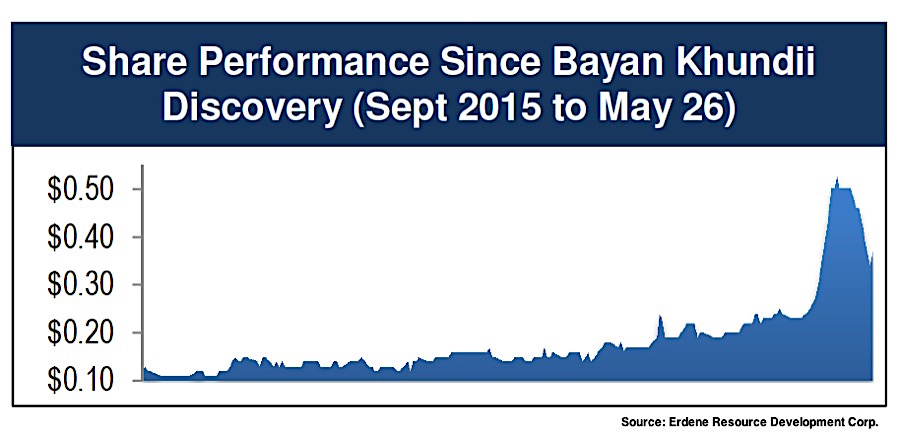
Canada’s Erdene Resource (TSX:ERD), one of the very few miners to never have encountered issues in Mongolia, has seen its shares soar in the last few months after the company hit the jackpot with a new multi-ounce gold discovery in the country’s southwest.
Erdene’s new darling, the Bayan Khundii project, went from greenfield prospect to the company’s flagship asset in roughly nine months.
One of the most remarkable characteristic of this new discovery, said Erdene’s vice president and CFO Ken MacDonald in a recent presentation at a mining convention in Nova Scotia, is that at Bayan Khundii gold can be observed at surface, and not only in one or two spots, but at several holes and trenches.
“We knew we had something important in our hands when we noticed local gold prospectors coming daily to the area, with just a few tools to scratch the rocks and land,” he said.
Located within the mineral-rich Tian Shan Gold Belt, 160 km from the border with China, the project’s first drilling results show that Erdene’s executives intuition wasn’t wrong.
Canada’s Erdene Resources sees bright future after striking gold in Mongolia
The Halifax, Nova Scotia-based miner announced fresh results Tuesday for a 3,845-metre drill program that began in April to follow up on initial figures and test more prospect areas over a 1.7 km trend.
This, the third batch of results, proves the presence of high grade gold in multiple holes and trenches, ranging from 11.2 to 30.3 g/t gold, Erdene says.
Those numbers, together with a clearer socio-political landscape in the country, courtesy of Rio Tinto’s (LON: RIO) successful investment negotiations at its Oyu Tolgoi copper-gold mine, have helped Erdene attract the interest of other industry key players, such as Sandstorm Gold (TSX:SSL).
Erdene recently completed a $2.5 million financing and royalty sale with the Vancouver-based bullion miner. And earlier this month, the firm secured a $500,000 private placement from copper exploration partner Teck Resources (TSX:TCK.A) (NYSE:TCK), Canada’a largest diversified miner.
Investment picking up
Canada’s Erdene Resources sees bright future after striking gold in Mongolia
Erdene Resource’s vice president and CFO, Ken MacDonald, is optimistic about Mongolia's stance towards foreign mining investment over the coming years.
MacDonald believes the recent rout in commodities prices made Mongolia realize how reliant it is on its natural resources and the importance of keeping foreign investors happy.
In his presentation, he highlighted several key changes in recent months that hint to a government’s new attitude, including a reduction in gold royalties and the granting of key permits to Centerra Gold (TSX:CG) for its Gatsuurt project.
Earlier this year, the Asian country also launched a new program aimed to attract a fresh wave of mining exploration.
Investors’ confidence is building up as a result. At the end of 2015, the National Bank of Canada bought 10.5% stake in one of Mongolia’s top banks. Shortly after, a series of Canadian government-funded mining projects were approved. Then, in May, Robert Friedland’s group merged with Kincora Copper (CVE:KCC) in an effort to consolidate the southern Gobi copper belt.
Landlocked Mongolia, once known as “Minegolia” due to the interest generated by its vast unexploited reserves of copper, coal and other minerals, would benefit from the renewed interest from foreigners.
According to the World Bank, the country’s population risks being dragged back below the poverty line as the economy sinks. Mongolia’s unemployment rate jumped to 8.3% in the final quarter of 2015, from 6.3% a quarter earlier.
In January, the World Bank cut the country’s growth forecast this year to just 0.8%. Two years ago, it forecast growth of 7.7% for 2016.

Source:http://www.mining.com/
Share:

Defending Mongolia’s Growing National Park System

A visit with Tumursukh Jal, director of one of the largest protected areas in northern Asia


BY GARY COOK – JUNE 15, 2016

A few months ago, when Mongolian national park director Tumursukh Jal was on an official visit to the Grand Canyon, one of his hosts asked a simple question: “How many national parks do you guys have there in your home country?” When Tumursukh mentioned there were 99 of them, his US colleagues seemed a bit nonplussed. “That many, really?”
Sensitive to his audience’s surprise, Tumursukh* went on to say: “Well, it seems to me that, when you Americans think of national parks, you normally conjure up a picture of one of your own amazing areas, like Yellowstone or Yosemite, or the Grand Canyon here. But you know, my friends, the rest of the world is catching up with you. Before long, we’ll have just as many national parks in Mongolia as you do here.”
Although it might take a few decades for Mongolia to surpass the United States in the sheer number of its national parks, in one way it already has outstripped America. The Mongolian parks now cover nearly seventy million acres, or almost one fifth of the entire country. By comparison, all the American national parks and monuments put together protect only 14 percent of US lands. And unlike America, where the pace of change is slower, there are new parks being created virtually every year in Mongolia. (Read more about the need for new national parks in the United States in the Journal feature “Room for More.”)
photo of Darhad Valley, MongoliaPhoto by Kerik Kouklis, courtesy of the Mongol Ecology CenterThe Darhad Valley, located in the Ulaan Taiga parks that Tumursukh manages.
The issue that worries Tumursukh is not that Mongolia lacks enough national parks. Instead, there is almost too much territory to protect – and certainly not enough park rangers and other resources to do the job correctly. This seems to be a problem facing many of the former Soviet bloc countries. Over the last 25 years, countries like Mongolia and Russia have been creating new parks at near-record rates. But now they need to catch up, and recruit qualified rangers and train them for the rigorous work of managing these parks. And to do this, they often need to reach out for advice and support from their western counterparts.
In fact, this was one of the objectives of Tumursukh’s recent visit to America’s parks. At each official meeting, he was quick to point out that the three parks that are under his command cover over 3 million acres – or an area that is around four times larger than California’s Yosemite National Park. But whereas the permanent staff at Yosemite hovers around 800 full-time employees, the three parks that Tumursukh manages only have 30 staff members total. So it’s easy to understand the challenges that the Mongolian park rangers face every day as they try to patrol such massive landscapes with such small numbers of staff.
Tumursukh is also quick to point out that they are not just randomly creating new national parks in Mongolia. Each of the new protected areas contains either a unique landscape (like the Gobi Desert), or was formed to preserve one of the country’s several engendered species and their habitats. The Ulaan Taiga Parks that Tumursukh manages lie on the edge of several mountain ranges, which are the last strongholds of the famed Snow Leopard, as well as the Argali Mountain Sheep and the Ibex. The Argali sheep (Ovis ammon) are a sight to behold; their horns weigh an average of 50 pounds, making them the largest of all the big-horned sheep. Also listed on the IUCN Red List, the Ibex (Capra sibirica) is no less impressive. Adult male goats will often have horns more than four feet long.
The streams in Tumursukh’s parks are also home to the largest (and most threatened) trout species in the world. And there is another, more familiar animal that takes shelter in these parks: the northern Reindeer. With only a few left in the wild here, many more have been domesticated by local nomadic families. When Tumursukh was in Yosemite, he showed a somewhat humorous video of himself riding one of these reindeer to patrol his park. He says he prefers this mode of transport to noisome snowmobiles, which the Ministry of Nature, Environment and Tourism has offered to purchase for the park. (You can view this video on the website of Mongolia’s leading environmental NGO, the Mongol Ecology Center, a group that Earth Island helped spawn some half-dozen years ago.)
During his trip to the US, Tumursukh left the distinct impression with American park directors and rangers that he is very confident in his work. This positive outlook, however, belies a recent tragedy in Tumursukh’s life, one that is not uncommon in those countries in the world like Mongolia that are trying to fight against industrial development.
This tragedy struck at the heart of what Tumursukh and his colleagues are trying to do in the steppe-lands of northern Asia. It started in the spring of 2014, when Tumursukh’s activist son, Sumbe Jal, was stabbed by assailants allegedly affiliated with the gold mines that Sumbe was battling near Mongolia’s border with China. These assailants were never apprehended.
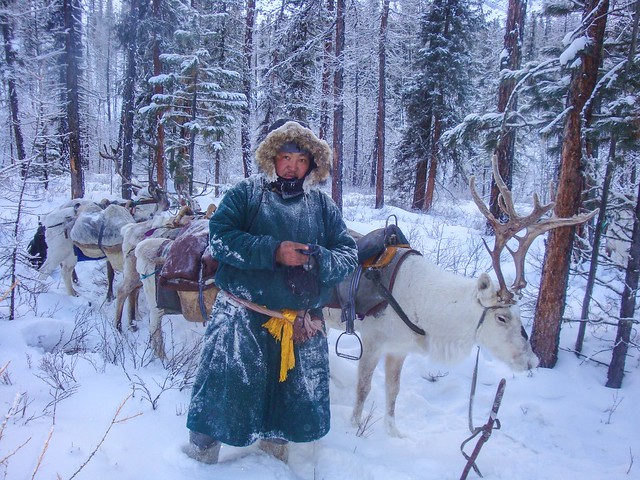
photo of Darhad Valley, MongoliaPhoto by Unudelgerekh Batkhuu, Mongol Ecology CenterTumursukh, who manages three parks covering more than 3 million acres in Mongolia, following a park patrol.
Unfazed by this first attack, Sumbe continued in his quest to create a new national park in the gold-rich Tost Mountain area, one of the last Snow Leopard habitats in the world. Once again, however, several masked men confronted and stabbed Sumbe, yet were unsuccessful in their attempt to extinguish Sumbe’s life and spirit.
In an effort to recover from these attacks, Sumbe retreated to his father’s homeland near the Ulaan Taiga Park in northern Mongolia. This time he was tracked down by his pro-development enemies; and in November of last year, Sumbe’s body was found on the main road that leads back to his favorite Gobi Desert region.
Even though Tumursukh and his family were numb with grief following this loss, Tumursukh did not cancel his spring trip to America. Nor did he stray from his determination to continue in his son’s footsteps and protect his native lands from development.
At the time of Tumursukh’s visit to America in March, the Mongolian government was debating the creation of a Tost Mountain National Park. This new park would effectively nullify all the mining permits that had previously been issued in the region, and bring to fruition Sumbe’s dream. However, the fate of this new national park is still uncertain – there are many in the government who likely fear standing up to mining interests in Mongolia. This same fear probably influenced the decision of local police to rule Sumbe’s death as a suicide, a rather dubious ruling given the previous violence against him.
Many of Tumursukh’s friends and colleagues believe that justice might never be served in the case of his murder. But perhaps, if the Tost Mountains do become the latest in a series of new national parks in Mongolia, some form of vindication of Sumbe’s life and efforts will come to pass.
We should note that the lands that Sumbe sought to protect from development – as well as the ones that his father is currently struggling to protect further north as a park manager – are all essential parts of a much bigger eco-system. This system spreads from the headwaters of Tumursukh’s mountain parks all the way down into the Lake Baikal watershed of Russia, and further onward to the Arctic Ocean, comprising one of the world’s largest watersheds. And at many points along its waterways, the surrounding lands are still relatively pristine and abundant with wildlife.
The question now is whether the likes of Tumursukh and Sumbe will prevail in keeping the upper reaches of this watershed relatively unspoiled by human development. The question also is what the rest of the world can do to support these brave men.
*Note: In Mongolia, it is customary to address people by their first names only.
Gary Cook
Gary has been director of Earth Island's programs in eastern Russia and  Mongolia for the last quarter century. Throughout this time he has worked to nurture the environmental movement in northern Asia, offering particular support to the many activists who are fighting to protect the Lake Baikal watershed.
Source:http://www.earthisland.org/

Share:

Mongolia kicks off parliamentary election campaign amid sinking commodity prices

ULAN BATOR, June 11 (Xinhua) -- Mongolia Saturday kicked off campaigns for parliamentary and local council elections due on June 29, which would shape the country's political life in the coming four years.
The quadrennial event caught public attention as the resource-rich country is faced with sinking commodity prices and weaker demand in the global market.
According to the General Election Commission of Mongolia, 498 candidates, coming from 12 parties, three coalitions or as independents, will run for 76 seats of the State Great Khural, as well as posts in local law-making councils.
However, analysts said that the main race for parliamentary seats will be done between the two largest parties of the country, namely the ruling Democratic Party of Mongolia and the oppositional Mongolian People's Party (MPP).
To nudge for more supports, both parties have nominated well-known singers, athletes and actors to run on their behalf. For instance, the ruling party has put up popular singer Erdenetungalag Gavaasuren and judo athlete Tuvshinbayar Naidan, who won a gold medal in the 2008 Olympic Games, to run respectively in the northern province of Selenge and Southwestern province of Bayankhongor.
The opposition MPP also nominated former wrestler Sukhbat Agvaansamdan to run for a seat in the central province of Tov.
Despite all the publicity, however, analysts predicted that economy-related issues, such as poverty, slowdown and unemployment will remain at the forefront of the campaign, as the economy of the 3-million-population country was predicted to shrink slightly this year amid sinking commodity prices and sluggish demands.
Currently, the prices of coal and copper, two main commodities for export of the land-locked nation, fell sharply in the global futures market. Mongolia was also reported to run low on hard currency to pay for imports.
The ruling Democratic Party of Mongolia advocated that the party has improved the livelihood for ordinary Mongolians in the past four years and take many key measures to boost the national economy, including the approval of the development of copper and gold mine OyuTolgoi in partnership with Rio Tinto.
However, the oppositional MPP held the government accountable for the nation's snow-balling foreign debt of 23 billion U.S. dollars accumulated these years, as the country's tight finance has confined its ability to pay the debt back.
The MPP also blamed the Democratic Party for stalling the large coking coal mine project of TavanTolgoi, which was expected to attract the much needed investments from Chinese coal miners.
"Politicians of previous generations ... failed the country by making populist promises. It is time to change this whole system," said Munkhsoyol Baatarjav, a female independent candidate.
Mongolian political life is shaped by this four year election cycle. The party or coalition that gets most of the seats in parliament in the election forms the government and appoints prime minister.

Source:Xinhua News Agency
Share:

Mongolia, Hit Hard by the Commodities Slump, Wearily Faces Elections

When a country’s economy is doing poorly and voters are suffering, a government can expect to be voted out of office on election day. So Mongolia’s upcoming parliamentary elections June 29 could see a staggering defeat for the ruling Democratic Party (DP), which has led successive governments over the past four years. This is not lost on DP officials. Yet rather than offer a compelling vision for Mongolia’s future, their campaign strategy has focused on reconfiguring the entire election system, creating more problems in the process.

Two factors have combined to depress the Mongolian economy: world commodity prices and domestic political choices. No mining economy has been spared the impact of the global slump in commodity prices that is linked to a slowing down of the Chinese economy. Given Mongolia’s dependency on China’s purchases, this downturn has been particularly acute

Worse, over the past several years, it was primarily new coal deposits that were set to be exploited, just as coal declined in significance on the back of measures to deal with climate change. Mongolia, like every other resource economy, might have prepared more diligently for this downturn. Yet decisions by the Mongolian government, both under the leadership of the DP and under its predecessors, have significantly worsened the economic impact.

Before the 2012 election that brought the DP to power, a series of decisions were made by the then-governing Mongolian People’s Party (MPP) to regulate foreign investment. That gave Mongolia the reputation of being inhospitable to foreign investors, which drove away most foreign direct investment. Add to this the decision to take on significant foreign debt with the issuance of so-called Chinggis Bonds in late 2012 under the then-newly elected DP-led coalition government, and the Mongolian government has left itself very little monetary or fiscal wriggle room to deal with its current economic woes.

These two factors have combined to cause a downturn in GDP growth from 12.4 percent in 2012—the last parliamentary election—to forecasts of 7.9 percent in 2014, 2.3 percent in 2015, and just 0.8 percent this year. The relatively high rates of inflation over this period have combined with the decline of Mongolia’s currency, the tugrik, to lead to job losses, unemployment and poverty. This trend is a reversal from the years leading up to 2012, when GDP growth, driven largely by the commodities boom, was strong enough to vault Mongolia into the rank of upper middle-income countries.

Until there is a significant upturn in world commodity prices, the current economic woes are likely to continue through the presidential election in June 2017, when President Elbegdorj Tsakhia’s second and final term is up. Given that Mongolians continue to identify the bad state of the economy and their concerns about unemployment as the most pressing policy issues in polling, it is difficult to imagine an election, whether this month’s parliamentary polls or next year’s presidential race, where the economic performance of DP-led governments will not be front and center.

It is not only the economic performance of the past four years that suggests that voters might take the DP to task. The past four years have also seen some significant turmoil in the DP’s governing coalition and among members of the Cabinet. In this, the DP government has mimicked the Democratic Union governments in power from 1996 to 2000. 

The Democratic Union had been formed out of various constituent elements of the democracy movement that brought about the Mongolian Revolution of 1990. In 2000, these elements united in the Democratic Party, but they have maintained their identity as factions within that party. It has been difficult to understand these factional rivalries at times, especially because some internecine battles have been clearly to the detriment of the DP and the Mongolian government. Prime Minister Altankhuyag Norov’s government fell in 2014, for instance, largely because of factional struggles within the party. 

Until there is a significant upturn in world commodity prices, the current economic woes are likely to continue through the presidential election in June 2017.

DP stalwarts of the democratic revolution like Elbegdorj, but also Ulaanbaatar’s mayor, Erdeniin Bat-Uul, continue to dominate the party, along with other factional heads such as the speaker of parliament, Zandaakhuu Enkhbold. Much of this DP old guard is set to run again in this month’s election, fueling some frustration among Mongolian voters who feel that there are few attractive choices and alternatives.

Meanwhile, although an amended electoral law that handicaps smaller parties has grabbed headlines, debates about the election system are nothing new in Mongolia. The last three parliamentary elections—in 2004, 2008 and 2012—have all been run in different ways. This month’s election looks set to return to the 2004 system of 76 directly elected, first-past-the-post constituencies, after a high court ruled that proportional representation, which was partially introduced in 2012, was unconstitutional.

It does not take much imagination to recognize that majoritarian elections favor large parties and incumbents. Therefore, this electoral shift seems like an attempt by the DP—and perhaps to a lesser extent the MPP, which looks set to move out of the opposition and back into government—to maintain its share of power in Mongolia’s parliament, known as the State Great Khural. 

Other measures have reinforced this impression. The official campaign period ahead of election day on June 29 has ostensibly been shortened to 18 days, starting June 11, in order to reduce the amount of spending by candidates and theoretically make it easier for smaller candidates to enter the election. It is not clear that that will be the effect, however. A shorter campaign period would seem to represent a clear benefit to better-known incumbents, especially when coupled with majoritarian voting. This is especially the case since candidates are not allowed to appear publicly in their constituencies prior to the beginning of the campaign, though incumbents are much less restricted in this regard.

It is also no surprise that the DP-appointed General Election Commission is addressing administrative shortcomings in party and candidate registration by ruling such candidacies out. This seems to have removed the upstart XUN Party from the ballot already, and is likely to exclude former president—and convicted money launderer—Nambaryn Enkhbayar, as well.

Where does this leave the actual content of parties’ campaign platforms? In truth, the substance of political discourse ahead of the election seems to be outweighed by manipulations of the political process. So far, no political parties have announced any major policy initiatives that would see departures from the current government. Since candidates are legally bound to their party’s platform in campaigning, it is unlikely that the campaign will hold any major surprises.

Mongolians have grown critical of their political institutions while remaining committed to democracy in the abstract. As the country prepares for this election campaign, there is little on the horizon likely to inspire voters in their political institutions—and much to be cynical about. Some of that cynicism may express itself in lower-than-expected voter turnout; it even seems possible that some constituencies will not see the minimum 50 percent voting rates stipulated in the election law.

While the new government is likely to be led by the MPP, the lack of policy differences between the large party platforms suggests that the biggest question is not whether policies, economic or otherwise, will shift. Instead, it is whether the MPP will forego an opportunity for yet another wholesale replacement of public servants, and whether anti-corruption efforts will continue to be politicized. Those factors will likely have a significant impact on Mongolians’ confidence in democracy, shaping the country for years to come.

Julian Dierkes is associate professor and Keidanren Chair in Japanese Research at the University of British Columbia.

Source:http://www.worldpoliticsreview.com/
Share:

Facebook page

Powered by Blogger.

Categories

Advertising in Mongolia An Asian Development Bank Culture Editorial of the Mongolianviews education Environmental protection Famous Mongolians Foreigners in Mongolia Inner Mongolia Ivanhoe Mines Mongolia Adventure Mongolia agriculture Mongolia air pollution Mongolia analysis Mongolia and Armenia Mongolia and Asian Development Bank Mongolia and Australia Mongolia and Azerbaijan Mongolia and Belorussia Mongolia and Bulgaria Mongolia and Cambodia Mongolia and Canada Mongolia and central Asia Mongolia and China Mongolia and Cuba Mongolia and Czech Mongolia and donors Mongolia and EU Mongolia and Germany Mongolia and Hongkong Mongolia and Hungary Mongolia and IFC Mongolia and IMF Mongolia and Ind Mongolia and India Mongolia and Indonesia Mongolia and Inner Mongolia Mongolia and Iran Mongolia and Israel Mongolia and Italy Mongolia and Japan Mongolia and Kazakhstan Mongolia and Korea Mongolia and Kuwait Mongolia and Kyrgyzstan Mongolia and Malaysia Mongolia and Nato Mongolia and North Korean Mongolia and Poland Mongolia and Qatar Mongolia and Russia Mongolia and Russia and Mongolia and China Mongolia and Singapore Mongolia and South Korea Mongolia and Taiwan Mongolia and Thailand Mongolia and the world Mongolia and Tibet Mongolia and Turkey Mongolia and UK Mongolia and Ukraine Mongolia and UN Mongolia and US Mongolia and USA Mongolia and Vietnam Mongolia Banking Mongolia blind Mongolia Cashmere Mongolia Christianity Mongolia civic society Mongolia Corruption Mongolia crime Mongolia diplomacy Mongolia Economy Mongolia Education Mongolia Energy Mongolia environment Mongolia Finance Mongolia Health Mongolia History Mongolia holiday Mongolia in international media Mongolia Industries Mongolia investment Mongolia Joke Mongolia law Mongolia LGBT Mongolia medical Mongolia military Mongolia Mining Mongolia Mining Developments Mongolia Mortgage Mongolia natural disaster Mongolia news media Mongolia Nuclear Mongolia Petroleum Mongolia Politics Mongolia Poverty Mongolia public announcements Mongolia railways Mongolia Religion Mongolia slums Mongolia society Mongolia Sports Mongolia Stamp Mongolia Sumo Mongolia telecommunication Mongolia tourism Mongolia trade Mongolia Transportation Mongolia Urbanization Mongolia Wild Life Mongolian Agriculture Mongolian and Cuba Mongolian Archeology Mongolian Climate Mongolian Food Mongolian Gay Mongolian Government news Mongolian History Mongolian Kazakh Mongolian Meat Mongolian Military Mongolian Mining Development Mongolian Movie Mongolian News Mongolian Parliament Mongolian Political news Mongolian Press Mongolian Songs Mongolian Sumo Mongolian Women Mongolian Youth Mongolians abroad Moninfo Opinion Oyu Tolgoi Investment Agreement Photo news Press Release Rio Tinto Tavan Tolgoi coal mine Ulaanbaatar development Weird expatriates in Mongolia World bank and Mongolia

Blog Archive

Followers