Showing posts with label Mongolia Sports. Show all posts

Mongolian wrestling champion fails anti-doping test

ULAN BATOR, Aug. 27 (Xinhua) -- Mongolian wrestler Enkhtugs Oyunbold, who ascended to the highest rank of Titan in the country's traditional wrestling tournament at this year's Naadam festival, has failed an anti-doping test, the Mongolian government announced Tuesday.
"After the wrestling tournament at the Naadam festival in July, the National Anti-Doping Center of Mongolia gave doping tests to the top 16 wrestlers in the tournament, of whom two were found to have violated Mongolia's anti-doping regulations," read a government press release, quoting tournament organizers.
The statement added that Oyunbold's urine sample tested positive for four prohibited substances, namely meldonium, stanozolol, chloroazide and hydrochlorothiazide.
The 26-year-old missed the deadline for the B sample, according to the sub-committee on wrestling tournament. It is unclear what sanction he will now face.
The organizing sub-committee declined to reveal the identity of the other athlete who failed the test as it is waiting for the result of his B sample.
The Naadam Festival, which is on UNESCO's list of intangible cultural heritages, is an official holiday celebrated every year from July 11 to 15 across Mongolia.
The festival includes the country's three traditional sports of horse racing, archery and wrestling. A total of 512 wrestlers competed in this year's wrestling tournament.
Share:

Soccer-Mongolia advance to second phase of World Cup qualifying

Mongolia booked their place in the second round of Asia's qualifying tournament for the 2022 World Cup finals on Tuesday, with a second-half penalty from Norjmoogiin Tsedenbal sealing their progress despite a 2-1 loss against Brunei.
Tsedenbal's spot-kick two minutes into the second half meant Mongolia held on to claim a 3-2 aggregate win over Brunei, who had initially cancelled out the visitors' first-leg advantage thanks to a first-half brace from Razimie Ramlli.
The Mongolians are joined in the draw for the next phase of qualifying by Bangladesh, Guam, Malaysia and Cambodia after they came through their respective second-leg encounters on Tuesday.


Share:

Surfing: Dude, where's my sea? Landlocked Mongolia catches the wave

(Reuters) - Landlocked Mongolia has become the latest country to join the International Surfing Association, taking the world body's total membership to 106 nations on five continents.
Surfing, which traditionally needs only a beach and some waves, can now be enjoyed inland and even indoors thanks to wave machines and is due to make its Olympic debut in Tokyo next year.
The sport is also on the program for the 2020 Asian Beach Games, in Sanya, China.
"The growth of surfing in non-traditional surfing nations is testimony to how surfing's Olympic inclusion has expanded the sport to new corners of the globe," said ISA president Fernando Aguerre in a statement.
"Surfers that thought the Games were far out of reach, now have a tangible dream that they can pursue."
The ISA said the Mongolian federation, recognized by the country's National Olympic Committee, could now organize indoor surfing competitions using wave pool technology and set up a network of surfing clubs.
It will also develop disciplines that can be practiced on flat water, such as StandUp Paddle.
Mongolia Surfing Federation (MSF) President Tamir Amarbayasgalan said in the ISA statement that membership was "a crucial step toward promoting and popularizing the sport of Surfing in Mongolia.
"This creates an opportunity for us to field a national team to compete at the ISA's international competitions. The MSF has created a platform that will allow surfers to get information and become a part of the worldwide surfing community."
Oman, which held its first surf contest in August last year, also joined the ISA as a member.
(Reporting by Alan Baldwin, editing by Christian Radnedge)
Share:

MONGOLIAN CHAMPIONSHIPS KICK-OFF THE SEASON

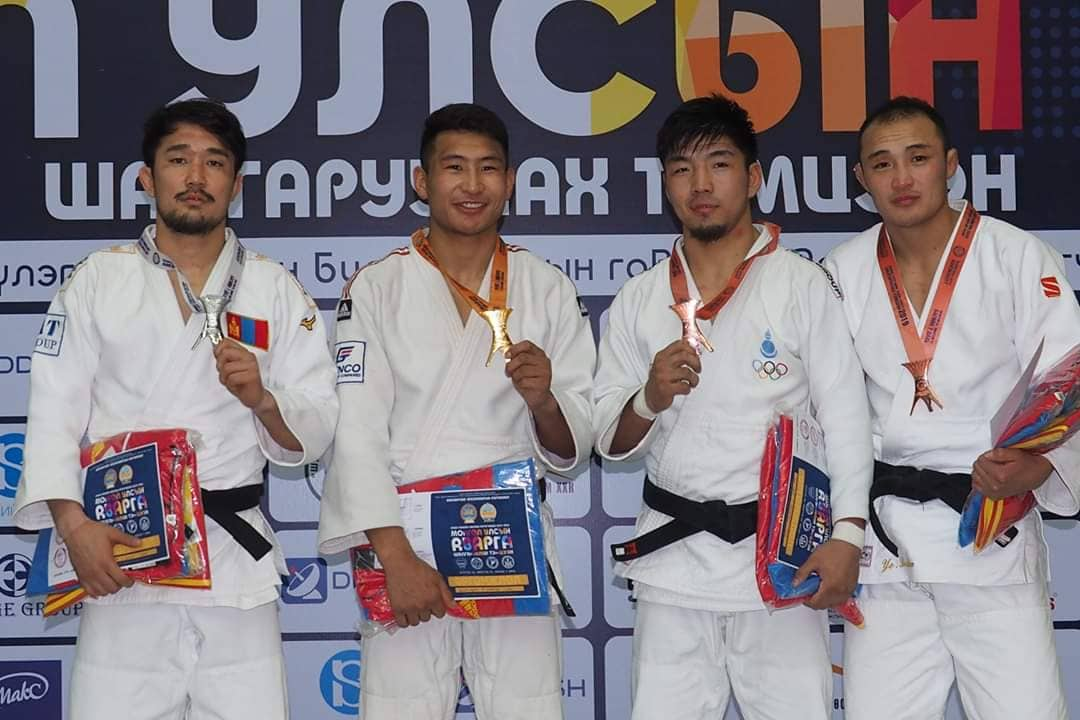
The first national championships are a fact. In one of the most promising judo countries of the world, in Mongolia the championships are held this week. Tsogtbaatar Tsend-Ochir and Gankhaich Bold prolonged their titles at the first day where the light- and middle weights fought. In Ulaanbaatar some of the categories where amazingly strong.

20190107_mongolian_champs_m66
Especially in today’s U66kg category for men with Munkhbayar Nergui eventually won the gold medal. In the second round Tumurkhuleg Davaadorj defeated Altansukh Dovdon. In the quarter final Davaadorj lost to Kherlen Ganbold in a heroic nine minutes fight where Davaadorj lost on penalties. Munkhbayar Nergui overcame Kherlen Ganbold in the final U66kg.
U73kg Tsogtbaatar Tsend-Ochir defeated the other favourite in this category Odbayar Ganbaatar and the youngster caught Batbold Bulgan in the final and prolonged his title.
Without the stars U60kg it was Ariunbold Enkhtaivan who claimed the gold medal in the men’s lightweights. Dashdavaa Amartuvshin surprisingly lost in the first round.
In the women’s division Narantsetseg Ganbaatar grabbed the gold. Urantsetseg Munkhbat didn’t compete at all and the gold U52kg weight class went to Sosorbaram Lkhagvasuren who became the youngest champion with just 17 years. A gap with the second youngest Enkhriilen Lkhagvatogoo who won the gold U57kg where Sumiya Dorjsuren didn't compete. Lkhagvatogoo defeated Khorloo Battamir in the final U57kg. The only woman who retained her title of last year was Gankhaich Bold U63kg, she bested Mungunchimeg Baldorj in the final.

Source:Judoinside.com
Share:

MONGOLIA’S GRAND PRIX MAESTRO URANTSETSEG MUNKHBAT WINS SIXTH GOLD

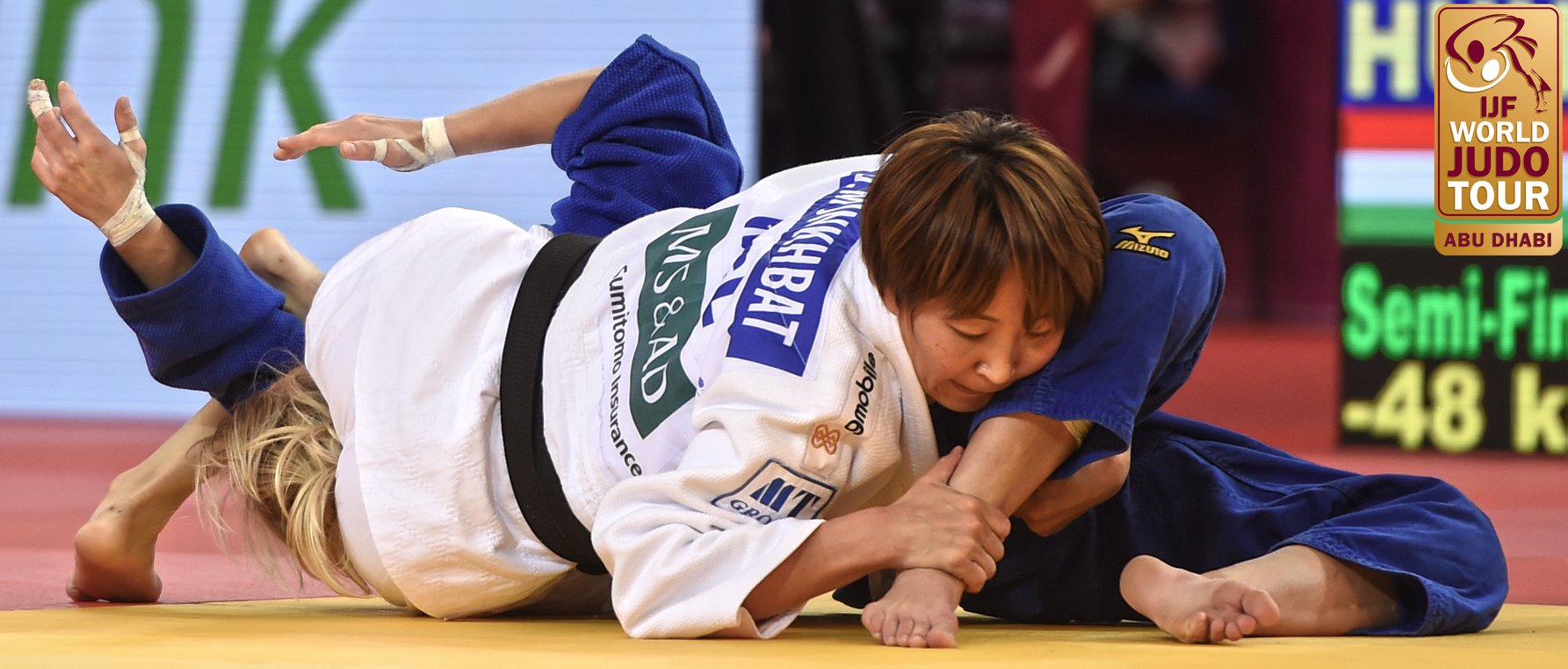
World number three Munkhbat Urantsetseg of Mongolia was back amongst the medals in Abu Dhabi after finishing fifth at the World Championships in September. The former world champion won her first gold medal in 12 months by pinning down Budapest Grand Prix bronze medallist Distria Krasniqi (KOS) for 20 seconds after initiating a sankaku turnover and was unrelenting in her committed finish to win the first final in the U.A.E.
In the first semi-final Munkhbat submitted London 2012 Olympic bronze medallist Csernoviczki Eva (HUN) from a sankaku-gatame hold for ippon. In the second semi-final Olympic champion Paula Pareto (ARG) was disqualified againat Krasniqi after picking up a third shido for a false attack in the closing seconds.

20181027_ijf_fb_abudhabi_action_urantsetseg_munkhbat
The first bronze medal contest was won by Cancun Grand Prix winner Pareto who beat Cancun Grand Prix bronze medallist Milica Nikolic (SRB) by a waza-ari in golden score. Pareto was the first medallist at the Abu Dhabi Grand Slam 2018 as her contest opened the final block and yielded a seventh Grand Slam career medal.  
The second bronze medal was won by former Qingdao Grand Prix winner Li Yanan (CHN) who thwarted Csernoviczki by a waza-ari after 12 seconds of added time. Li grew stronger as the contest went on and claimed victory in golden score in front of China Judo Assocation President and new IJF Hall of Fame member Xian Dongmei.

Source:Judoinside.com


Share:

Mongolia to host int’l ultra-marathon

ULAN BATOR, June 25 (Xinhua) -- The Gobi March ultra-marathon, one of the 4 races in the Deserts Race Series, will be held from July 29 to August 4 for the first time in Mongolia, the organizer said on Monday.
According to B. Barsbold, director of Discover Mongolia Travel LLC, a total of 230 ultra-marathoners from more than 40 countries will participate in the race.
"Organizing the event is a great opportunity for promoting the country through tourism," he said.
Established in 2002, the 4 Deserts Race Series is an annual series of four 250-kilometer races across deserts around the globe, including the Gobi March in China, the Sahara Race in Namibia, the Atacama Crossing in Chile and The Last Desert in Antarctica.
The Gobi March's challenges include changes in temperature from the hot highlands to the oppressive cold in sand dunes, the open sun, potential sandstorms and variety of terrain - soft sand-dunes, rocky tracks, steep hills, ridges and riverbeds.
The international ultra-marathon has been consistently been named by Time Magazine as one of the Top 10 endurance events in the world.
Share:

Mongolia beats Brazil to reach FIBA 3x3 World Cup quarterfinals

MANILA, June 11 (Xinhua) -- Mongolia qualified for the quarterfinals of the FIBA 3x3 World Cup 2018 after beating Brazil 19-16 in Pool C on Monday at the Philippine Arena in Bulacan.
Previously, the Mongolian team beat host the Philippines and Russia. The team next faces Serbia, the No. 1 team in the world.
This is the first time that the Mongolian national team has participated in the competition. The team won the Asian University 3x3 Basketball Championships, which were held in Malaysia in April. 
Share:

Fighting pride – Mongolia in the Olympics

Chris Kempson puts into perspective Mongolia’s achievements in international boxing

THE sovereign state of Mongolia, historically Outer Mongolia, is bordered by the might of both China and Russia but surprisingly, it is holding its own in the Olympic and World championship boxing rings – especially for a country of a little over 3 million people. In fact it is the most sparsely populated sovereign state in the world; its peoples’ largely of nomadic origin. The country’s old Communist party ruled for many years, but in the early 1990s the democratisation movement came to the fore and remains the major political force in the country today. Mongolians are tough, resilient and very proud people and their disciplined and varied life-style have helped them succeed, mainly in recent times on the international amateur boxing stage. More of this however a little later on.
Amateur boxing emerged there in 1948 and in 1960 the Mongolian Olympic boxing team was formed. Mongolia first entered the summer Olympics in 1964 and has been an ever present since, apart from 1984, when it joined the old Soviet led boycott of the Games. Their first foray into the Olympic ring came in 1972 in Munich.
Seven Olympic boxing medals have been acquired – one gold, two silver and four bronze; while ten medals have been bagged at the AIBA Men’s World championships – one gold, four silver and five bronze. Quite an impressive haul for a very small country (population wise, and one which is spread over a huge land mass).
Turning first to the Olympics, their initial two entrants in 1972 didn’t last long. Light-flyweight, Vandui Batbayar lost in his opening bout; while light-middleweight, Namlhal Tsendaiush had first a bye then lost in his first actual bout. Results took some time to improve, but they eventually did just that.
Their initial medal came in the Olympic boxing ring in 1988, although they had first entered the summer Games at large in 1964, when the then Soviet style Communist type of regime prevailed in Mongolia. However, a medal in the men’s World championships had come six years earlier in 1982 and we will return to that in due course.
In 1988 a bronze went to lightweight Nerguin Enkhbat and four years later in 1992 another bronze was won by the fists of another lightweight Namjilyn Bayarsaikhan. Some fallow years then followed until 2008 when Mongolia’s initial (and so far only) gold medal was secured by bantamweight, Enkhbatyn Badar-Uugan who outpointed Cuba’s Yankiel Leon in the final. On his way to gold, the Mongolian had also outscored Ireland’s John Joe Nevin. The Mongolian also added the coveted Val Barker trophy to his gold medal triumph. Also at these Games, a silver went to light-flyweight Purevdorjiin Serdamba who sustained an early shoulder injury in his final against China’s outstanding Zou Shiming who thus secured a technical victory.
In London in 2012 another silver went to flyweight Nyambayaryn  Togstogt who lost out on points to the Cuban Robeisy Ramirez in a close and tough final, while light-welterweight Uranchimegin Monkh-Erdene weighed in with a bronze having narrowly eclipsed on points Team GB’s Thomas Stalker along the way.
In Rio in 2016, lightweight, Dorjnyambuugiin Otgondalaai [pictured] picked up a bronze losing out to eventual French silver medallist, Sofian Oumiha.
So Mongolia have been building up a useful Olympic medal pedigree of late, especially with a very small population on the global stage, and they aim to continue this trend in Tokyo in 2020.
Turning out attention now to the AIBA World amateur championships, Mongolia has a good story to tell here as well as we shall see:
1982 saw featherweight, Rawsalyn Otgonbayar claim a silver medal losing in the final to the legendary Cuban maestro, Adolfo Horta. Fast forward to 1993 when light-flyweight Erdenetsogtyn Tsogtjargal won a bronze medal, while four years later in 1997, silver was struck once more when lightweight, Tumentsetseg Uitumen lost on points to the Russian gold medallist, Alexander Maletin.
2007 saw another silver medal go to Mongolia, this time bantamweight, Enkhbatyn Badar-Ugan lost a narrow points decision in the final against Russia’s Sergey Vodopyanov. The Mongolian having beaten England’s Joe Murray in their semi-final bout.
But two years later in 2009, Mongolia received a full set of medals from these championships. Gold went to light-flyweight Purevdorj Serdamba who bested Russian David Aayrapetyan in their final encounter. Silver was won by flyweight Tugstsogt Nyambayar who lost in his final to the classy Puerto Rican McWilliams Arroyo. Bronze was captured by Uranchimegin Monkh-Erdene who lost to the eventual gold medallist from Cuba Roniel Iglesias.
In 2011 light-flyweight, Purevdorjiin Serdamba  failed to retain his world crown, but he did win bronze medal losing to the eventual silver medallist from South Korea, Shin Jong–Hun. In 2013, Uranchimegin Monkh- Erdene gained another bronze medal losing to the eventual silver medallist from Cuba, Yasniel Toledo
Last year in 2017, saw a clash of old Olympic lightweight foes: Frenchman, Sofian Oumiha and Mongolia’s Dornyambuugiin Otgondalai with the Frenchman eventually taking gold, having defeated his Mongolian counterpart in their semi-final clash.
Mongolian men have also boxed with distinction in the Asian Confederation Championships  and World Military Games, AIBA World Junior and  Youth Championships as well as at regular international tournaments at home and abroad. Their women have had success in the past at Asian Confederation Championships, especially in the women’s case in 2012, when their first two gold medals were clinched. Success has also been chalked up at AIBA Women’s World Junior and Youth World Championships. Mongolian women boxers did not feature in the London and Rio Olympic Games; but have been entered in the AIBA World Women’s Championships , without medal success so far. All in all, a fine catalogue of continuing success for such a distant nation and one it can be immensely proud of.
So this is the Mongolian medal story in the Olympics and the Worlds and also at home and abroad too, very commendable indeed so far and with every indication that there is much more to come from this remote land of fighting me and women.
Please do spare a thought for this writer with advance apologies if necessary in the light of such intriguing Mongolian names, hope I have not done too much of a disservice to their splendid fighting contestants.

Source:http://www.boxingnewsonline.net
Share:

Carrots fuelling an unlikely Mongolian medal charge

Carrots fuelling an unlikely Mongolian medal charge
©Lillehammer 2016
12/02/2016
Ochirsukh Adiyabaatar’s journey from Mongolian city life to the ski slopes of Lillehammer has been an unlikely one. He grew up in a country where basketball, martial arts, lifting events and horse riding reign supreme. His chosen discipline, cross-country skiing, barely registers on the national consciousness.
“All my friends at school only like basketball, and they are curious about what I’m doing on skis,” he said. “But my mum used to do it, so she encouraged me to give it a go. I’m glad she did. I love it, and it has given me the chance to travel the world.”
Training is not easy for the 17-year-old, who was given permission from his high school to come to Scandinavia. “There is no snow where I live, in Erdenet, which is Mongolia’s third-biggest city,” he said. “I have to travel 240km, up towards Ulaanbaatar, to find some snow.
“Otherwise I have to just train by running, which keeps me fit, but isn’t so useful when it comes to doing the event. I don’t have a ski training machine or anything like that. I’m a good runner though, and have won a bronze medal in a [national] competition in Mongolia.”
Adiyabaatar also found himself in for a bit of a shock when he hit the training slopes in Lillehammer. “In Mongolia where I train, the mountain is kind of flat; it’s not hilly like it is here in Norway. I found it very difficult to train on; I’ve never done anything like this before. On the first day, I fell over a lot because of it being extremely up and down. I lost balance, but I’m getting used to it now. It’s a course that will suit athletes with a lot of height and strength, and I’m not so tall. So I’m going to have to train hard this week otherwise it will be very tough for me to compete.
“In this region, skiing is really very competitive. It is very common. Norwegian people grow up skiing and use skis to get around everywhere. There are some great athletes here, but I’m going to enjoy myself.”
While he may not be troubling the podium in Lillehammer, Adiyabaatar recognises the importance of his role to both his sport and his country.
“I like to think I’m representing Mongolia in skiing here, showing that winter sports are something we can do. I’m also representing the sport in Mongolia, telling people that it’s a great activity that keeps you really fit. More and more people are getting interested in cross country back home, and there are a growing number of young athletes learning to ski.”
The Mongolian contingent in Lillehammer, who flew in via Moscow, consists of just two athletes, two coaches and their federation secretary. “It’s been great, I love the village and have made friends already,” Adiyabaatar said. “All my friends back home can’t believe it. They say ‘dude, you are seeing the world’, and ask me to take photos for them. Most of them have never been outside Mongolia.”
There’s just one problem left for the athlete who has overcome myriad difficulties of being involved in a minority winter sport while living in a city with no snow. “I have to eat a lot, but I try to avoid eating meat,” he said. “But Mongolians eat so much meat and so do Norwegians. I think it can be bad for you, so I stick to vegetables as training food. I particularly like carrots.”
YIS / IOC Nick Moore
Nick Moore is a reporter for the Lillehammer Youth Information Service ‘YIS’. A sports and music journalist with 20 years experience, he covered the London 2012 Summer Olympic Games and the Nanjing 2014 Summer Youth Olympic Games. Based in the UK, he has written for numerous titles including FourFourTwo, The Independent, Q and The Times.

Source:http://www.olympic.org/
Share:

Runner gets lost in freezing temperatures during charity marathon held in Mongolia

image: http://i2.dailyrecord.co.uk/incoming/article7356122.ece/ALTERNATES/s615/JS82165979.jpg
Maurice faced temperatures of -40 while running along Tuul Gol River.
A Bonhill runner has told how one wrong turn in a race at the other side of the world could have cost him his life.
Maurice Donohue recently travelled to Mongolia to take part in the Genghis Khan Ice Marathon for the first time.
It was supposed to be the adventure of a lifetime for the 53-year-old dad, but it turned into his worst nightmare after Maurice ended up stranded in freezing temperatures of -40 degrees in the wilds of Mongolia.
Maurice went off track halfway through the marathon and found himself lost on the frozen and heavily wolf populated Tuul Gol River.
With no one around for miles, the temperature dropping and daylight fading, Maurice really began to fear for his safety.
And he had to endure “the longest nine hours” of his life before his ordeal was over.
“It’s certainly an event I won’t forget and thankfully I lived to tell the tale,” Maurice told the Lennox Herald.
“Although I wasn’t hundreds of miles away from civilisation it was still a potentially life threatening situation.
“I knew I had to stay calm and think about what I was going to do.
“So I sat down to gather my thoughts but the light was starting to fade and the temperature was dropping.
“I even thought about digging a hole in the snow to keep myself warm in case I was going to be stuck out there.
“I knew I had two options - I could either stay where I was and hope someone appeared or I could retrace my steps.
image: http://i2.dailyrecord.co.uk/incoming/article7356121.ece/ALTERNATES/s615b/JS82165978.jpg
“I tried to find my way back to the river junction, but I got disorientated as everything looked different.
After almost two hours in the forest on his own, Maurice managed to flag down a local man, but the language barrier was a problem.
Maurice said: “The man couldn’t understand what I was trying to say to him.
“Eventually he let me into the truck but he signalled to me that he was looking for money.
“But I didn’t have any but he had got me to a point where I knew that I wasn’t far from the hotel.”
At the hotel Maurice faced another language barrier as the receptionist did not speak English and couldn’t help him.
Fortunately, a Japanese doctor who spoke English came by and assisted.
Maurice said: “I had to contact the police to explain that I was missing.
“The police turned up and I had to try and explain who I was as I didn’t have any identification with me.
“We managed to get a message to the organisers and I was finally reunited with them about 7pm.”
Now back in Bonhill, Maurice has not been deterred from taking on another mammoth running challenge in aid of a good cause.
His efforts this year helped raise vital funds for the Scottish Association for Mental Health (SAMH) and he last year he completed 104 half marathons in 104 weeks for the charity.
But he is looking forward to a well deserved rest before he signs up for another escapade.
Maurice added: “ I think the Balloch 5k will be satisfying enough for me for a while but I do have a number of races coming up in the summer, including the Great Scottish Run so I am looking forward to that.”

Source:http://www.dailyrecord.co.uk/
Share:

B. Gangaamaa’s perilous climb up Mt. Everest

In 2005, the first Mongolian in history stood on the top of Mount Everest. The second conquest occurred six years later by a female climber, B. Gangaamaa. B. Gangaamaa first attempted to climb the Everest in 2007 as a member of a team led by Mongolia’s honored mountaineer G. Osokhbayar. However, she stopped climbing at 7,680 meters and returned due to health factors. Early this spring, she was involved with a Russian team called ‘Seven Summit’ and achieved her goal. A certificate was presented to her by the Mountain Climbing Union of the Tibet Autonomous Region of China that reads: “This is to certify that B. Gangaamaa has climbed to Jomolungma summit of the Himalayas and reached 8,848 meters above sea level at 6.30 am on May 22, 2011”. B. Gangaamaa was briefly interviewed during a press conference on June 2 at the Central Sports Palace in Ulaanbaatar.
-Every mountaineer has a dream to stand on the top of Mount Everest. You have become the first Mongolian woman that reached the peak of the Mount.
Every sportsperson wants to takepart in Olympic Games and become an Olympic winner. Likewise, every mountaineers dream and sincere wish is to climb Mount Everest.
I have studied and made preparations for the past decade. Previously, I was part of the team to climb this Mountain; but had no way to return when only I needed to climb 168 meter further.
It gave me an important lesson. As a result of persistent effort, I was able to reach the peak. I am very excited.
-How does the earth look from the summit?
-For two months, I climbed. I started the most important climb at 9pm on May 21, and continuously climbed during the night and reached the peak when it was dawn. I felt there was only one way to go down from Mount Everest when I saw it from the summit. The summit has very little space. When I looked down from the summit, there were clouds below and it was just dawning in the east. Also, I saw thunder in dark clouds in the west. It looked completely dark covering the world from the highest peak of the world. My guide followed me up. We spent about 10 minutes on the peak and it was impossible to stay longer because it has negative effects on human health. On the peak, I was photographed holding the State Flag of Mongolia. The Physical Culture and Sports Department gave me this State Flag that was raised when Mongolian athletes brought number of medals won during the Beijing Olympic Games. I raised it on the peak of highest mountain. I believe that I could invigorate the spirit of Mongolian sportspeople who will take part in 2012 London Olympic Games.

-Was your long travel full of adventures?
-Weather and your own physical condition are very important. This year, the weather was not so good. Therefore, the specific path for climbing stretched above 8,300 meters late in May. I climbed up carrying a total weight of 10 kg, including two 4-liter hydrogen balloons, three state flags and a hot pot of tea. Our team was comprised of one each from 7 countries such as Mongolia, Russia and Canada and two from the USA. I and one of two US sportspeople could stand on the peak and the others could not. I cannot express in words what I felt at the summit after so much effort. It was also difficult to go down safely from the summit. It was vital to go down fast because my hydrogen reserve was nearly depleted. During my climb up and going down, I saw many dead people who could not reach the peak. A mountaineer from UK, a member of our team, died. It was so sad seeing own team’s member die. Also, another mountaineer became blind. This year, 20 expeditions, comprising about 30 countries participated in the climbing.
During the press conference, Physical Culture and Sports Department and National Olympic Committee of Mongolia awarded B Gangaama with its top prize ‘Altan Od’ and Mongolia’s Mountain Sport Union awarded her with a medal for its 40th anniversary

source:'The Mongol Messenger'

Share:

Developing Mongolian coaches

Participants of the coaching clinic in Erdenet pose for a group photo.

Providing help in Asia, the IIHF held a clinic in Erdenet

ERDENET, Mongolia – At the beginning of December, the first international coaching clinic was held in Mongolia. After arriving in the capital of Ulaanbaatar, the daily 12-hour train trip brought the crew to Erdenet.

The 1975-built mining town has become the second-biggest city thanks to its huge deposit of copper ore and it could possibly become Mongolia’s hockey centre with a project to build the country’s first covered ice arena within the next few years.

The event was funded by the Olympic Solidarity Program “Scholarships for Coaches” and focused on basics in ice hockey coaching and off-ice training, especially due to the fact that Mongolian ice hockey is only played outdoors in short seasons from December to mid-February.

Despite the rough conditions, Mongolia has a league and almost 1,000 players, but their national teams can hardly keep up with Division III nations due to the short calendar and lack of practice. While an arena would be an essential step to improve Mongolian hockey, coaching education should also help move the progress.

“The first day was a full day in the classroom going through the principles underlying the physical development and effect of physical maturation on trainability from the perspective of the Long Term Athletic Development Model originally created by Istvan Balyi but nowadays implemented also by many ice hockey associations in their player development programs,” Jukka Tiikkaja, the IIHF’s Asian Sport Development Manager said.

The event was attended by Mongolian coaches and officials such as general secretary Baasandavaa Choijiljav, who was translating information into Mongolian, and national team coach Shinebayar Enkhbayar. Totally 15 coaches from various cities made use of this opportunity.

The event continued with sport-specific strength training lessons in ice hockey in the class room and free-weight training. Day 3 followed with information on agility, balance, coordination and speed training before the participants went onto the ice for technical skills development on the fourth day. It was the time for stickhandling, skating, passing and shooting with snappy and freezing temperatures.

The last full day was all about sport-specific tactical skills development on and off the ice.

Training open air, the flexibility needed due to the weather and temperatures down to -15° made it certainly a special event.

“The Mongolian National Olympic Committee is interested in developing ice hockey, and this clinic is a concrete example of the co-operation. These possibilities are also important to improve partnership between ice hockey associations and the National Olympic Committees at a domestic level. Especially in Asia, the role of the NOCs is relatively big,” Tiikkaja said. “After the clinic, the vice-president of Mongolian NOC expressed the desire to continue the co-operation with the IIHF and the MIHF to develop the sport in Mongolia.”

With the conclusion of the clinic, the Mongolian league was ready to start for the next two-and-a-half months before the men’s and U18 national teams will play internationally.

MARTIN MERK

Source:
INTERNATIONAL ICE HOCKEY FEDERATION (www.iihf.com)
Share:

Young chess rivals become friends

D.Nomin-Erdene
Ten year-old international chess champion Nomin-Erdend Daraademberel has been nominated as a candidate for Best Young Athlete of the Year. On December 23, the Mongolian National Olympic Committee will hold the Borte Chono ceremony and announce the winners of the best athletes of 2010.
D. Nomin-Erdene scored record success by gaining the title of the world champion in Asia and furthermore, the world champion among junior chess players in one year. She began to play chess at age of 5. At the age of 6 she won a medal in an international competition and at the age of 10 she won the title of the champion of the continent and the world. The junior champion and her father were invited to participate in this issue of our newspaper.
-Would you introduce yourself to our readers… in which school and in which grade are you studying?
-I am a 5th grade “G” student of school # 45 and have been playing chess for five years. 
-As I understand you have no time to play like your school mates and friends. Do you sometimes feel exhausted or tired when you are sitting behind a chess board concentrating your attention on different moves for hours?
-No, on the contrary, I like to play chess. This is a very serious sport and demands much patience and discipline from a person. It requires at least 4 hours to make a simple move, and no less than 12 hours when you sit playing in two rounds. Sometimes I become tired and have a headache. In order to overcome this I need to be well-trained and have good physical exercise and training. I used to run early in the morning and attend the swimming pool and play basketball.
-What did you feel when you won the competition and when the name of the junior Mongolian girl was announced as the winner of the world championship?
-I was really embarrassed. The images of my parents, of my father and mother and of my younger brothers and sisters appeared before my eyes. I thought about them and my country. It was a fascinating moment in my life when I was handed the gold metal and a cup and the hymn of Mongolia was heard in the hall
 -Who was the most serious rival for you?
-I played 11 rounds. Every round was very responsible and competitive, but the most serious rival was the twotime world champ and the Asian champ from Kazakhstan. This was a 12-year old girl named Sanzai and she was the winner of the world championship in the mixed kids competition organized among boys and girls up to 12 years. We quitted in the 5th round and Sanzai occupied second place.
-What was your impression when you came back home after gaining the title of world champ? Who met you at the airport? Were your class mates, friends, relatives there?
-I thought to meet my granny, my grand dad, my parents and relatives, officials from the Chess Club but there
were a crowd of people, more than 160 people and everybody seemed to be my relative.
-What are your plans for future? In what contests and competitions will you participate?
-I dream to become a master of international sports in chess playing. I wish to play and become the world champ among adolescences. To become grand international master requires stamina from me, the successful participation in high grade competitions and improving my results. On the agenda is a cup competition for the champs held in the Arab Emirates. The invitation for this contest was handed-over during the world juniors chess players competition.
-What about your rating, in which place are you among world juniors chess players?
-My rating is 1700. The rating is defined by the World Chess Federation and I am 5th in the world by that rating.  Now, when I became the world champ I think I shall be in 2nd or 3rd place. The World Chess Federation identifies the rating and the place according to the results you scored, by playing in the top competitions and contests.
-From childhood you have been travelling to many countries. What are your most fascinating impressions or the most serious difficulties you faced?
-My first contest overseas was an international kids competition in Ulaan-Ude where I won a silver medal. Then, in the Arab Emirates at the Asian championship, I occupied  9th place. It was so hot in the Emirates that some of our team fainted in the blazing heat. Such heat was very difficult for Mongolians. I was placed  18th among the top 20 rating chess players among girls at the world championship held in Turkey. One of the most serious competitions was the last round at the 2008 world juniors chess championship. If I will lost, I was going to be placed 3rd, but I quitted. I was so scared and disturbed that I might be defeated. I hardly believed when I heard that the Mongolian girl placed 8th.
-Sportsman win and lose. Are you crying when you lose? 
-Yes. I always think to win, not lose. I know that a sportsman must be strong morally and physically. Some girls did not feel well during the competition and it happens that the contest was postponed because of that. As far as I was concerned, I was lucky and in good form.
-Are you a good pupil, are you good in math? Chess players must be good in mathematics.
-My friends and teachers help me much when I am unable to attend some lessons because of training for
the competitions, but I am not bad in mathematics. I have a lot of friends, but unfortunately I do not have enough time to meet with them frequently. By the way, I have many foreign friends. Despite the fact we are rivals on the both sides of the chess table we are good friends after the competitions. 
-I remember the competitions for the world’s best chess players among women held in our country. All of them were good in English which I think is very important for sportsmen. Are you learning foreign language?
-I am becoming to understand the importance of leaning foreign language, especially the English language. At every competition we attend, learning foreign language is my second purpose despite my tough schedule.
-Do you have a top chess player who you follow and who you deeply respect? Would that be a foreigner or Mongolian?
-There are three sisters, the Hungary born Polgars. I like and deeply worship the youngest of the, Udit Polgar. Her playing is wonderful and I want to play like Udit. Also, I deeply respect the grand master B.Munguntuul, master of the chess sport, and P.Davaademberel champion of the world juniors chess sport. Davaademberel, a father of the girl, said that his daughter first learned chess ABCs in 2005 at the “Tsetsen Nuudel” chess club with Erdenedorj as her teacher. “Some people refused to support my daughter’s candidature in her participation in the mini-chess competition held that year saying that she was too small. But I insisted, and she was lucky to win. She became the winner of the gold medal of the 80th anniversary of the Mongolian children’s organization Mongolia celebrated in 2005. This was the first gold and the first success for my  daughter. My wife and I are engaged in a small business. But now we are  working for my daughter and for her success in chess. We attended many chess contests. When she was six years old she won a silver medal from the international children’s festival. In 2006 we worked together with the international master of sports
Lhagvasuren and since 2007; we worked with Battuvshin, the trainer of the league.”
-Your daughter gained top success. Is it hard work or in-born talent, what do you think?
-Visa versa. When she was 9 months old she began to speak and walk. The movements of her right and left hands worked in balance. She was very smart and quick in learning at once. She strived to catch everything,
to find and understand. What I am afraid of is that one day my daughter will ask me “Dad, how did my childhood pass away?” When kids of her age were playing outside, running and being noisy she was quietly
sitting for 7-8 hours playing chess and concentrating all her attention on chess moves. I am proud of her patience and purpose which enabled her to become the Asian female champ in one year’s time and the world champion among juniors. This was a really brilliant success for a 10 year old child. I must say that grand master B.Munguntuul is a bright example for all children who are playing and learning chess. At the juniors world championship, Georgii, the Greek trainer with rating results of 2597 said in his interview with the press and TV that successful chess players continue to be born in Mongolia and nobody, among kids from more than 100 countries are unable to stop the new champ. The father of my daughter’s rival, a girl from Kazakhstan, the two-time winner of the world chess championship congratulated us and said he was happy to meet such a clever rival. He said he strongly believes these 10-year old girls will become world champions in future adults competitions. The words of this man have encouraged me greatly and my efforts to support and work with my own daughter.
Recently we reached an agreement with the Mongolian Chess Union. The Mongolian children won almost all awards except the world adults championship. We agreed to work out a special program and to cooperate together. For the sportsmen, finances are one of the decisive factors to reach success. The sportsmen who  are trained in the chess game need to have reliable computer sites and update chess playing programs. In other words, the chess players must be wellinformed in this kind of sport.
In previous years, we played in competitions bearing the expenses ourselves. In almost eight top rated contests, we displayed very good results and gained record awards. The Mongolian Chess Union was responsible for finances of the Asian and the junior world chess championships. We are very grateful to the Ulaanbaatar State Department collective and all other people of goodwill for their donation and support, Nomin-Erdene’s father said
source: The Mongol Messenger
Share:

New Sport’s palace opens in Yarmag

There are over 5,000 seats inside the domed arena
On December 2, the opening of a Sport’s Palace built in the Yarmag,Khan-Uul District with non-refundable aid of China’s government was held. An agreement of transfer of the new Sports Palace to the Mongolian side was signed by S. Bayartsogt, MP and member of the Government of Mongolia, and Yu Hongyao, Chinese Ambassador to Mongolia.
Spacious parking areas surround the new sports facility located near the airport
The Palace has 5,045 seats in total, a 2,950 sq.m arena for sports events, two smaller halls with 260sq.m each for sport training and a total of 104 rooms. In accordance with the Intergovernmental Economic and Technical Cooperation Agreements signed by the two governments on December 26, 2003, June 5, 2004, and May 24 and November 20, 2005, two sides agreed to implement construction of Sports Palace. China’s ‘Shanghai General Constructional Group’ was selected as an executor of construction work and established a cooperation agreement with Mongolia’s Finance Ministry and Physical Culture and Sports Department on December 24, 2007. Construction work was officially launched on June 20, 2008.
The Palace is not only dedicated to sports competitions, but to cultural events as well. Present at the opening ceremony were Prime Minister S. Batbold, Health Minister S. Lambaa and officials of sports organizations.
Mongolia finished the Guangzhou- 2010 Asian Games on November 28 with 2 gold, 5 silver, and 9 bronze medals. Mongolia ranked 21st in the official medal tally, which based pm the number of gold medals each country wins

source: 'The Mongol messenger' newspaper

Share:

Mongolia Record their Best Ever Performance in Asian Games

Written by Kh.Ganchimeg

Mongolia grabbed two gold, five silver and nine bronze medals in the 16th Asian Games, held in Guangzhou, China from November 12 until 27, 2010.

The 16th Asian Games officially closed on Saturday in the southern Chinese metropolis of Guangzhou with a rousing and colorful outdoor spectacular.

“The 16th Asian Games, which has been a huge success, comes to an end,” said Olympic Council of Asia president Sheikh Ahmed Al Fahad Al Sabah.

Altogether 227 athletes from Mongolia competed in 28 different sport’s event at the Asian Games.

Freestyle wrestlers G.Mandakhnaran and G.Naranchimeg took the gold medals in the games.

In particular, Mandakhnaran won the men’s 60kg freestyle wrestling gold medal by defeating Japanese Hiroyuki Oda 5-0 in the final.

Chinese Gao Feng and Kazakhstan’s Dauren Zhumagazyyev shared the bronze medal in that event.

Naranchimeg won the women’s 72kg freestyle wrestling gold medal when she overpowered host country’s Li Dan 4-0 and 6-3 in the final.

Kyoko Hamaguchi from Japan shared the bronze medal with Guzel Manyurova from Kazakhstan in the women’s event.

In the last days of the event, Mongolian O.Nasanburmaa and J.Chuluunbat earned silver medals in freestyle competition.

Nasanburmaa received the women’s 63kg’s silver medal by defeating Suman Kundu from India in semifinal. She lost the gold medal to Kazakhstan’s Yelena Shalygina. Park Sangeun Yun (South Korea) and Chen Meng claimed the bronze medal in the event.

In the men’s 120kg weight category, Chuluunbat placed the second when he won Chinese Liang Lei in the silver medal’s match.

Artur Taymazov from Uzbekistan garnered the gold medal; bronze medals went to Liang Lei and Fardin Masoumi from Iran in the men’s event.

China leads the medal table with 199 gold, 119 silver and 98 bronze medals, followed by South Korea with 76 gold, 65 silver and 91 bronze medals and Japan with 48 gold, 74 silver and 94 silver medals at second and third respectively in the Asian Games 2010.

Mongolia finished 21st place with 16 medals. In 1998 and 2006, Mongolian team bagged 15 medals in the Asian Games.

A total of 45 countries competed for 477 package medals in the Guangzhou-2010 Asian Games.

Guangzhou was handing over the Asian Games torch to the South Korean city of Incheon, which will host the four-yearly multi sports event in 2014
source: The UB Post

Share:

Host Nation Mongolia tops Medal Table at 4th World University Boxing Championship

ULAANBAATAR - Host nation Mongolia topped the medals table at the 4th World University Championships, which were held in Ulanbaatar, Mongolia, from October 5th to 10th.

The first edition of the championships was held in Antalya, Turkey six years ago, just after the Athens Olympic Games. The story continued in Almaty, Kazakhstan two years later, while the last edition was held in Kazan, Russia.

Altogether 77 boxers from 15 nations competed at the Championships, they were: Belarus, Chinese Taipei, Costa Rica, Czech Republic, Kazakhstan, Lithuania, Moldova, Mongolia, Netherlands, Poland, Russia, Slovakia, Thailand, Turkey and Ukraine.

Reigning World Champion and Olympic Games silver medallist 25-year-old national hero Purevdorj Serdamba after beating Beijing Olympian Poland's Lukasz Maszczyk in the semi-final had a hard final contest against Kazakhstan's National Championships bronze medallist Mardan Berikbayev where the Mongolian boxer won only by 2:1.

Mongolia's 18-year-old Tugstsogt Nyambayar achieved a silver medal at the AIBA World Championships among elite boxers last year but he missed the qualification to the Youth Olympic Games in Baku. Nyambayar thrashed 19-year-old Khabibulla Ismail-Akhunov of Kazakhstan in the final and claimed the valuable gold medal.
Turkey's 19-year-old Furkan Memis Ulas was the youngest qualified boxer at the Beijing Olympic Games but was replaced by Mehmet Topcakan in the Turkish team last year. At the Turkish Prime Ministry Tournament he came back with a gold medal in April while he also made the best performance in Ulanbaatar and took the podium against Iderkhuu Enkhjargal of Mongolia.

Makar Mazay Tournament winner Denis Berinchik defeated Kazakhstan's strong favorite Gani Zhailauov in the lightweight final by 4:0 and claimed Ukraine's only victory in Ulanbaatar. Berinchik thrashed his opponents in Ulanbaatar and may well be able to qualify for Ukraine's elite squad next year.
Mongolia's 23-year-old Asian Championships silver medallist Byamba Tuvshinbat was named best boxer at the Shaheed Benazir Bhutto Tournament in January and won the gold medal in Ulanbaatar after outpointing Beijing Olympian Onur Sipal of Turkey 5:0 in the 64kg final.

Experienced Onder Sipal from Turkey had a hectic battle against AIBA World Championships quarter-finalist 20-year-old Rustam Svayev of Kazakhstan, saving his lead in the final round to win the contest by a close 5:4 margin.

Newcomer in the international level middleweight Andrey Yefremenko of Russia and his compatriot 19-year-old surprise-man Ruslan Faifer both took gold medals in Ulanbaatar.
Kazakhstan's Daniyar Ustembayev moved up a weight category after he missed the gold medal at the National Championships at 81kg. The young Kazakh boxer eliminated Evgenijus Tutkus of Lithuania in the semi-final and triumphed over Aleksandr Karakazyan of Russia in the heavyweight final.

Russia's super heavyweight class boxer Arslanbek Mahmudov who won the Popenchenko Memorial Tournament in July defeated his biggest rival, the experienced Rustam Rygebayev of Kazakhstan, in the semi-final and hammered his local opponent Iderbat Davaalchagva in the final contest to take the gold medal.

Complete results can be found on the OC website at www.mssf.mn or in www.fisu.net.
source: http://www.eastsideboxing.com
Share:

”I have two hearts beating in my body -- Mongolia gave me birth and Japan fostered me,” Asashoryu says after bidding the ring farewell

Asashoryu, the 68th Yokozuna or Grand Champion of sumo, bade formal farewell to the ring on Sunday at a ceremony organized by The Japanese Sumo Association in Tokyo. Among those present to watch his topknot cut in a ritual to officially end his controversial career were Prime Minister S.Batbold and other Mongolians.

More than 300 people, ranging from a professional boxer to a television personality, each cut a tiny portion of his knot with a large pair of gold-colored scissors on the ring under the glare of fans and media. Asashoryu, who quit the sport in February, sat rigid and shut his eyes tight when his stablemaster Takasago chopped off the final strand.

"I have two hearts beating in my body -- Mongolia gave me birth and Japan fostered me. I love these two countries most," the 30-year-old Mongolian said on the ring to huge cheers from fans after he parted with the knot. He saluted the fans as he left the ring. He kissed its side and raised both hands in the air before leaving the arena.

After the ceremony, Asashoryu, whose real name is Dolgorsuren Dagvadorj, told reporters he wanted to be "reborn as a Japanese".

"It"s my dream to become a yokozuna as a Japanese," he said, using the Japanese word for a grand champion.

He won enthusiastic followers with his "bad boy" image and colorful character. But he also angered traditionalists who believed his comments and behavior were too abrasive for a sumo champion expected to be a discreet social role model. He quit the sport after he was accused of punching a man in a nightclub brawl.
Asashoruy began sumo in January, 1999 and got the Yokozuna rank in 2003. He won the Emperor’s Cup 25 times, fewer than only two others in sumo history. In 2005, he became the first ever to win all six bashos in a calendar year.
source:news.mn
Share:

S.BATTSETSEG BECOMES WORLD CHAMPION

Ulaanbaatar, Mongolia, /MONTSAME/ A member of the state selected team for free-style wrestling and an international master of sports S.Battsetseg won a gold medal in the FILA Wrestling World Championship running in Moscow city, Russia.
Battsetseg Soronzonbold of Mongolia celebrates her victory over Zhang Lan of China in their women's 59 kg free style gold medal match at the World Wrestling Championships in Moscow September 9, 2010.… Read more »
REUTERS/Grigory Dukor (RUSSIA - Tags: SPORT WRESTLING)
S.Battsetseg competed in women's free-style wrestling in the weight category of 59 kg. She had a bye in her first round, and then defeated her rivals Tonya Lynn Verbeek from Canada, Joice Souza Da Silva (Brazil) and Ayoko Shoda (Japan). At the final round, S.Battsetseg beat Zhang Lan from China by scores of 8:0.
The 20-year old S.Battsetseg has become the first ever female wrestler of Mongolia to win a gold medal of the FILA Wrestling Championships.

source:
Share:

Asashoryu D. Dagvadorj invites PM to retirement ceremony

On August 17, Prime Minister S. Batbold met with the Grand Champion of professional sumo tournament Asashoryu D. Dagvadorj who will have an official ceremony to retire
and cut hair at Kokugikan Palace in Tokyo on October 3. In connection, D. Dagvadorj presented an invitation to the Prime Minister and his spouse to take part in the ceremony. Receiving the invitation, S. Batbold said, “Mongolia’s government and people are very grateful to you for raising Mongolia’s reputation and playing a significant role in promoting the nation. This ceremony would, of course, open
one more page in Mongolia-Japan relations and cooperation. We hope that you can still raise Mongolia’s reputation with other many activities in the future despite leaving the sumo arena. I would like to wish you the best in your life and work”.
More than 16,000 domestic and foreign guests are invited to the ceremony, including famous Japanese businessmen, athletes, artists, and world-known people. From Mongolia, over 100 representatives will attend the ceremony.

source: Mongol Messenger

Share:

Sumo champ Asashoryu starts MMA camp

Retired sumo star Asashoryu might be serious about mixed martial arts, after all.

An official with World Victory Road says Asashoryu has started an MMA team for athletes from his native country of Mongolia, according to the Nightmare of Battle. World Victory Road runs Sengoku Raiden Championships, one of Japan's two leading MMA brands along with K-1's Dream organization.

Dream and Sengoku have been open about their interest in Asashoryu as soon as he announced his retirement from sumo in February, following his latest controversial episode in a career rife with them.

Sumo athletes generally have not done well in MMA competition, but none as talented or accomplished as Asashoryu, who was just the third non-Japanese in sumo's long history to become a yokozuna, the sport's highest rank. A surprisingly quick and agile 330-pounder, he ranks third on the all-time list for tournament wins at the top level of sumo.

Also during the World Victory Road press conference, flashy veteran Akihiro Gono confirmed that he is trying to drop to lightweight. He spent years as a 183-pounder before cutting to 170 when he joined the Ultimate Fighting Championship in 2007. He stayed at welterweight after Sengoku picked him up in 2009, following his release from UFC.

Gono is scheduled to make his lightweight debut Aug. 22 at Sengoku 14.

(Posted by Sergio Non)
source: http://content.usatoday.com
Share:

Facebook page

Powered by Blogger.

Categories

Advertising in Mongolia An Asian Development Bank Culture Editorial of the Mongolianviews education Environmental protection Famous Mongolians Foreigners in Mongolia Inner Mongolia Ivanhoe Mines Mongolia Adventure Mongolia agriculture Mongolia air pollution Mongolia analysis Mongolia and Armenia Mongolia and Asian Development Bank Mongolia and Australia Mongolia and Azerbaijan Mongolia and Belorussia Mongolia and Bulgaria Mongolia and Cambodia Mongolia and Canada Mongolia and central Asia Mongolia and China Mongolia and Cuba Mongolia and Czech Mongolia and donors Mongolia and EU Mongolia and Germany Mongolia and Hongkong Mongolia and Hungary Mongolia and IFC Mongolia and IMF Mongolia and Ind Mongolia and India Mongolia and Indonesia Mongolia and Inner Mongolia Mongolia and Iran Mongolia and Israel Mongolia and Italy Mongolia and Japan Mongolia and Kazakhstan Mongolia and Korea Mongolia and Kuwait Mongolia and Kyrgyzstan Mongolia and Malaysia Mongolia and Nato Mongolia and North Korean Mongolia and Poland Mongolia and Qatar Mongolia and Russia Mongolia and Russia and Mongolia and China Mongolia and Singapore Mongolia and South Korea Mongolia and Taiwan Mongolia and Thailand Mongolia and the world Mongolia and Tibet Mongolia and Turkey Mongolia and UK Mongolia and Ukraine Mongolia and UN Mongolia and US Mongolia and USA Mongolia and Vietnam Mongolia Banking Mongolia blind Mongolia Cashmere Mongolia Christianity Mongolia civic society Mongolia Corruption Mongolia crime Mongolia diplomacy Mongolia Economy Mongolia Education Mongolia Energy Mongolia environment Mongolia Finance Mongolia Health Mongolia History Mongolia holiday Mongolia in international media Mongolia Industries Mongolia investment Mongolia Joke Mongolia law Mongolia LGBT Mongolia medical Mongolia military Mongolia Mining Mongolia Mining Developments Mongolia Mortgage Mongolia natural disaster Mongolia news media Mongolia Nuclear Mongolia Petroleum Mongolia Politics Mongolia Poverty Mongolia public announcements Mongolia railways Mongolia Religion Mongolia slums Mongolia society Mongolia Sports Mongolia Stamp Mongolia Sumo Mongolia telecommunication Mongolia tourism Mongolia trade Mongolia Transportation Mongolia Urbanization Mongolia Wild Life Mongolian Agriculture Mongolian and Cuba Mongolian Archeology Mongolian Climate Mongolian Food Mongolian Gay Mongolian Government news Mongolian History Mongolian Kazakh Mongolian Meat Mongolian Military Mongolian Mining Development Mongolian Movie Mongolian News Mongolian Parliament Mongolian Political news Mongolian Press Mongolian Songs Mongolian Sumo Mongolian Women Mongolian Youth Mongolians abroad Moninfo Opinion Oyu Tolgoi Investment Agreement Photo news Press Release Rio Tinto Tavan Tolgoi coal mine Ulaanbaatar development Weird expatriates in Mongolia World bank and Mongolia

Blog Archive

Followers