Showing posts with label Mongolia and UK. Show all posts

Paraglider from Helsby murdered in Mongolia has inquest date confirmed

Steve Nash was killed in 2016 with his killer sentenced to 16 years behind bars

he inquest date for a paraglider from Helsby who was murdered in Mongolia has been set for mid-April.
Steve Nash, 53, was killed during a robbery in 2016 while he was trying to cross the Khangai Nuruu mountain range in the country.
Lawyers for Mr Nash’s family said Gantulga Batsukh was found guilty of his murder following a trial in Mongolia in 2017 and was sentenced to 16 years behind bars in a maximum security jail.
The inquest date for Mr Nash, who worked as an engineer and of Sandy Lane in Helsby , has now been confirmed.
It is due to take place on Wednesday, April 15, at Chester Magistrates Court and is expected to last for a whole day.
The provisional cause of death given is shock and haemorrhage in the location of Khuut in the landlocked nation.
The inquest will be presided over by Alan Moore, senior coroner for Cheshire.

Share:

British Queen’s birthday celebration 2019 in Ulaanbaatar, Mongolia: Ambassador’s speech

British Ambassador to Mongolia, His Excellency Philip Malone, gave a speech to celebrate the Queen’s 93rd birthday, the ever-strengthening UK-Mongolian connections, and possibilities of green growth.

Our Guest of Honour, MP Oyundari, Honourable Ministers and MPs, my ambassadorial colleagues and members of the Diplomatic Corps, ladies and gentlemen.
A very warm welcome to you all to the British Residence to join us in celebrating Her Majesty The Queen’s Birthday in Ulaanbaatar.
It has been another memorable year for Her Majesty The Queen who celebrated her 93rd birthday this year. Her Majesty became a great-grandmother for the seventh time with the birth of Archie Harrison Mountbatten-Windsor to TRH The Duke and Duchess of Sussex. Just this week Her Majesty hosted the State Visit by the President of the United States and attended the national event to commemorate the 75th anniversary of the D-Day landings of 1944. And Her Majesty made her very first post on Instagram earlier this year!
Here in Mongolia too, we have enjoyed a further year of strengthening relations between our two countries. We have seen a high number of senior visits in both directions which have underscored the strong relationship between our two countries, have progressed important areas of bilateral cooperation and highlighted the UK’s commitment as a Third Neighbour of Mongolia.
We have shared interests in trade and investment, in promoting democracy and a rules based international system and in supporting economic development and diversification in Mongolia.
Our trade and investment relationship continues to thrive. One of the British Government’s most important interests in Mongolia is to support Rio Tinto’s investment in Oyu Tolgoi, the single largest foreign investment of any kind in Mongolia which represents a significant contribution to Mongolia’s prosperity. I am hopeful that the current politically-motivated challenges faced by Oyu Tolgoi will be resolved sensibly and to the benefit of both Mongolia and Oyu Tolgoi.
Our combined trade continues to increase. The UK is Mongolia’s second-largest export destination and Mongolia enjoys a healthy surplus with the UK. To help bilateral trade, the British Government offers support through the UK’s Export Finance organisation and will introduce a UK equivalent of the EU’s GSP+ trade preference scheme when we leave the EU which will enable continued preferential access to the UK market for Mongolian exports.
A further priority for us is to expand the partnership between the London and Mongolian Stock Exchanges to support development of capital markets in Mongolia and initial public offerings of state enterprises.
We have worked together on important issues and shared interests at the United Nations. This week I attended once again the UB Dialogue on NE Asian Security and the UK will send a contingent to next week’s Khaan Quest defence exercise. Our respective peacekeepers are enjoying a very strong and collaborative relationship in South Sudan with British peacekeepers providing English lessons for their Mongolian counterparts in exchange for wrestling and martial arts training!
We continue our work to support economic development and diversification for example in education, the cashmere sector and green growth. And it is indeed green growth that is our theme for this year’s Queen’s Birthday Party.
Taking action to combat climate change and environmental degradation is a top priority for the UK government both at home and around the world. These issues are highly important for Mongolia’s economic development too.
You will see around you this evening examples of British activities and innovative technologies showcasing the UK’s Green support for Mongolia in areas such as renewable energy, low carbon initiatives. protection of the environment and conservation of Mongolia’s iconic wildlife and forest steppe ecosystem. We also have a recycling point to reflect our aim of being a Plastic Free Embassy by the end of this year. I am grateful to Shine Zuun shop, to Raspberry Pie, the National University of Mongolia and the Academy of Sciences and students from the New Mongol College of Technology for enabling these displays tonight. Do check them all out during the evening.
And we continue to make good use of the UK’s soft power with our Great Train Journey earlier this year, a video of which you can see on the LED screen and the BBC’s documentary about the UK Foreign Office which included a section on the UK/Mongolia relationship featuring the President of Mongolia among others.
One well known example of our soft power has of course been the Steppe Inne pub at the Embassy which has for so many years provided a haven for Mongolians and Brits alike. Sadly, its reign is coming to an end as we will shortly move to new offices in the Shangri-La complex after more than 50 years in our current office. But to celebrate the legacy of the Steppe Inne, we have created a mini-version for you here this evening!
Of course, there are many other things which make up the UK/Mongolia relationship and all of you here this evening play your own particular role and I am grateful to you all for that. Before I finish, I wanted to say a big thank you to our sponsors this evening: Cummins Mongolia, Jaguar Land Rover, Pandrol, Diageo, Chinggis Beer and Ahmad Tea. To our caterers, Namaste Restaurant. And of course to my wonderful Embassy team who continue to excel themselves and have once again done incredible work to make tonight’s event such a success. So please enjoy the food, drink, music and company and thank you again for coming.
Published 21 June 2019

Source:UK Gov't
Share:

Mongolia: small embassies can have a big impact

Former British Ambassador to Mongolia

Catherine Arnold


Mongolia is everything you expect. Mongolia is also everything you don’t expect. At least that’s what I found as the UK’s Ambassador. The world’s least densely populated country, which was once one of the largest empires in world history, it is a land of immense beauty and rich history.
Mongolia is also a vibrant 21st century democracy. Many issues that matter to Mongolia, matter to us – media freedom, climate change, global peacekeeping. And, it’s quite literally sitting on a gold mine. Home to over 6000 deposits of more than 80 different minerals, Mongolia has the potential to be the richest country per capita in the world.
That means the small, motivated embassy of three UK diplomats and our excellent Mongolian team, covers a huge range of work.

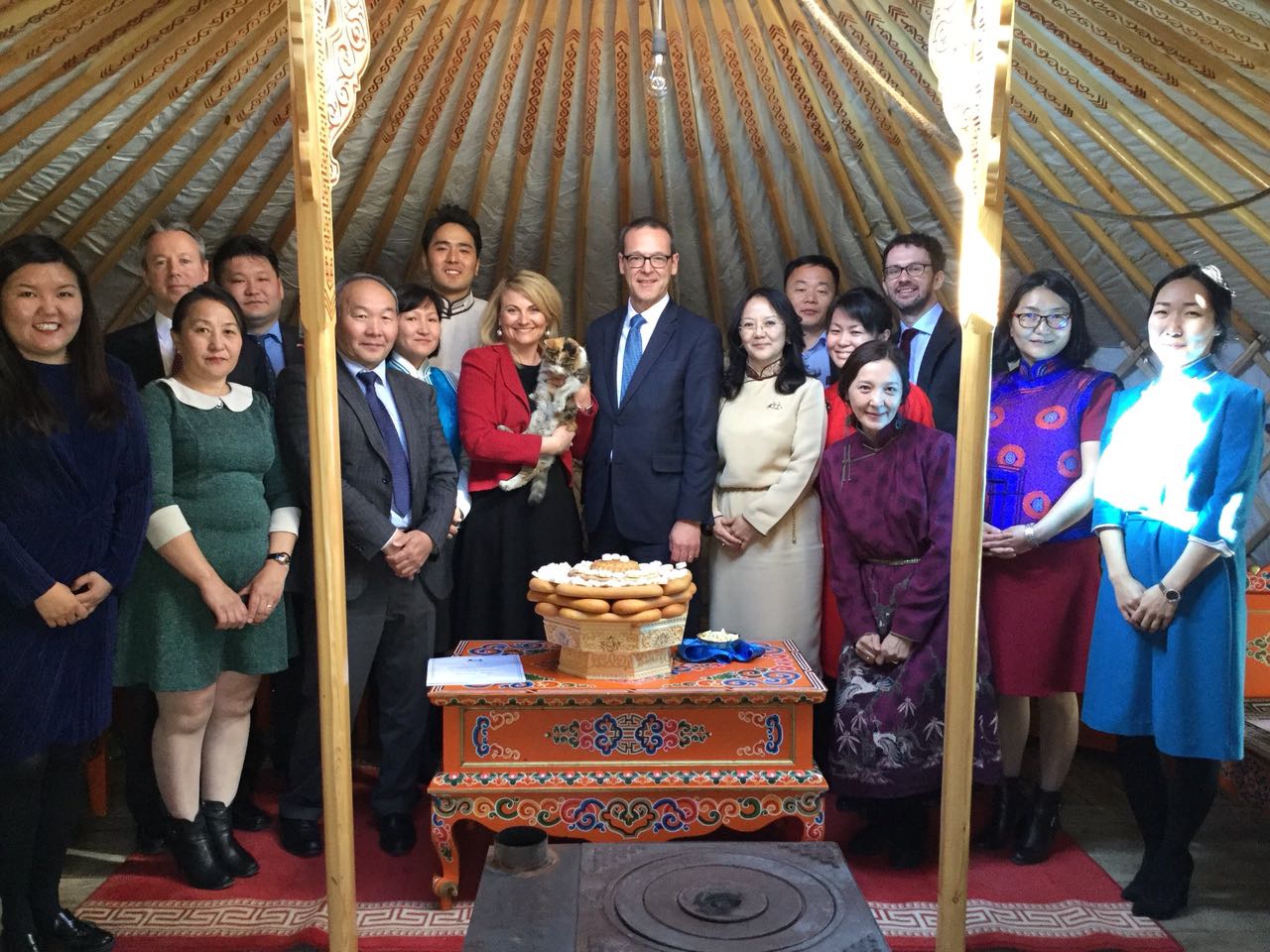
The Permanent Under-Secretary, Simon McDonald, and embassy staff, including our longest-serving member Minnie the Mongolian Mouser (who sadly died earlier this year after 15 years of service).
The UK and Mongolia have recently celebrated 55 years of diplomatic relations and, as Mongolia’s second largest trading partner, our trading relationship matters for both countries. To celebrate the 55th anniversary, we announced:
  • the appointment of Julian Knight MP as the Prime Minister’s Trade Envoy to Mongolia;
  • that UK Export Finance will increase how much it lends to support suppliers and buyers of UK exports to Mongolia.
Having fretted about meeting our export targets the excellent Department of International Trade team exceeded them.
Cambridge Mask Company’s initial consignment of pollution masks sold out within 24 hrs of the fashion show they were launched at, developing into a thriving collaboration with a Mongolian pharmacy chain.

The mask fashion show also means more people have started to wear effective masks – of whatever brand. The embassy has since taken this to the next level, focussing on supporting the poorer parts of Ulaanbaatar, where pollution levels often go off the international air-quality scale.
This is typical of our work in Mongolia – supporting UK trade is of course an essential part of what diplomats do around the world but the relationship between our 2 countries is about so much more than that.

We work with Mongolia in the UN Human Rights Council, Mongolian troops joined coalitions with ours in Kosovo, Iraq and Afghanistan, and Mongolian peacekeepers are currently working across Africa. UK expertise is supporting education reform and a UK funded mobile app and training for border guards is helping to counter the illegal wildlife trade (IWT) here.
The last had swift, positive results, including a 25-fold increase in detection of smuggled, endangered wolf-parts. The Mongolian Foreign Minister spoke powerfully about this at the recent major international conference on IWT, in London.
It’s true that supporting UK trade is important work for diplomats around the world and small embassies can have a big impact. The British Embassy Ulaanbaatar has helped UK companies in Mongolia to secure exports worth many times the total running and staff costs of our embassy.

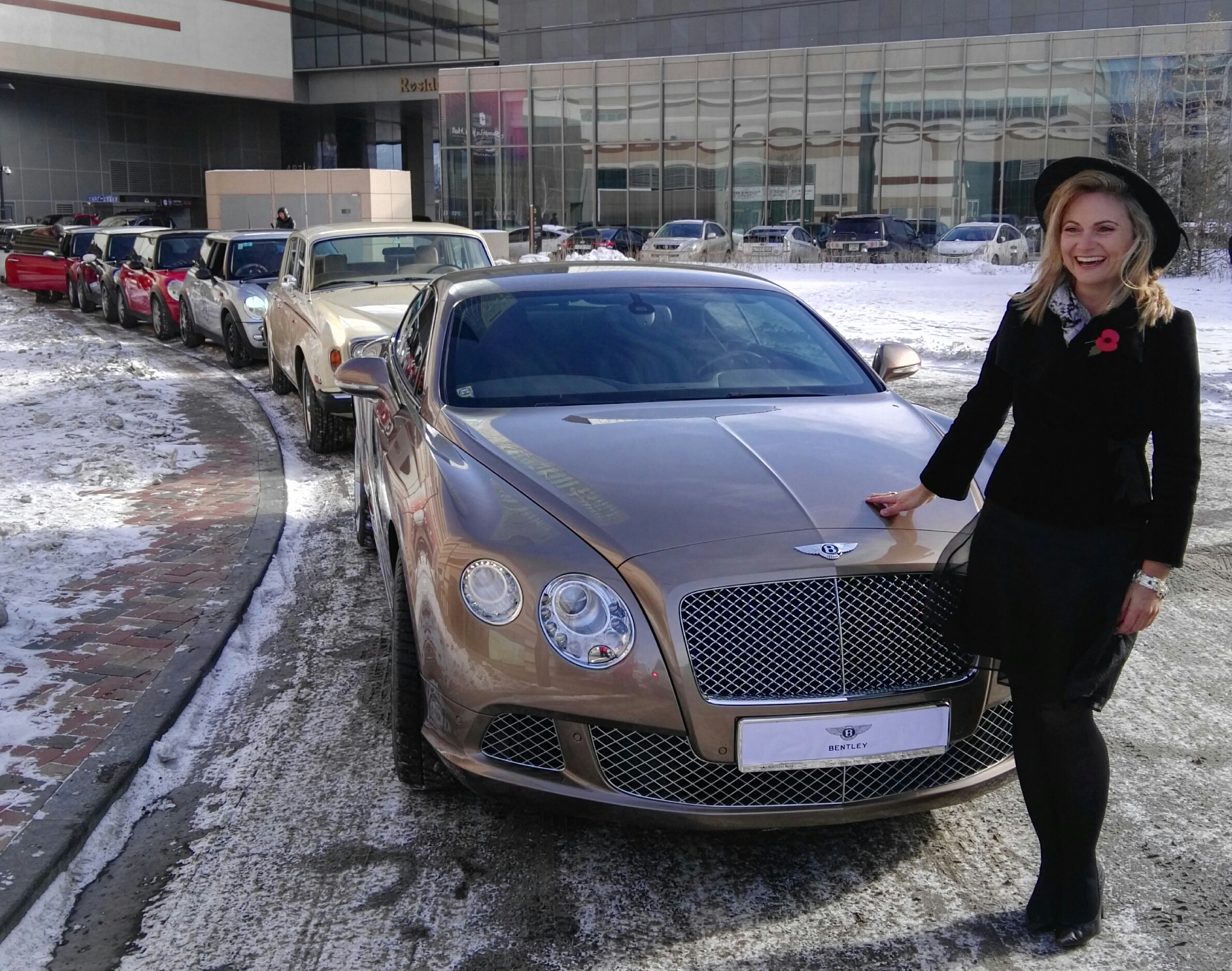
UK car manufacturer promotional parade for the #InspireMe UK festival.But diplomacy works best when trade is one of many links between the UK and the countries we work in. A key task for diplomats is to fit together the people and pieces to make the UK’s presence overseas much more than the sum of its separate parts.
Find out more:
/
Share:

Speech by UK Ambassador to Mongolia at the Queen's Birthday Party 2018

HE Philip Malone, British Ambassador to Mongolia addressed esteemed guests on the occasion of the celebration of Her Majesty The Queen's birthday on 14 June.


Share:

Mongolian Foreign Minister: ‘Our future is in educating our people, not mining’

H.E Mr. Lundeg Purevsuren, Minister for Foreign Affairs of Mongolia, left, is pictured at the private briefing with Michael Lawrence, Chief Executive of Asia House, right
H.E Mr. Lundeg Purevsuren, Minister for Foreign Affairs of Mongolia, left, is pictured at the private briefing with Asia House corporate members and sitting next to him is Michael Lawrence, Chief Executive of Asia House, right, who chaired the discussion
03/05/16
By Naomi Canton
The Government of Mongolia has turned its attention to diversification of its economy in the light of falling commodity prices and China’s slowdown and is now looking for foreign investment in many sectors from renewable energy to education, according to the country’s Minister for Foreign Affairs H.E Mr. Lundeg Purevsuren.
Mongolia, only recently the fastest growing economy in the world, is forecast this year to see growth of a mere 0.1 per cent in 2016 and 0.5 per cent in 2017, according to the Asian Development Bank.
In contrast, in 2011, GDP growth reached a staggering 17.3 per cent. Mongolia is possibly the single country in the world that has been the worst affected by falling commodity prices and the slowdown in China, which has also led to decreasing foreign direct investment.
Whilst Mongolia hosts 10 per cent of the world’s known coal reserves and has significant copper deposits, FDI plunged from US$ 4.45bn in 2012 to US$ 507.6m in 2014.
Mongolia has to date been reliant on exporting minerals and 89 per cent of its total exports go to China, which is itself experiencing an economic slump.
Before a trip to Oxford University to speak to students about Mongolian foreign policy, H.E Mr. Lundeg Purevsuren gave an exclusive interview to Asia House. He said: “Our economy has to diversify. We have learnt our lessons. We were concentrating too much on the mining sector in the past. Commodity prices are dropping so we need to look at long-term sustainable economic growth. That means investing in non-mining sectors like agriculture and food.”
He pointed out there were 60 million livestock in Mongolia.
He said sectors that Mongolia could diversify into included renewable energies, cashmere, leather, food and wool.
“We need to discover global markets for all of these goods. Food will become a major commodity issue in the future. Mongolia can for example provide meat and milk to China and other markets. We have a lot of space that can be used if we can come up with irrigation systems. We would also like to invest in our downstream industries and export not just to our neighbours Russia and China, but also to third markets,” he said.
A year ago Mongolia did not have any regional or bilateral FTAS. But in October 2015 Mongolia signed a free trade agreement with Japan, officially called the Japan-Mongolia Economic Partnership Agreement, paving the way for elimination of import tariffs on most products traded between the two nations. Mr Purevsuren said it would also lead to the transfer of knowledge and technology to Mongolia from Japan, and development of supply chains in Mongolia for Japanese industry.” He said that apart from minerals, Mongolia wanted to export finished products to Japan.
“The EPA will give us access to the Japanese markets and give the Japanese access to our markets and we hope it will allow the transfer of technology and knowledge, as well as management skills. We have a well-educated workforce and Japan can produce and manufacture in Mongolia,” he said.
The main products that Mongolia currently exports to Japan are minerals and textile products and the key products Mongolia imports from Japan are cars, construction and mining machinery.
Used cars currently account for 45 percent of Japanese exports to Mongolia. Trade is still very skewed towards Japanese exports. In 2013 Japan’s exports to Mongolia were valued at US$ 288 million and Mongolia’s exports to Japan just US21 million. Yet that could be set to change if Mongolia’s mineral exports to Japan rise.
The two countries also agreed to work on infrastructure development in Mongolia, including the construction of a rail lines to the Tavan Tolgoi coal mine and Japanese involvement in the project. Tavan Tolgoi is one of the world’s largest untapped coking and thermal coal deposits, located in the Umnugovi Province in southern Mongolia.
The Mongolian Government is also working closely with Japan on the construction of a new international airport in Ulaanbaatar which has been financed by Japanese loans and benefited from Japanese technology.
“We hope that the airport will become a regional hub connecting East Asia and Central Asia and South Asia and this will also benefit cargo,” he said.
Apart from this FTA with Japan, he said Mongolia was in “quite advanced talks” about an FTA with Canada and had signed a number of agreements and treaties with the USA, whichwere the first steps to an FTA.
He said Mongolia started talks last year with the Eurasian Economic Union, which began with an MoU and they were working on cooperation. “We are expecting China to create a joint research group to study the possibility of a China-Mongolia FTA,” he added.
He added there were plans to develop an economic corridor between Mongolia, China and Russia. “We have discussed this programme for two years and now it’s ready to sign. It’s about infrastructure, transit routes, railway lines and pipelines,” he said.
The economic corridor fits in with China’s Belt and Road project. “It was negotiated as part of that project, it is the north-eastern part of the Belt and Road project,” he said.
Mongolia, which became a multi-party free market democracy in 1990, is set to hold its eighth parliamentary elections on 29 June 2016. The last elections took place in 2012 when the current ruling party, the centre-right Mongolian Democratic Party, won the most seats and formed a government in coalition with some smaller parties.
“Our goal is to get a majority in the June 29 general elections,” Mr. Purevsuren said.
“As what we have seen is that it is always hard to work in coalitions. We are confident that we will get a majority because we have developed many programmes for the public including economic programmes for herders. Nevertheless I am also confident that whichever party wins or whichever coalition is formed, the policies we have set in place will continue.”
An electoral pact between the country’s two main opposition parties, which are splitting the centre-left vote, recently collapsed.
In July Mongolia will host many different heads of state and governments at the 11th ASEM Summit being held in Ulaanbaatar.
The Summit will also be the 20th anniversary since the Asia-Europe Meeting dialogue process was inaugurated in 1996 in Bangkok.
“At this summit we are going to define our strategy for the next 20 years and look at how Europe and Asia will work together for the next two decades and where Mongolia can contribute for greater cooperation. Historically Mongolia has always contributed towards Europe-Asia structures. We built the Silk Road in the 13th century opening up free trade between Europe and Asia and therefore it has always been our tradition to bring together the two continents,” he added.
He said that Mongolia was happy with its Observer status of the Shanghai Cooperation Organisation (SCO) (an international alliance that consists of six member states and five observers from Eurasia) and “would stick with that.”
“We are happy with that status so we can watch carefully what’s going on especially since India and Pakistan are going to take up membership soon, so it’s interesting to study more,” he said.
He said following his official visit to India in April this year, a credit line of US$1 billion had been extended to Mongolia from the Indian Government.
“We will use this for infrastructure in railways and other sectors,” he said.
Why take the loans from India? “India is a regional power traditionally and we see India as our spiritual neighbours. We share Buddhism and agriculture and now we are looking at a new economic cooperation,” he explained.
The second phase of theUS$ 4.4 billion Oyu Tolgoi underground mine has begun after the Mongolian Government reached an agreement with Rio Tinto and Turquoise Hill Resources in May 2015 and a Project Financing agreement with 20 international banks and financial institutions to fund the development was signed in December 2015. It is considered one of the largest gold and copper deposits not only in Mongolia, but worldwide. The mine is expected to generate one third of Mongolia’s GDP.
“The second phase of construction has started since we have reached agreement with investors after several years of the project being stuck. There were certain mistakes on both sides and we have reached consensus on both sides. We are now happy with the agreement,” Mr Purevsuren said.
“The fact the project is going ahead is a good signal not just for the project but for the overall business environment in Mongolia,” he added. “Everywhere in the world mining is in trouble since commodity prices have gone down yet the Mongolian Government has managed to reach consensus and sort this project out which is the largest new mining project in the world.
“Critics from the first phase said that locals were not benefiting from it and so we paid attention in this second phase to that to make sure that more local businesses were invited to be part of the project and that more local people will benefit,” he continued.
Apart from foreign investment in mining, there were opportunities for foreign companies in sectors such as education, food, downstream industries and renewable energies.
“The future of Mongolia is in educating people, not mining,” he said.
But he admitted that the Mongolian market had not yet been discovered by British companies. “We have very minimal interest from Britain right now. But no one is going to invest in a country they know nothing about so one of our policies is to promote Mongolia globally and encourage more tourists to visit and then people might think about investing in Mongolia,” he said.
“Mongolia has history, Buddhist heritage and nomadic traditions plus it is an untouched land so we want to promote tourism,” he said. He said that Mongolia was putting a lot of effort into its soft power and promoting its sports, sumo wrestlers, culture, history and traditions.
He explained the attraction of investing in renewable energies.
“We have more than 300 sunny days and we could supply clean energy to the whole of Asia. We are part of the Asia Super Grid,” he continued, referring to a proposed grid in the Northeast Asian region which would allow for electricity, including power sourced from solar and wind energy, to be sent across that part of the continent.
“We have several solar projects already and we have built our first wind farm. The market is well known. In the 1990s there were several solar programmes developed for nomads. What we want now is foreign investment and technology from foreign companies.
“We could export renewable energy to countries like China. China is the biggest polluter and it needs clean energy,” he said.
Earlier in the day Mr. Lundeg Purevsuren took part in a private briefing and roundtable discussion with Asia Housecorporate members. Corporate members represented at the table included Rio Tinto and G3.
naomi.canton@asiahouse.co.uk

Source:www.asiahouse.co.uk
Share:

British freelance journalist claims to have found long-lost burial place of Genghis Khan, written a book

Freelance journalist Robin Ackroyd claims to have found the long-lost tomb of 13th century Mongol leader Genghis Khan.
The revelation is included in his new book Genghis: Sacred Tomb, Secret Treasure.
He believes the secret tomb is located high on a mountain in northerly Mongolia and is also the last resting place of his grandson Khubilai, the Yuan dynasty ruler of China.
Ackroyd completed a 700km horseback expedition, lived among nomads and travelled into a wilderness known as the Great Forbidden Sanctuary to research his book.
He concludes that, although the international conqueror died in northern China in August 1227, he was brought back to Mongolia for burial.
Ackroyd, who won a celebrated protection of sources battle in 2007, said: “It is likely that the early Mongol khans were buried with grave-goods, perhaps of great value, to see them into the afterlife.
“The area was guarded by a tribe called the Uriankhai. They were exempt from taxes and military service.
“The guarding of the imperial grave site undermines the folkloric suggestion that the soldiers who witnessed the funeral were executed.
After translating ancient Mongol texts, and his own on the ground research, Ackroyd concluded that previous theories about the last resting place of the early Mongol chief are wrong. Ackroyd says his theory has now been accepted by the Mongol government.
He said: “Height mattered to the Mongols. Mountains brought the Mongols physically, and spiritually, closer to the Eternal Blue Heaven that they worshipped.
“The best evidence firmly points to the Mongol khans, and others regarded as being of noble position, being traditionally buried on mountain heights.
“These mountains were in areas set aside as inviolable sanctuaries – either in their native territories, or in their appointed realms.
“Genghis Khan was repatriated in death. He was not buried in the Ordos region of China. His famous mausoleum is merely a memorial.”
Source:http://www.pressgazette.co.uk/
Share:

2014 Tsetserleg festival news

Displaying Tengri_yakwear_Catwalk_AW2014_15_IMG_0527_lores.jpg
Logo of the Tsetserleg festival 2014

Aimag mountains in Mongolia provided the scenic backdrop for the first ever Tsetserleg

Festival on the weekend of August 17-19. Conceived and staged by Mongolia-inspired luxury

fashion brand, Tengri, the festival was a celebration of culture and community spirit. The

town of Tsetserleg was transformed by decorations, live music, art, food and high-end

fashion.

The weekend commenced with a volunteer incentive which saw Tengri join forces with

RockCorps, the global volunteer organisation whose ethos is ‘Give, Get Given’. Festival

volunteers travelled to the nearby Tamir River, which has suffered badly from pollution,

to begin a clean-up operation. Inspired by the opportunity to see performances by some of

Mongolia’s most famous live acts, the volunteers selflessly dedicated eight hours to cleaning

up the river.

The following day was a fun-filled day for families, with children's activity workshops,

exhibitions and Mongolian musicians, whose performances included combinations of

traditional and modern sounds. As the sun set, the steps of the magnificent Buddhist temple

at Zayain-Khuree became a catwalk for a spectacular fashion show to showcase the first ever

Tengri knitwear collection, which officially launches next month.

To close the festival, Mongolia’s award-winning hip-hop star Quiza took to the stage. More

than 1,500 people, old and young, gathered to see one of the country’s most famous faces

light up the evening with a performance that was truly electrifying.

After his performance, Quiza said: “This weekend we made history in Mongolia. Bringing

together different people from different backgrounds through music, culture and volunteering,

collectively through the (Tsetserleg) festival we were able to put the spotlight on Mongolia

and promote its many cultural and natural characteristics to the world.”

Nancy Johnston, founder of the Tsetserleg Festival and the Tengri label, said: “The

purpose of the festival was to give support to nomadic herder families in the region

by creating an event so inspiring and fun that people not only want to travel there and

experience it, but also tell their friends. Actually we went beyond that. Through fashion,

music and so much more we connected with people in the local community and touched

people interested in social responsibility and environmental activism. Knowing how the

Tsetserleg Festival has made such a difference, together with RockCorps, ensures we’ll

return next year – and it will be even bigger!”

http://www.jhpr.co.uk

For interviews and press information contact:

Jude at JH Public Relations

jude@jhpr.co.uk / 07979 850 342

Notes to editor:

The Tsetserleg Festival is organised by the herder families that make up the Arkhangai Aimag

Federation of Pasture User Group (PUGs) and delivered in partnership with the Arkhanghai Aimag

Governor’s Office, Tengri and RockCorps.

About Tengri

Tengri is more than just a fashion label. It is a collective movement that brings together design,

fashion, ethics, business, environmental activism and individual consumer choice to do good. Tengri

knitwear is designed and made in the UK, using 100% natural and undyed Mongolian yak wool.

We aim to bring the unique qualities of this fibre to the forefront of the fashion industry through

sustainable, eco-friendly and fairshare business and seek to improve the lives and livelihoods of

Mongolian nomadic herders, while protecting the country’s beautiful and unique landscape and

pastures. www.tengri.co.uk

Displaying Volunteers_RockCorps.JPG
Participants of the Tsetserleg 2014 festival
Share:

Runners raise money for Mongolian students

This is the first year the Windhorse Half Marathon partnered the Blue Sky Education Project with the Bellingham Sister City Association to raise money for education in Mongolia.
The 13.1-mile half marathon, held on Saturday, July 19, began and ended at Fairhaven Park in Bellingham.
“[The Windhorse Half Marathon] is a really low-key race,” race coordinator Cami Ostman said. “It starts at Fairhaven Park. They head out on the trail and they turn around at roughly 6 1/2 miles and come back.”
Mark Cook, a United States Navy Chaplain and University of Washington alumnus, finished first overall with a time of 1:32.49, just 1 minute and 12 seconds off the race record set in 2012 by Bryan Marenstein and Chris Bates.
“I love it when races have charities and raise awareness for good causes,” Cook said. “I was in Afghanistan in March and April and just saw firsthand how other places in the world need all the help they can get.”
This race was designed by the Blue Sky Education Project to raise money for underprivileged children in Tsetserleg, Mongolia to attend school, which is one of Bellingham’s sister cities, Ostman said.
“While education is free for a lot of Mongolians, you have to have uniforms and school supplies,” Ostman said. “Sometimes those kinds of things can actually prevent people from getting an education.”
Iggy Munkhuu, Western alumna and former resident of Mongolia, said the money the BSEP raises even the smallest amount helps the kids get supplies needed for their education.
“If they don’t have those supplies they’re not going to school and they won’t have an education,” Munkhuu said. “Enabling their future, that’s an amazing thing.”
To participate in the race, runners paid a $30 fee or $35 if they signed up on race day, Ostman said.
This year was the first year that the Blue Sky Education Project officially partnered with the Bellingham Sister City Association to host the race, Ostman said.
“In the past they were definitely there supporting us,” Ostman said. “This year we are actually splitting the funds between them and the Blue Sky Education Project.”
The BSCA promotes understanding between international cultures and develops grassroots relationships between individuals at the municipal level, race coordinator Ross Grier said.
Grier said that the BSCA is essentially a world peace movement, events like the Windhorse Half Marathon move us closer to world peace.
The two main projects that the BSEP runs are the student sponsorship program and the teacher education program, Smith said.
Through the teacher education program, BSEP gives students full ride scholarships to attend college for a teaching degree, Smith said.
“I was born and raised in Mongolia and I can see that’s one of the main things that can stop poverty and help people to change their lives—education,” Smith said.
Currently, there are approximately 120 children in Mongolia benefiting from the student sponsorship program in five rural towns, Smith said.
This year’s half marathon was a success, despite the rainy weather, Ostman said.
“We had several first time half mar athon runners,” Ostman said. “That is always very fun to see people finish their first ever half marathon.”
Seventy-four runners and two dogs completed the 4th annual Windhorse Half Marathon. The groups are still raising funds and discussing where exactly the money will go, Ostman said.

source:http://www.westernfrontonline.net/

Windhorse Marathon
Water cup grab: Brian Barry grabs a cup of water without stopping at the halfway point, approximately 7 miles from the starting line. The Windhorse Half Marathon's course begins and ends at Fairhaven Park, with the turnaround point in the Clayton Beach parking lot. // Photo by Melissa McDonough
Share:

Mongolian school to open on Castle Boulevard in Nottingham

NOMF20140212B-041_C

WITH 36 symbols instead of our 26 letters – the Mongolian alphabet is no easy read.
But for children born into Nottingham’s tiny and tight-knit Mongol community it provides a valuable link with their homeland more than 4,000 miles away.
A new Mongolian education centre is about to be launched at a city church and will be the first place of its kind in the East Midlands.
It has already begun hosting weekly language classes for primary-aged children whose parents travelled from Mongolia to settle in Nottingham.
Nineteen families have been taking part in the pilot and parents have expressed their delight over the opportunity.
Dima Kim, 34, lives in Aspley with his wife and two daughters, Angela, nine, and Jessica, eight.
Mr Kim, a full-time student at NCN who has lived in Nottingham for 12 years, thought it was important that his children connected with their heritage.
He said: “We are first generation Mongolian families in Nottingham so we do not have an established community like some of the other ethnic groups in the city.
“This is the first type of group I have been involved with and I think it is really important.
“The children get to meet other Mongolian children and they can learn about where they are from.
“It gives the children options as well in case they ever want to go back to Mongolia. It is a hard language to learn because it is a completely different alphabet and the sounds are different.”
It is thought that there are around 7,000 Mongolians living in the UK, but retired teacher Francis Luckcock, who is the acting centre director, said he did not know how many had settled in Nottingham.
He said: “Mongolian parents want their children to be global citizens and have opportunities of following their careers in the UK or in Mongolia.
“Because these families are first generation they don’t have the background in the UK so we want to help and support them to succeed within Nottingham.”
Mr Kim’s daughter Angela, who attends Rosslyn Park Primary and Nursery School, in Aspley, has been enjoying the classes.
She said: “We’ve been learning the alphabet which has been hard because there are 36 letters instead of 26 but it is funny too as some of the words are hard to say. I like learning the old songs too.”
Angela’s sister Jessica, who also attends Rosslyn Park School said: “We got to learn the ABC but it wasn’t the ABC – it goes way past Z.”
Fellow student Michael Stone, 10, of Sherwood, who attends Seely Primary School, has also been enjoying the classes and was finding it easier the more he practiced.
Based at Grace Church, in Castle Boulevard, the East Midlands Mongolian Centre will officially be launched on March 1 at 2pm.
The centre hopes to teach young Mongolian children about their heritage and welcome Nottingham residents from all backgrounds into the school to learn about the nation’s history and culture.
The project has been two years in the making and was originally the brainchild of a former caterer at Nottingham’s Masonic Hall, in Goldsmith Street. Jamts Chimedbaldir has now returned to Mongolia after 30 years in the UK.
The East Midlands Mongolian Education Centre will be hosting an open day on February 22 from 2pm until 4.30pm in The City Suite at Grace Church.

Share:

Foreign office accused of luring Mongolian official to UK

UKPA) –

A senior member of the Mongolian security services was lured to the UK so he could be arrested in London's Heathrow Airport and jailed under a European Arrest Warrant, his lawyer has said.

Bat Khurts, the head of the executive office of Mongolia's National Security Council, thought he was coming to the UK for high-level Government talks on a new era of intelligence co-operation relating to Muslim fundamentalism.

The 41-year-old was arrested at Heathrow Airport when he arrived in September and is now fighting extradition to Germany over claims he was involved in the kidnap, false imprisonment and return of a Mongolian national suspected of murdering a government official.

Mr Khurts, who is being held at Wandsworth prison in south west London, will appear before City of Westminster magistrates in central London on Wednesday.

Mr MacDonald, of law firm JD Spicer, said: "The Mongolian government, their UK embassy and my client Mr Khurts all had been repeatedly led to believe that meetings with Mr Khurts' British counterparts would be finalised on his arrival in the UK, following prolonged correspondence.

"Yet instead, it seems the Foreign Office was duplicitously luring Mr Khurts to his arrest and imprisonment at the behest of the German government. This is no way to treat any individual, let alone a senior official of an allied nation."

Mr Khurts understood he was travelling to the UK on behalf of the Mongolian government for talks with the UK's National Security Advisor Sir Peter Ricketts and his strategy and counter-terrorism director William Nye. But he claims the UK Government enticed him to the UK, knowing that there was a European Arrest Warrant against him which dated back to 2003 and of which he was unaware.

The warrant related to the kidnap, false imprisonment and repatriation of Mongolian national Enkhbat Damiran, who was wanted for questioning in connection with the murder of the Mongolian Infrastructure Minister Zorig Sanjasuuren. It is alleged Mr Khurts was involved in the kidnap of Mr Damiran from France, driving him to Berlin, Germany, drugging him and flying him back to Mongolia.

Mongolian Prime Minister Sukhbaataryn Batbold cancelled his visit to the UK in November following Mr Khurts' arrest. But a Foreign Office spokesman said the cancellation was due to "Parliamentary business in Mongolia" and added that officials were looking to reschedule the trip.

The spokesman said: "Mr Bat Khurts was arrested under the European Arrest Warrant issued by the German judicial authorities. The arrest in no way amounts to a diplomatic or political statement by the British Government."

Copyright © 2011 The Press Association. All rights reserved.

Source:UK Press Association

Share:

British heritage in Mongolia

Written by G.Chingis

During socialist times, Britain had the first Western embassy in Mongolia.
Therefore, the life of British diplomats was very boring and depressing. There were no air flights to Beijing, Seoul or even Moscow. Access to the entire world was only by train to Beijing. Mongolian relations with China were strained for a lone time since the Cultural Revolution. Therefore, Mongolia had only one train per week to Beijing, which was the Moscow-Ulaanbaatar- Beijing train. The British Embassy was surrounded by a district which was occupied by Soviet/Russian civil and military personnel. Maybe this is the reason why the sign on the embassy was in Russian. Maybe British diplomats were worried about some unexpected intrusion of Russian soldiers.

The relationships between Mongolia and the United Kingdom were very fragmental. It was mostly limited to cultural and some small economic cooperation. Mongolians bought cap technology for the state owned vodka factory from them. Therefore, the Mongolian export version of vodka had a completely different cap than the local version. It was very difficult to find some Mongolian who spoke English in Ulaanbaatar. Russian was the only foreign language in schools and universities. Only high school # 23 had English as a second or third foreign language. Maybe this is the reason why their alumni were successful later in their studies in the United Kingdom and the United States. Mongolia also was sending a tiny number of Mongolians, mostly diplomats, for language studies to the United Kingdom. Therefore, our third President, Mr. N. Enkhbayar went to study at Leeds University in 1985/1986. Then, in 1990/1991 the current Prime Minister Mr. S. Batbold went for Master’s study either to the London Business School or to Middlesex University. After him, another Mongolian Prime Minister, current Member of Parliament, Mr. R. Amarjargal did his Masters in Economics at Bradford University in 1994/1995. Then, current Member of Parliament, Mrs. S. Oyun received her Ph. D. from Cambridge University in 1996. Then she joined the Rio Tinto Company. The sudden death of her brother, Member of Parliament, Minister of Infrastructure, Mr. S. Zorigt did not allow her to continue her career with that mining company and Mrs. S. Oyun took his seat in the Mongolian Parliament. By the way, the former President of Mongolia, Mr. N. Enkhbayar and current Member of Parliament Mrs. S. Oyun both graduated from high school # 23.

Until now, Mongolian-British relationships have been very stable and nice. Of course, Mongolia is not a Commonwealth country. Therefore, we do not expect to see Her Majesty in Mongolia. Other members of the royal family frequently visit us. Probably, being stationed in Mongolia for Foreign and Commonwealth personnel is still boring, unless you like hardships and extreme conditions along with other features of wild life. Of course, if you like driving a Russian SUV in the Mongolian steppes or you like hiking, Mongolia is a great destination. Otherwise, it is a very hard place to live, especially in winter. There is a relatively small British community, mostly of them old British gentlemen, who married relatively young Mongolian ladies. Two people are some exception from the entire local British community. One gentleman is putting enormous efforts to spread British English here, he even invited his brother hereto help. Another gentleman is busy with mismanaging a cashmere business in Mongolia along with promoting Mongolian whiskey/Scottish vodka.

The suddenly arrest of Mongolian intelligence official Mr. B. Khurts at Heathrow devastated the relationship between the United Kingdom and Mongolia at least in the Mongolian mass media. There has been much speculation in Mongolian newspapers and on Mongolian TV. In the end, Her Majesty’s Ambassador Mr. William Dickson went back to London, and Charge d’Affaires Miss Lynne Falconer was representing Her Majesty in Mongolia. Now, the Foreign and Commonwealth Office sent Miss. Thorda Abbott-Watt again. She took over from Mr. Christopher Osborne, when he left Mongolia due to health problems. Now, Miss Thorda Abott-Watt back after she left on July 2009. Now, the Mongolian media enjoys writing about the postponing of an official visit of the Prime Minister of Mongolia to the United Kingdom, and it connects this with the recent arrest of Mr. B. Khurts. Of course, the Ministry of Foreign Affairs cannot say directly that the main reason for that postponement is the incident with Mr. B. Khurts.

There is an Oxford tradition to give honorary degrees to all Prime Ministers who had been educated there. Maybe, the Prime Minister of Mongolia, S. Batbold was planning to receive his honorary degree from some mysterious London university or London Business School, or London School of Economics. Why is this so mysterious? In the Mongolian language version of the official Mongolian parliament website, it says London City Business Administration University. There is no such university in London, at least in London, United Kingdom. Unfortunately, the English version of the official Mongolian parliament website is still under construction. Probably, it will be finished by the end of this parliamentary term. Anyway, his Alma Mater Moscow State Institute of International Relations should give him his honorary degree during his upcoming official visit to Russia.

Another Mongolian Prime Minister, Mr. R. Amarjargal was luckier. He managed to receive his honorary degree from the University of Bradford during his official visit to the United Kingdom in 1999.

There is no doubt that Miss Thorda Abbott-Watt and her Deputy Miss Lynne Falconer will restore normal relations between the United Kingdom and Mongolia. Usually female foreign Ambassadors are more successful in Mongolia, even though it must be a huge challenge for any woman to live through the harsh Mongolian winters.
source: The UB Post
Share:

Facebook page

Powered by Blogger.

Categories

Advertising in Mongolia An Asian Development Bank Culture Editorial of the Mongolianviews education Environmental protection Famous Mongolians Foreigners in Mongolia Inner Mongolia Ivanhoe Mines Mongolia Adventure Mongolia agriculture Mongolia air pollution Mongolia analysis Mongolia and Armenia Mongolia and Asian Development Bank Mongolia and Australia Mongolia and Azerbaijan Mongolia and Belorussia Mongolia and Bulgaria Mongolia and Cambodia Mongolia and Canada Mongolia and central Asia Mongolia and China Mongolia and Cuba Mongolia and Czech Mongolia and donors Mongolia and EU Mongolia and Germany Mongolia and Hongkong Mongolia and Hungary Mongolia and IFC Mongolia and IMF Mongolia and Ind Mongolia and India Mongolia and Indonesia Mongolia and Inner Mongolia Mongolia and Iran Mongolia and Israel Mongolia and Italy Mongolia and Japan Mongolia and Kazakhstan Mongolia and Korea Mongolia and Kuwait Mongolia and Kyrgyzstan Mongolia and Malaysia Mongolia and Nato Mongolia and North Korean Mongolia and Poland Mongolia and Qatar Mongolia and Russia Mongolia and Russia and Mongolia and China Mongolia and Singapore Mongolia and South Korea Mongolia and Taiwan Mongolia and Thailand Mongolia and the world Mongolia and Tibet Mongolia and Turkey Mongolia and UK Mongolia and Ukraine Mongolia and UN Mongolia and US Mongolia and USA Mongolia and Vietnam Mongolia Banking Mongolia blind Mongolia Cashmere Mongolia Christianity Mongolia civic society Mongolia Corruption Mongolia crime Mongolia diplomacy Mongolia Economy Mongolia Education Mongolia Energy Mongolia environment Mongolia Finance Mongolia Health Mongolia History Mongolia holiday Mongolia in international media Mongolia Industries Mongolia investment Mongolia Joke Mongolia law Mongolia LGBT Mongolia medical Mongolia military Mongolia Mining Mongolia Mining Developments Mongolia Mortgage Mongolia natural disaster Mongolia news media Mongolia Nuclear Mongolia Petroleum Mongolia Politics Mongolia Poverty Mongolia public announcements Mongolia railways Mongolia Religion Mongolia slums Mongolia society Mongolia Sports Mongolia Stamp Mongolia Sumo Mongolia telecommunication Mongolia tourism Mongolia trade Mongolia Transportation Mongolia Urbanization Mongolia Wild Life Mongolian Agriculture Mongolian and Cuba Mongolian Archeology Mongolian Climate Mongolian Food Mongolian Gay Mongolian Government news Mongolian History Mongolian Kazakh Mongolian Meat Mongolian Military Mongolian Mining Development Mongolian Movie Mongolian News Mongolian Parliament Mongolian Political news Mongolian Press Mongolian Songs Mongolian Sumo Mongolian Women Mongolian Youth Mongolians abroad Moninfo Opinion Oyu Tolgoi Investment Agreement Photo news Press Release Rio Tinto Tavan Tolgoi coal mine Ulaanbaatar development Weird expatriates in Mongolia World bank and Mongolia

Blog Archive

Followers