Showing posts with label Mongolia and North Korean. Show all posts

Mongolia keeps the dialogue going on North Korea

WASHINGTON, Sept. 19 (UPI) -- Mongolia has been quietly playing a mediating role in North Korea talks, hosting representatives from Pyongyang when they seek informal discussions with counterparts from Japan and South Korea.
The Mongolian foray into hosting North Korea-related bilateral talks has made progress since the launch of informal Track 2 dialogues in 2015, Ambassador Jargalsaikhan Enkhsaikhan said Thursday at a closed-door roundtable hosted by the Global Peace Foundation in Washington.

Enkhsaikhan, now retired, is the chairman of Mongolian NGO Blue Banner. The group, together with the Global Partnership for the Prevention of Armed Conflict, a regional network, has been organizing the talks known as the Ulaanbaatar Process to help grease the wheels of dialogue even during times of tension on the Korean Peninsula.
Mongolia may be in a unique position to host North Korea-related meetings at a time when the long abandoned six-party talks on denuclearization, last held in China in 2009, have become a distant memory. Under Kim Jong Un, Pyongyang has instead favored one-on-one, high-stakes summits with world leaders.

Dramatic summitry is no substitute for substantive working-level talks, however.
Enkhsaikhan, who said his views are his own, didn't rule out a future U.S.-North Korea summit in Ulaanbaatar. He also told UPI that Washington and Pyongyang will need to lay the groundwork ahead of the summit. Talks collapsed in Hanoi, Vietnam in February because not much was discussed at the expert or ministerial level; all the nuances came from the top.
"Now they're talking about working-group meetings," Enkhsaikhan said. "That's very good. Hopefully they will meet soon."

Mongolian cooperation on sensitive issues has helped countries like Japan to build low-level dialogue on the issue of abducted Japanese citizens. At the meeting on Wednesday, a Japanese academic from a university in Kyoto said Mongolia's mediating role for countries that "lack trust" has enabled Japan to provide financial support to Mongolia so that it could use the funds to invite North Koreans.
The issue of North Korea's nuclear weapons has dogged past U.S. presidents. Mongolia is a traditional partner for North Korea, and their relationship dates back to the Cold War, when the two countries were part of the Soviet bloc.
"We have not changed our attitude toward North Korea," the former diplomat said. "We don't forget friends."

Friendship does not mean Mongolia is not concerned about North Korea's weapons of mass destruction --- a program that has been on Ulaanbaatar's radar since the '90s.
"First it was a 'nuclear program,' now they say it is a 'nuclear weapons program'," Enkhsaikhan said.
Following the collapse of the Soviet Union, Mongolia and North Korea took divergent paths. Pyongyang maintained isolation and may have secretly started a uranium program in the '90s, while Mongolia pursued democratization and declared itself a nuclear weapon-free zone.
Mongolia's decision to reject weapons was rooted in a historical lesson, according to Enkhsaikhan.
The landlocked Asian republic may have faced an existential threat when rivals China and the Soviet Union were on the brink of a potential nuclear war in 1969. Moscow at the time stored dual-use weapons, including midrange missiles and planes in Mongolia, which could have made Soviet bases in Mongolia a target of Chinese fire.
"A duck is calm when the lake is calm," he said, referring to a Mongolian saying that summarizes how national interests are best served by a stable regional security environment. "That is why Mongolia tries to stay as active as possible."
Enkhsaikhan said he supports a U.S. security assurance for North Korea that comes with a "double assurance" from Russia and China, a guarantee that could help build trust with Pyongyang.
"And no matter how detailed the agreements, they should be ratified by government, meaning parliament," he said.
Mongolia's willingness to host North Korean officials has also served as a barometer for the mood in Pyongyang.
During the closed-door meeting on Wednesday, a former U.S. State Department officer and Mongolian specialist said after talks collapsed in February between President Donald Trump and Kim, North Korea stopped showing up at the dialogues in Ulaanbaatar.
Enkhsaikhan said Mongolia, with its steady ties to both Koreas, supports Korean unification, and that his country is ready to share its experience of democratization with Pyongyang.
"If they are interested, we will tell them" about democratic systems, he said.
The Global Peace Foundation is affiliated with the ultimate holding company that owns United Press International.

Source:UPI
Share:

How Mongolia leverages its neutrality to influence diplomacy with North Korea

Ulaanbaatar is increasingly positioning itself as a mediating force

Anthony V. Rinna 

Geographically remote and marginalized from participation in regional security dialogue, Mongolia has once again made a small foray into multilateral discussions over North Korea-related issues. 
During a recent visit to Ulaanbaatar for talks with his Mongolian counterpart Damdin Tsogtbaatar, Japanese foreign minister Taro Kono implored Mongolian assistance in resolving the issue of Japanese citizens abducted by North Korea.
The two sides also reportedly agreed on the need to maintain pressure against Pyongyang in the form of sanctions. 
Tokyo has recently sought to engage Pyongyang directly, with Japanese prime minister Shinzo Abeexpressing willingness to meet with Kim Jong Un. North Korea, however, has been cool toward Japanese overtures. 
The meeting between Japan and Mongolia’s chief diplomats comes on the heels of the sixth Ulaanbaatar Security Dialogue (UBD). The UBD has, since 2013, brought together participants from across Northeast Asia in a neutral forum where participants openly discuss issues according to Chatham House Rules. 
In spite of Kim Jong Un’s dismissal of Abe’s gesture, Japanese officials hoped to meet directly with delegates from the DPRK at this year’s UBD. Nevertheless, Pyongyang withdrew its participation in the 2019 gathering in Ulaanbaatar, frustrating Japanese attempts at direct engagement with the North. North Korea’s withdrawal from this year’s UBD is somewhat surprising, given that Pyongyang has normally been a supporter of the Mongolian initiative.

Mongolia has hoped to position itself as a mediating force in North Korean security issues

Post-communism, Mongolian foreign policy is based on a policy of strict neutrality. Ulaanbaatar pursues a neutral position in diplomacy and interstate relations so as to prevent itself from becoming geopolitically entrapped by any single power or concert of states. 
Although China and Russia by far comprise the biggest challenges to Mongolia’s maintenance of sovereignty, Ulaanbaatar nevertheless takes great care to not allow itself to become beholden to other less powerful states including Japan and the ROK, on which Mongolia depends in part for economic assistance and investment.  
As far as the Korean peninsula is concerned, the Republic of Mongolia maintains diplomatic equilibrium between Pyongyang and Seoul in part to preserve an air of non-alignment with the informal but very real blocs involved in the Korean security crisis. 
Furthermore, Mongolia values economic cooperation with both the DPRK and the ROK; the former providing Mongolia with access to the Pacific Ocean via the port of Rason-Khasan, and the latter for its vast investment potential. 
In the context of the Korean security crisis, neutrality positions Ulaanbaatar to act in a mediating role between the DPRK and South Korea as well as the U.S. This in turn, Ulaanbaatar hopes, will cement other states’ respect for Mongolian sovereignty, insofar as Mongolia’s unique position serves as a method of advancing peace in Northeast Asia.
Japan’s direct outreach to the Mongolian government shortly after Tokyo’s failed attempt of dialogue with the DPRK on neutral Mongolian territory highlights Ulaanbaatar’s unique position in the North Korean security crisis. Although Mongolian diplomacy is ensconced in the notion of neutrality, Mongolian foreign policyemphasizes an orientation toward the Northeast Asia sub-region. 
Mongolia’s relationship with Japan is based in part on the latter’s status as one of the largest donors to MongoliaUlaanbaatar has recently sought to expand trilateral cooperation between itself, Tokyo and Washington. Beijing and Moscow – which yield considerable geopolitical influence over Mongolia – could potentially see such trilateral cooperation with Japan and the U.S. as threatening. 
The Mongolian government, however, has declared that the reason for such collaboration is to advance Ulaanbaatar’s interests in the North Korean security crisis.  
Mongolia has hoped to position itself as a mediating force in North Korean security issues since the onset of the second North Korean security crisis
Given Mongolia’s diminutive stature in Northeast Asian affairs, Ulaanbaatar relies in part upon American support for Mongolian participation in Northeast Asian security dialogues. At the same time, Washington has been largely unwilling to allow Mongolia a role as a direct mediator in the current standoff over Pyongyang’s WMD program. 
Mongolia’s strict neutrality vis-à-vis the Korean security crisis has occasionally come under question, particularly in light of communications between Ulaanbaatar and Washington over North Korea unveiled during the Wikileaks revelations. 
Although Mongolia’s diplomatic stance allows Ulaanbaatar room to maneuver in Northeast Asia’s tight geopolitical environment, Mongolia does have a concrete vested interest in seeing Northeast Asia realize greater security.
Post-communist Mongolian foreign policy is based on a policy of strict neutrality
Today, Mongolia and North Korea have a friendship treaty that callsamong other things, for mutual cooperation in securitizing the Asia-Pacific. Furthermore, the Mongolian government supports integrating North Korea economically with the rest of Northeast Asia. However, post-Cold War Mongolia-North Korea relations have not been without trials, depending in part upon the state of Ulaanbaatar’s ties with Seoul. 
In particular, positive developments in Seoul-Ulaanbaatar ties have had negative implications for Mongolia’s ties with the DPRK. This has been particularly true not only of the general state of Mongolia’s relations with either one of the Koreas, but has also occurred in light specific issues such as past Mongolian assistance to North Korean refugees attempting to flee to the ROK. 
At the same time, Mongolia has pressed for North Korea to implement reforms, albeit in a subtle manner. Rather than pontificating to the DPRK, Ulaanbaatar relies on using its experience transitioning to a democratic form of government and free-market economy to induce change within North Korea.

Ulaanbaatar’s best efforts notwithstanding, developments this month in Mongolia’s participation in resolving the North Korean security crisis underscore Ulaanbaatar’s limited capacity. Furthermore, the interplay between the DPRK, Japan, and Mongolia signal that the latter will have a tough time maintaining its position of neutrality. 
North Korea’s dismissiveness toward Japanese overtures and Tokyo’s very public failed attempt to reach out to Pyongyang via Mongolia do not bode well for either Mongolia’s desire to use mediation or Japan’s hope that the Republic of Mongolia can play a positive role in advancing Japanese interests vis-à-vis the DPRK. 
Deepening cooperation between Japan and Mongolia, while possibly serving both countries’ interests at the bilateral level, could also send the wrong message to Pyongyang about Mongolian neutrality. The onus will be on Ulaanbaatar, therefore to tread carefully in the midst of DPRK-Japan relations. 
For the sake of maintaining its diplomatic balance between Pyongyang and Tokyo, Ulaanbaatar may find itself engaging in more direct outreach to the North in the coming months so as to assure the DPRK and developments in Japan-Mongolia relations don’t mislead the DPRK into thinking Mongolia is explicitly taking Tokyo’s side.
Edited by James Fretwell

Source:NKnews.org
Share:

Asian Regional Seminar on the Juche idea started in Ulaanbaatar Mongolia

No photo description available.

DPRK Academy of Social Sciences and International Association of  Juche Ideology study is organizing Conference " Asian Regional Seminar on the Juche Idea for Self-Reliance Guarantees National Socvereignty and World Peace" in Ulaanbaatar, Mongolia today.

Researchers from North Korea and several other Asian countries are participating in the Workshop.


Share:

Mongolia: Bridge or Buffer in Northeast Asia?

Reflections from the 6th Ulaanbaatar Dialogue and beyond.

By 
Share:

Mongolia to urge N.Korea to continue talks

The foreign minister of Mongolia, which has longstanding ties with North Korea, says he will urge the country to hold talks with the United States and Japan and to refrain from further provocative acts.

Damdin Tsogtbaatar, who is on a trip to the US, spoke to NHK over the phone on Saturday.

He stressed Ulan Bator 's friendly ties with Pyongyang and revealed that a Mongolian delegation is visiting North Korea to celebrate the 70th anniversary of diplomatic ties.

Asked about the second US-North Korea summit which broke down in Hanoi, he said it was part of an ongoing process and urged observers not be disappointed. He added that Mongolia will continue to offer support and help set the stage for dialogue.

Tsogtbaatar also expressed concern over recent reports in North Korea's state media claiming the country has tested what it calls a "new type of tactical guided weapon." He described it as a provocative act that would have a negative impact on the current situation.

On the issue of Japanese nationals abducted by the North, Tsogtbaatar said his country has supported dialogue between Japan and North Korea and will continue its cooperation.
Share:

Mongolian foreign affairs delegation in Pyongyang for talks: KCNA

U.S. ally Mongolia seen as potential mediator in ongoing denuclearization negotiations

A delegation from the Mongolian Ministry of Foreign Affairs (MOFA) arrived in Pyongyang on Thursday for a series of high-level meetings, the DPRK’s state-run Korean Central News Agency (KCNA) reported.
Led by State Secretary Damdinsuren Davaasuren, the delegation met with foreign minister Ri Yong Ho and vice-chairman of the Central Committee of the Workers’ Party of Korea (WPK) Ri Su Yong in separate meetings Thursday.
Details of the topics of discussion have yet to be released by either side.
Davaasuren became State Secretary in 2016, a role within the Mongolian MOFA which assists the foreign minister and deputy foreign minister.
He speaks Korean in addition to English and Russian, according to his profile on the MOFA website, and studied international business in South Korea in the late 1990s.
The most recent high-level contacts between the two countries came in December last year, when DPRK foreign minister Ri Yong Ho led a delegation to Ulaanbaatar to celebrate 70 years of bilateral ties.
In those talks with Mongolian foreign minister Damdin Tsogtbaatar, the two sides discussed “brisk exchange and cooperation in various fields” that year and “exchanged views on the development of bilateral relations and international and regional issues,” KCNA reported.

Earlier this week, Tsogtbaatar was seen attending a cultural event at a North Korean restaurant in Ulaanbaatar hosted by the DPRK ambassador O Sung Ho, according to a Facebook post from the Corporate Union of Mongolian Shamans.
China’s Xinhua also reported in early April that O Sung Ho, in a meeting with Mongolian Parliament Speaker Gombojav Zandanshatar, said “the DPRK attaches great importance to DPRK-Mongolia relations.”
“A further expansion of friendly relations and cooperation between our two countries is a foreign-policy priority for the DPRK,” O reportedly added.
Zandanshatar, in turn, said “the Mongolian parliament will pay special attention to further developing traditional friendly relations between our two countries,” and that Ulaanbaatar is “willing to further enhance parliamentary cooperation with the DPRK.”
The two countries’ relations have remained friendly over the past decades, from an era where the two shared similar political systems and similarly precarious positions between Beijing and Moscow.
There was even speculation over winter that Mongolia could be a candidate for the second U.S.-DPRK summit — which eventually took place in Vietnam — with President Khaltmaagiin Battulga in October officially invitingNorth Korean leader Kim Jong Un to visit the country.
Writing for NK News in December, analyst on Russian foreign policy in East Asia for the Sino-NK research group Anthony Rinna cautioned that “the bilateral DPRK-Mongolia relationship will not likely be of any major consequence in and of itself.”
“The future of Mongolia-North Korea relations, rather, will likely be most pronounced in a multilateral format, whether in economics or security,” Rinna wrote at the time.
The meetings in Pyongyang this week come as North Korea and Russia are preparing the first summitbetween Kim Jong Un and President Vladimir Putin in the latter half of April.
A location has yet to be confirmed for the summit, though it is widely expected to take place in Vladivostok.
While the U.S. watches for how enhancing Pyongyang-Moscow ties may affect ongoing denuclearization negotiations, Washington may also be hoping Ulaanbaatar furthers its role as mediator with the discussions this week.  
Last September, during a visit to Washington by Mongolian Prime Minister Khurelsukh, the U.S. and Mongolia released a joint statement declaring that “both sides also reaffirmed the essential importance to regional and global security of the final, fully verified denuclearization of the DPRK.”
The two “pledged to continue cooperation and information sharing to ensure the full implementation of all UN Security Council resolutions,” and the U.S. “thanked Mongolia for its assistance in this regard and urged continued support for the efforts of the international community.”

Source:nknews.org
Share:

Mongolia keen to strengthen parliamentary cooperation with DPRK: parliament speaker

ULAN BATOR, April 2 (Xinhua) -- Mongolian parliament speaker Gombojav Zandanshatar said here Tuesday that his country is keen to strengthen parliamentary cooperation with the Democratic People's Republic of Korea (DPRK).
Zandanshatar made the remarks when meeting with the DPRK's Ambassador to Mongolia O Sung Ho, according to a statement of the Mongolian parliament's press office.
"The Mongolian parliament will pay special attention to further developing traditional friendly relations between our two countries," said Zandanshatar. "We are willing to further enhance parliamentary cooperation with the DPRK."
In an effort to expand parliamentary cooperation between the two countries, he made a proposal on co-organizing a parliamentary session of the regional countries in Ulan Bator, capital of Mongolia at any time under the theme of promoting regional peace and stability by pushing forward the denuclearization of the Korean Peninsula, the statement said.
For his part, the DPRK ambassador said that "the DPRK attaches great importance to DPRK-Mongolia relations. A further expansion of friendly relations and cooperation between our two countries is a foreign-policy priority for the DPRK."
Mongolia and the DPRK have maintained good relations since the establishment of diplomatic ties in 1948.
Share:

Ri Yong Ho in Ulaanbaatar: where the DPRK-Mongolia relationship goes from here

Mongolia continues its push to serve as a third-party mediator

By Anthony V. Rinna 

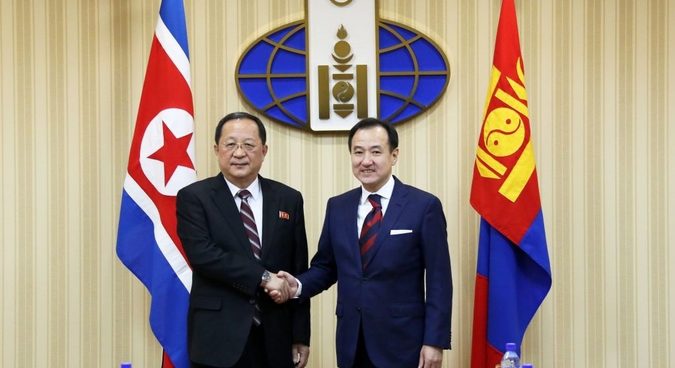
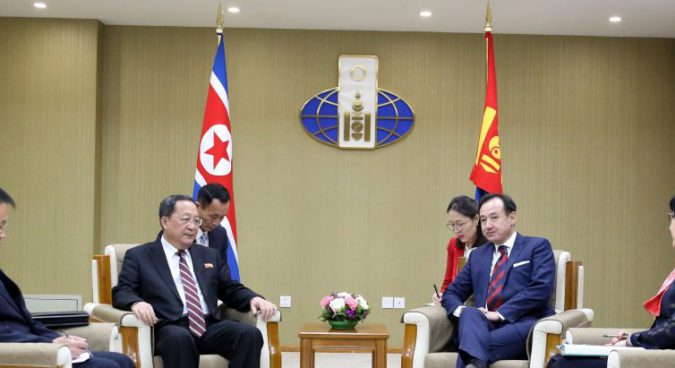
Wrapping up a year of 70th anniversary celebrations, North Korean foreign minister Ri Yong Ho traveled to Mongolia this weekend following a visit to Beijing.
The visit, intended to mark seven decades of relations between Ulaanbaatar and Pyongyang, saw Ri hold discussions with his Mongolian counterpart Damdin Tsogtbaatar over DPRK-Mongolia bilateral ties as well as security issues on the Korean peninsula.

Ri Yong Ho in Ulaanbaatar: where the DPRK-Mongolia relationship goes from here
Ri’s visit to Mongolia comes two months after Ulaanbaatar issued a formal invitation to Kim Jong Un. In February of this year, too, Damdin Tsogtbaatar visited Pyongyang.
Though no longer based on a shared ideology, the Mongolia-North Korea relationship is nevertheless in a healthy state.
This isn’t so much because of shared values as it is because of coinciding interests. As Pyongyang-Ulaanbaatar ties have remained stable since 1948, Ri’s journey to Mongolia offers a chance to observe what keeps the relationship between the DPRK and Mongolia smooth, as well as what Ulaanbaatar can bring to the table in helping to address issues in Korean security.
During the Cold War, Mongolia and North Korea enjoyed a degree of solidarity as two small communist states caught between giants China and the USSR.
Nevertheless, as Balázs Szalontai asserts, relations between the DPRK and Mongolia were not always founded on ideologically solid ground. The two states often experienced diplomatic tensions. Szalontai nevertheless asserts that the DPRK and Mongolian People’s Republic tried as much as possible maintain façade of communist solidarity.
Following the end of communism in Mongolia, Ulaanbaatar pursued a highly independent foreign policy. Responding to then-U.S. Secretary of State James Baker III’s invitation to Mongolia to consider the US its “third neighbor”, Ulaanbaatar reached out across Eurasia in search of relationships in order to avoid domination by either China or Russia.
As far as the Korean peninsula is concerned, this policy of neutrality has taken the form of maintaining diplomatic “equidistance” between Pyongyang and Seoul.
The nature of contemporary Mongolia-North Korea ties have changed with the post-Cold War political shifts in Northeast Asia. Today, in search of friends beyond its giant neighbors, North Korea views Mongolia as a harmless country with which it can leverage ties. In turn, Mongolia is keen to utilize its own small stature to promote itself as a fount of small country diplomacy that can play a constructive role in global crises.
Though Mongolia attempts to portray itself as a neutral and responsible international player, Ulaanbaatar’s relationship with the DPRK has complicated Mongolia’s response to North Korean refugees. Nevertheless, Ulaanbaatar has engaged in humanitarian outreach to the DPRK – in 2013 Mongolia provided North Korea with emergency food supplies in response to food shortages in North Korea.
In recent years in particular, Mongolia has engaged in several high-level exchanges with North Korea. Then-DPRK foreign minister Ri Su Yong visited Ulaanbaatar in February 2015. The meeting led to the signing of a memorandum of understanding between the two countries.
Even in the face of increasingly stringent sanctions against Pyongyang, Ulaanbaatar is eager to continue developing economic ties with the DPRK. Landlocked but with abundant natural resource wealth, Mongolia has made moves to use the North Korean port of Rason to transport goods to foreign markets.
Indeed, as discussions continue over linking North and South Korea to Russia via rail lines, Mongolia also has potential for connecting to rail lines that traverse the Korean peninsula.
One potential multilateral format for cooperation is the ROK’s “New Northern Policy”
The geographic separation between the DPRK and Mongolia, to say nothing of either country’s relative lack of economic prowess, is bound to limit the potential of economic collaboration between Pyongyang and Ulaanbaatar. The need to involve other countries in Mongolia-North Korea trade relations, if for nothing more than logistical purposes, means that an economic partnership between the DPRK and Mongolia will most likely be best served in a multilateral format.
Indeed, one potential multilateral format for cooperation is the ROK’s “New Northern Policy“, which includes Mongolia as a prospective partner, along with North Korea.
Since the end of the Cold War, Mongolia has been a staunch advocate of nuclear disarmament and non-proliferation. In 1992, Mongolia declared itself to be a nuclear weapons-free zone. Despite Mongolia’s positive relations with North Korea, Ulaanbaatar’s anti-nuclear policy has prompted Mongolia to speak out against the DPRK’s nuclear weapons complex.
Yet Mongolian outspokenness has not caused a major disruption in Mongolia-North Korean relations. Both North Korea and Mongolia believe that that latter can play a positive role in Korean security.  
The visit saw the two sides agree to continue improving ties| Photo: Mongolian foreign ministry
Furthermore, the idea of a positive role for Mongolia in Korea’s security quandary is not limited to officials in either Pyongyang or Ulaanbaatar: U.S. officials have also endorsed the idea of greater Mongolian participation in multilateral discussions over the North Korean security crisis.
Stemming from its policy of strict neutrality, Mongolia seeks to present itself in Northeast Asia as an even-handed actor.
This is partially due to Mongolia’s vulnerability due to being landlocked between China and Russia. Overt alliance with either one of these countries risks Mongolia losing its hard-won independence, while explicit alignment with China and Russia’s rival the United States would risk agitating Beijing or Moscow.
Mongolia has been offered up as a potential role model for North Korean disarmament
Mongolia, therefore, has sought to use its status as a neutral and non-threatening country to act as a resource for diplomacy and negotiations over regional security issues.
This has allowed Mongolia to pursue its “third neighbor policy”, both as a way of building a rapport with major powers as well as with smaller states such as Japan and South Korea, while not aligning with any single country or group of states.  
Aside from Ulaanbaatar actively participating in regional diplomacy, Mongolia has been offered up as a potential role model for North Korean disarmament. Mongolia’s status as a nuclear weapons-free state, one that is surrounded by major powers and utterly defenseless against them to boot, may provide a basis for a similar multilateral arrangement in Northeast Asia.
Others have argued that North Korea could draw upon Mongolia’s experience in democratizing and absconding nuclear weapons while maintaining delicate balanced diplomacy.  
After 70 years Mongolia-North Korea ties have proven themselves strong, even as Mongolia views its ties with the DPRK as part of a wider balancing strategy. For the DPRK, Mongolia may not be an ally, but it is at least something of a friend.
For these reasons, the bilateral DPRK-Mongolia relationship will not likely be of any major consequence in and of itself. The future of Mongolia-North Korea relations, rather, will likely be most pronounced in a multilateral format, whether in economics or security.  
Edited by Oliver Hotham
Share:

N. Korea, Mongolia agree to boost bilateral ties

SEOUL, Dec. 9 (Yonhap) -- North Korea and Mongolia agreed to boost their bilateral ties, Pyongyang's state media reported on Sunday.
According to the Korean Central News Agency, North Korea's foreign minister Ri Yong-ho and his Mongolian counterpart, Damdin Tsogtbaatar, exchanged views on cooperation in fields, such as trade and politics.
On Friday, the North Korean minister met with Chinese President Xi Jinping in Beijing, during which Xi reaffirmed his country's strong bilateral relations with Pyongyang.
Mongolia and North Korea established diplomatic relations in 1948.
Share:

North Korean, Mongolian foreign ministers agree to boost ties

ULAN BATOR (Kyodo) -- The Mongolian Foreign Ministry announced Sunday that Foreign Minister Damdin Tsogtbaatar and his visiting North Korean counterpart Ri Yong Ho exchanged views on the further development of bilateral ties in talks held the previous day in the capital.    
Ri was quoted as saying that Pyongyang is striving for denuclearization of the Korean Peninsula and that "trust in the region is indispensable."     Tsogtbaatar lauded the concrete progress made toward peace and stability of the region through the efforts of the countries involved and stressed the importance of resolving problems through talks. He also urged North Korea to take further steps toward denuclearization.    
On Friday, Ri told Chinese President Xi Jinping in a meeting in Beijing that Pyongyang's commitment to denuclearization has not changed, ahead of a potential second summit between the North and the United States early next year.    
The two sides celebrated the successful development of bilateral relations in culture, education, sports and humanities, and agreed on the possibility of future cooperation in the socioeconomic sphere.    
North Korea and Mongolia are this year marking the 70th anniversary of the establishment of diplomatic ties.    
Ri arrived in Mongolia on Saturday for a two-day visit on a tour that has already taken him to Vietnam, Syria and China. All four countries have a traditionally friendly relationship with North Korea.
Share:

Mongolia, DPRK agree to further expand ties

Mongolian Foreign Minister Damdin Tsogtbaatar and his Democratic People's Republic of Korea (DPRK) counterpart, Ri Yong Ho, have agreed to further strengthen bilateral ties between their countries, the Mongolian Foreign Ministry said Sunday. 

Ri arrived in the Mongolian capital of Ulan Bator on Saturday for a two-day visit at the invitation of the Mongolian foreign minister. 

The two foreign ministers exchanged views on expanding bilateral cooperation at the regional and international levels and in various sectors such as politics, trade, sports and education, and other issues of mutual concern, the ministry said in a statement. 

During the talks, Tsogtbaatar said that all relevant parties should cooperate closely to realize a completely denuclearized Korean Peninsula and solve any controversial issues in the region through negotiations. 

For his part, Ri said that the DPRK adheres to the denuclearization of the peninsula, noting that strengthening mutual trust is now crucial in the region. 

Mongolia and the DPRK established diplomatic ties in 1948.
Share:

Facebook page

Powered by Blogger.

Categories

Advertising in Mongolia An Asian Development Bank Culture Editorial of the Mongolianviews education Environmental protection Famous Mongolians Foreigners in Mongolia Inner Mongolia Ivanhoe Mines Mongolia Adventure Mongolia agriculture Mongolia air pollution Mongolia analysis Mongolia and Armenia Mongolia and Asian Development Bank Mongolia and Australia Mongolia and Azerbaijan Mongolia and Belorussia Mongolia and Bulgaria Mongolia and Cambodia Mongolia and Canada Mongolia and central Asia Mongolia and China Mongolia and Cuba Mongolia and Czech Mongolia and donors Mongolia and EU Mongolia and Germany Mongolia and Hongkong Mongolia and Hungary Mongolia and IFC Mongolia and IMF Mongolia and Ind Mongolia and India Mongolia and Indonesia Mongolia and Inner Mongolia Mongolia and Iran Mongolia and Israel Mongolia and Italy Mongolia and Japan Mongolia and Kazakhstan Mongolia and Korea Mongolia and Kuwait Mongolia and Kyrgyzstan Mongolia and Malaysia Mongolia and Nato Mongolia and North Korean Mongolia and Poland Mongolia and Qatar Mongolia and Russia Mongolia and Russia and Mongolia and China Mongolia and Singapore Mongolia and South Korea Mongolia and Taiwan Mongolia and Thailand Mongolia and the world Mongolia and Tibet Mongolia and Turkey Mongolia and UK Mongolia and Ukraine Mongolia and UN Mongolia and US Mongolia and USA Mongolia and Vietnam Mongolia Banking Mongolia blind Mongolia Cashmere Mongolia Christianity Mongolia civic society Mongolia Corruption Mongolia crime Mongolia diplomacy Mongolia Economy Mongolia Education Mongolia Energy Mongolia environment Mongolia Finance Mongolia Health Mongolia History Mongolia holiday Mongolia in international media Mongolia Industries Mongolia investment Mongolia Joke Mongolia law Mongolia LGBT Mongolia medical Mongolia military Mongolia Mining Mongolia Mining Developments Mongolia Mortgage Mongolia natural disaster Mongolia news media Mongolia Nuclear Mongolia Petroleum Mongolia Politics Mongolia Poverty Mongolia public announcements Mongolia railways Mongolia Religion Mongolia slums Mongolia society Mongolia Sports Mongolia Stamp Mongolia Sumo Mongolia telecommunication Mongolia tourism Mongolia trade Mongolia Transportation Mongolia Urbanization Mongolia Wild Life Mongolian Agriculture Mongolian and Cuba Mongolian Archeology Mongolian Climate Mongolian Food Mongolian Gay Mongolian Government news Mongolian History Mongolian Kazakh Mongolian Meat Mongolian Military Mongolian Mining Development Mongolian Movie Mongolian News Mongolian Parliament Mongolian Political news Mongolian Press Mongolian Songs Mongolian Sumo Mongolian Women Mongolian Youth Mongolians abroad Moninfo Opinion Oyu Tolgoi Investment Agreement Photo news Press Release Rio Tinto Tavan Tolgoi coal mine Ulaanbaatar development Weird expatriates in Mongolia World bank and Mongolia

Blog Archive

Followers