Showing posts with label Mongolia and Germany. Show all posts

German defense minister names Mongolian horse 'true friendship' as Asia tour starts

Ursula von der Leyen has kicked off a tour of Asia in Ulaanbaatar, where she didn't look her gift horse in the mouth but did whisper into its ear. She will also head to China, Australia and Bahrain for security talks.

As part of a weeklong Asia tour, German Defense Minister Ursula von der Leyen spent Saturday in Ulaanbaatar, where she visited German soldiers and discussed defense cooperation with Mongolian politicians. She also took part in traditional customs centered around the country's famous horses.

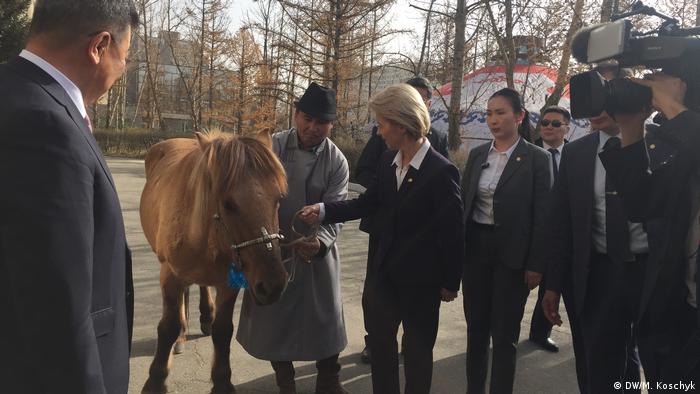
Von der Leyen pets her horse in Mongolia (DW/M. Koschyk)
The stop in Mongolia was the first on a trip that will also take her next to China, followed by Australia and Bahrain. The focus will be on security issues such as cyberattacks, hybrid threats, and the international fight against terrorism, von der Leyen told reporters in Berlin Friday before departing.
"Despite the long distance, the security situation in Asia directly affects Germany," she said. "That is why we must keep up our relationships and orient our policies towards the region."
Special gift, productive meeting

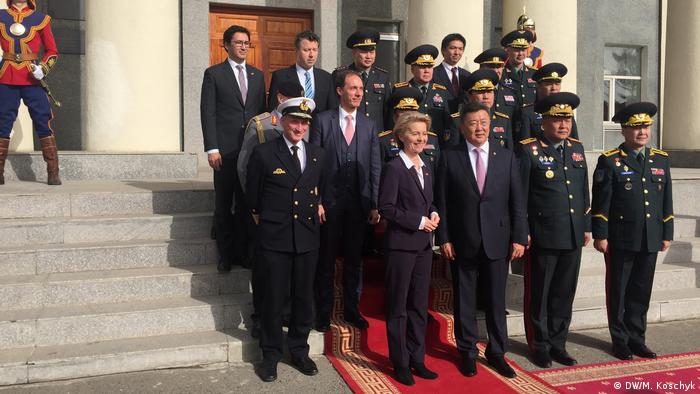
Ursula von der Leyen and Enkhbold stand on stairs surrounded by Mongolian military officials (DW/M. Koschyk)
After landing in the Ulaanbaatar, von der Leyen met with her Mongolian counterpart, Nyamaa Enkhbold, who also gave the German minister a Mongolian horse as an official state gift. In keeping with Mongolian custom, von der Leyen gave the horse a new name, whispering it into the animal's ear. Von der Leyen named the horse Andaa, a Mongolian word for "true friendship."
Horses are very important in Mongolian culture, and ownership is considered a sign of prestige. The country's horse population outnumbers its human one. 

In a joint press conference following talks, von der Leyen praised the long-term military cooperation between Germany and Mongolia, emphasizing their missions in Afghanistan. The two defense ministers signed a technical agreement outlining future cooperation.
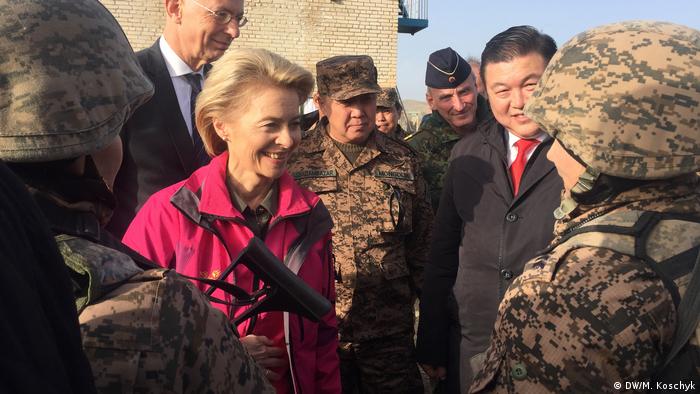
Von der Leyen also met with around 40 German soldiers who are stationed in Mongolia to help train the country's forces.
On to China, Australia and Bahrain
On Sunday von der Leyen will be in China, where she will meet with Chinese military officials the next day. She will then head to Australia. She will be present in Sydney on Thursday for the Invictus Games, a sports championship founded by Prince Harry of Britain for wounded, injured or sick armed services members from around the world.
She will finish up her Asia tour in Bahrain, where she will take part in the Manama Dialogue on Middle East security.

Von der Leyen meets with German troops who are training Mongolian soldiers (DW/M. Koschyk)
Von der Leyen met with German troops who are training Mongolian soldiers


Source:Deutche Welle, German TV news agency
Share:

German pledges 55-mln-euro aid to Mongolia

ULAN BATOR, Oct. 9 (Xinhua) -- Germany plans to offer non-refundable aid worth 55 million euros to support development projects in Mongolia for this year and next, Mongolian Foreign Affairs Ministry said Tuesday.
Negotiations were held here on Oct. 8-9 under the framework of bilateral technical and financial cooperation in 2018-2019 between the governments of Mongolia and Germany.
"We decided to provide the financial assistance for projects in the three priority sectors in Mongolia, namely energy efficiency, sustainable economic development and biodiversity," said Kathrin Oellers, the visiting head of the department for East Asia at the Federal Ministry of Economic Development and Development of Germany.
Over the past 25 years, Germany has provided a total of 450 million euros in aid to Mongolia.
Share:

German President lauds Mongolia as 'example' of democracy in the region

Germany's president has praised democratic progress in Mongolia, holding it up as a model example for neighboring Russia and China. Gauck is wrapping up a nearly week-long trip to East Asia.
President Joachim Gauck with Tsakhia Elbegdorj in Ulan Bator
German President Joachim Gauck said Thursday that he was impressed by Mongolia's efforts to "strengthen democracy and the rule of law."
"Your country is now in a position to give a good example of fair and free elections in the region," he said, adding that it was clear Mongolia "respects the principles of democracy, even if it's not always easy."
Unlike China and Russia, Gauck said, Mongolia had "chosen democracy and a market economy," and would have Germany's support in future development.
Earlier in the day, Gauck was received with military honors by President Tsakhiagiin Elbegdorj (above, left) in the capital, Ulan Bator. Gauck also met with students and teachers at the German-Mongolian Institute for Resources and Technology, founded in 2013 as part of a raw materials partnership between the two countries.
The German Federal Ministry for Economic Cooperation and Development has contributed 4 million euros ($4.6 million) to the project, which aims to train specialists in the mineral resource sector.
Rich in resources
Mongolia - more than four times the size of Germany and home to around 3 million people - is the world's least densely populated country. It also has a wealth of raw materials, with huge deposits of coal, copper, gold, uranium and rare earths. The country is largely dependent on exports to China, and resource-driven economic growth has started to slacken in recent years.
Behind the UK, Germany is Mongolia's principal trading partner in the European Union. During his visit, Gauck said he hoped to improve cooperation between Germany and Mongolia in several fields, including science, culture and research.
For decades, Mongolia was a tightly controlled satellite of the Soviet Union. But with the end of the Cold War, the country underwent a peaceful democratic revolution and subsequently introduced a multi-party political system and market economy.
Gauck's Asia trip ends Friday with a visit to the archaeological site of Karakorum, the former capital of the Mongol Empire under Genghis Khan. German funding has supported joint excavations at the site for the past two decades.
nm/ (AFP, dpa)
Share:

Mongolia a model of democracy for the region, German president says

Ulan Bator (dpa) - German President Joachim Gauck said Thursday that Germany was impressed with how Mongolia "respects the principles of democracy, even if it‘s not always easy."

"Your country is now in a position to give a good example in the neighborhood of fair and free elections," he said on a visit to the resource-rich country, which borders Russia and China.

He was received with military honours in the capital Ulan Bator by President Tsakhiagiin Elbegdorj, who said he would work to improve conditions for foreign investment.

Gauck also spoke with students and teachers at the German-Mongolian Institute for Resources and Technology. The college was founded in 2011 as a contribution to the raw materials partnership between the two countries.

The German Federal Ministry for Economic Cooperation and Development has provided 4 million euros (4.6 million dollars) for the project until 2016. There are currently around 75 students and several German teachers.

Mongolia is one of the richest countries in the world in terms of raw materials especially coal, copper, gold, uranium and rare earths that are used in the production of mobile phones among other products.

The country‘s economy is largely dependent on exports to China.

Mongolia has a population of around 3 million, making it the least densely populated country in the world.

Gauck was to end his Asia trip Friday with a visit to the archeological site of Karakorum, the former capital of the Mongol Empire under Genghis Khan, where joint excavations have been going ahead with German funding for 20 years.
Share:

German president in Mongolia for talks on raw materials, China

Ulan Bator (dpa) - German President Joachim Gauck was in resource-rich Mongolia Thursday for political talks as part of his Asian trip.

He was received with military honours by President Tsakhiagiin Elbegdorj in the capital Ulan Bator.

Gauck was scheduled to speak with students and teachers at the German-Mongolian Institute for Resources and Technology.

The college was founded in 2011 as a contribution to the raw materials partnership between the two countries.

The German Federal Ministry for Economic Cooperation and Development has provided 4 million euros (4.6 million dollars) for the project until 2016. There are currently around 75 students and some German teachers.

Mongolia is one of the richest countries in the world in terms of raw materials especially coal, copper, gold, uranium and rare earths that are used in the production of mobile phones among other products.

The country‘s economy is largely dependent on exports to China.

Mongolia is around four and a half times larger than Germany with a population of around 3 million people, making it the least densely populated country in the world.
Share:

Germany chancellor Merkel eyes airline, commodities cooperation with Mongolia

(Reuters) - Mongolian airlines want to intensify cooperation with German flag carrier Lufthansa , Chancellor Angela Merkel said on Tuesday after talks with Mongolian President Tsakhiagiin Elbegdorj that also touched on a commodities partnership.
At a joint news conference, Merkel said the two leaders had discussed the interest from Mongolian airlines in forging closer ties with Lufthansa.
"In Germany the government doesn't do that, the companies have to do it. We want to talk to Lufthansa to call their attention to the potential cooperation and maybe there can be an intensification of the cooperation between Lufthansa and Mongolian airlines," said Merkel.
Lufthansa was not immediately available for comment.
Merkel also emphasised Germany's interest in pursuing a commodities agreement signed in 2011 when she visited the Central Asian country.
Mongolia, which has Russia and China as its neighbours, has large quantities of natural resources including copper, gold, silver and uranium deposits. It also has big reserves of rare earths which the high-tech industry needs to make products.
Merkel outlined the difficulties involved in getting start-up financing for infrastructure and mining projects, and the need for infrastructure expansion in Mongolia.
"Thirdly, Mongolia has big neighbours who have their own ideas about infrastructure," said Merkel, pointing mainly to Russia and the need to discuss with Moscow ways to make exporting materials from Mongolia to Europe easier.
"I don't think that things are hopeless," said Merkel. (Reporting by Madeline Chambers; Editing by Mark Heinrich)
Share:

Mongolia: The official partner country of ITB Berlin 2015

Monday, 10th March 2014
Source : ITB Berlin
 
In 2015 Mongolia will be the Official Partner Country of ITB Berlin – on 5 March at this year’s ITB Berlin the signing will take place of the Partner Country agreement between Mongolia and ITB.

In 2015 the focus will be on Mongolia, the Partner Country of ITB Berlin. On Wednesday, 5 March 2014 at ITB Berlin, Mr. Altangerel Purev, State Secretary at the Ministry of Culture, Sports and Tourism of Mongolia, and Dr. Christian Göke, Chief Executive Officer of Messe Berlin GmbH, will officially sign an agreement between the world’s largest travel trade show and Mongolia, the Partner Country of the event.

“In its role as the Partner Country of ITB Berlin 2015 Mongolia will be sending out a clear signal as an emergent tourism destination. We are confident that Mongolia with its wealth of cultural and natural attractions and its eventful history will successfully present itself to the international market and that it will attract keen interest from both trade visitors and the general public“, said Dr. Christian Göke, CEO, Messe Berlin.

Mr. Altangerel Purev, State Secretary at the Ministry of Culture, Sports and Tourism of Mongolia,: “In 2011 Mongolia was already the Convention and Culture Partner of ITB Berlin and as the Partner Country of ITB Berlin 2015 we aim to build on that success and promote public awareness of Mongolia as a travel destination. Germany is an important market for us. Mongolia has maintained diplomatic relations with Germany for the past 40 years. Furthermore, we regard tourism as a long-term opportunity that diversifies our economy. Mongolian companies are also very keen to actively cooperate with the international tourism industry.”

'Everything except ordinary’ is how one could briefly describe this central Asian travel destination, which to date remains relatively unknown. The fascinating culture of Mongolia’s nomads, its almost endlessly undulating green steppes, its mystic traditions harking back to the legendary Genghis Khan and many other outstanding facets of Mongolia already await visitors to Hall 26 at this year’s ITB Berlin. 
Share:

Germans back 52MW in Mongolia

Germans back 52MW in Mongolia image
Germany-based Ferrostaal Industrial Projects is taking a majority stake in the 52MW Sainshand wind farm in Mongolia.
The project will be the largest wind facility in the country and total investment investment will be some $120m.
Local developer Sainshand Wind Park LLC already has a power purchase agreement and all licences in place, the company said. Grid connection is expected as early as end-2015.
“As project developers, our skills in the areas of project management, financing, engineering and contracting are in high demand. In this regard we have already joined forces with asset management experts from Ferrostaal Capital and initiated talks with international investors,” said Ferrostaal Industrial Projects mabaging director Klaus Lesker.
Image: Mongolia’s first commercial wind farm was the 50MW Salkhit (EBRD)
Share:

Release of Alleged Spy Angers German Investigators

nly weeks before German Chancellor Angela Merkel's visit to Ulan Bator, a court in Germany ruled that a Mongolian official detained as part of an investigation into an illegal kidnapping must be released. Criminal investigators here say the decision was "removed from reality" and "counterproductive".
Official visits between heads of state, worldwide, follow strict protocols and schedules determined far in advance. That means the schedule on Thursday, when German Chancellor Angela Merkel carries out the official part of her visit to Mongolia, is already common knowledge. First, the Mongolian prime minister will welcome the chancellor to Ulan Bator, the capital, with military honors. Then she is scheduled to meet with Mongolia's president, followed by lunch with the prime minister.

In between, scheduled for precisely 10:15 a.m., comes the signing of a trade agreement. Mongolia, once the heart of Genghis Khan's empire, is considered a highly attractive emerging market, with a small population but large reserves of coal, iron ore, copper and gold. Berlin provides development aid totaling around €25 million ($34 million) annually. That provides a number of conversation topics during a visit that will last only a few hours, meaning there likely won't be time to discuss the case of Bat Khurts, the head of Mongolia's National Security Council. The case, which played out across France, Belgium, Great Britain and Germany, reads like a political murder mystery. And it caused a battle between the highest institutions in German jurisprudence: the Federal Prosecutor's Office and the Federal Court of Justice.
Like any murder mystery, it began with a killing.
On Oct. 2, 1998, in Ulan Bator, a masked duo, or perhaps an entire gang, broke into the home of Sanjasuuren Zorig, the country's young infrastructure minister, a leading member of the Democratic Union and a man with an excellent shot at becoming prime minister. The attackers killed Zorig, 36, by stabbing him and striking him with an axe. The brutal crime served as a setback to the country's fledgling democracy movement. The former communist party, MPRP, returned to power with a promise to track down the murderers, presumably hoping to gain favor with the people. In other words, they needed to find a guilty party.
A Spook at the Center
The man who came under suspicion -- or toward whom suspicion was directed -- was Enkhbat Damiran, who was 43 at the time. If the account of Mongolian authorities is to be believed, he was sent to a penal colony as a teenager and later to prison for theft, assault and fraud. He was released in late July 1998, they say, two months before Zorig's murder. In 2000, and this much has been confirmed: Damiran immigrated to Germany with his family. In 2002, he moved to France and applied for asylum there under an assumed name. Around this time, Mongolia's Interpol branch began searching for him again -- though not in relation to the Zorig case, according to German investigators.
When these police actions proved unsuccessful, Mongolian authorities came up with another idea: abduct Damiran and pin the political murder on him back home. It's unclear who precisely gave the order to do so. Mongolia's attorney general and the former ambassador to Berlin later claimed the country's intelligence agency acted alone.
That's a curious defense, given the body of evidence -- and this is where Bat Khurts comes into the picture. According to investigations by two German institutions, the Federal Office of Criminal Investigation and the Federal Prosecutor's Office, it is believed that Khurts was an intelligence agent for Mongolia, although he was officially working as First Secretary at the Mongolian Embassy in Budapest.
Two women, one of whom knew Damiran personally, allegedly led Khurts to him in May 2003, in the northern French port city of Le Havre. Damiran was lured into a trap, overpowered, drugged and brought first to Brussels, and then to Berlin. On May 18, his abductors flew him out of Germany on a jet belonging to the Mongolian national airline, MIAT. They presented him to airport border guards as a Mongolian minister who had gotten into a fight in Brussels and urgently needed to be brought back home. According to witness testimony, Shirbazar Altansukh, consul at the Mongolian Embassy in Vienna, contrived this story. Altansukh was later removed from his post. The embassy declined to comment on the matter to SPIEGEL.
Legally speaking, Damiran's ordeal up to this point could be defined as nothing more than false imprisonment and assault. But German federal prosecutors classified what followed in Ulan Bator as a "Verschleppung," the German word that, in legal terms, is used to mean a specific type of abduction driven by political motives. As an offense against national security, this fell under the jurisdiction of the Federal Prosecutor's Office.
In Ulan Bator, Damiran was told to confess to Zorig's murder and to name who had hired the hit, perhaps a prominent politician from Zorig's party. Damiran insisted he'd had nothing to do with the crime. He insisted it once, twice and a third time.
Masked men sat in front of him, Damiran said in describing one interrogation, and "two civilians with guns stood behind me. I was shaking." He said he was so weak that he fell from his chair many times, and he also described a mock execution in the woods near the capital.
'The Charges Were Clearly Invented'
Damiran had his defense attorney, Lodoisambuu Sanjaasuren, to thank for making a record of these statements. Sanjaasuren smuggled a video camera into the cell and recorded his client's statements, in a video of just under 40 minutes. On Sept. 27, 2003, about four months after Damiran's forcible return to his homeland, the Mongolian private TV channel 25 broadcast the video.
Soon after, the country's attorney general dismissed the murder charge against Damiran, on grounds that there was no incriminating proof. Viennese law professor Manfred Nowak reinvestigated the case on behalf of the United Nations and reached the same conclusion but with different reasons. The case was dropped, Nowak believes, "because the charges were clearly invented."
However, Damiran remained in custody. As a result of the TV broadcast of his statements, he was then charged with betraying state secrets, for which he was sentenced to three years in prison. Critically ill, he was released on April 17, 2006, and died only five days later.
His family has since filed charges with the French police, who turned the case over to the Germany's Federal Office of Criminal Investigation (BKA) in Karlsruhe. The BKA in turn engaged the Federal Prosecutor's Office, and the investigating judge at the Federal Court of Justice issued a warrant that soon went into effect across Europe.
Agent Khurts was now a German case, file number 1 BGs 13/2006. By then the head of Mongolia's National Security Council, Khurts arrived at London's Heathrow Airport on Sept. 17, 2010, for diplomatic talks in Britain, only to be arrested at passport control. He claims he was lured into a trap, and should be protected by diplomatic immunity as well. Two different courts rejected both of these arguments. After 10 months in custody, Khurts was extradited to Germany, arriving in Berlin on August 19 of this year.
Release Criticized by Prosectutors

Soon, though, the Federal Court of Justice released Khurts at the request of his defense attorneys, Frankfurt lawyer Egon Geis and his Berlin colleague Rolf-Werner Bock. Geis maintained his client had "tracked down Damiran and brought him to Berlin, nothing more." The judges at the court's Third Criminal Division declared that the attack on Damiran hadn't been "Verschleppung," the type of abduction charged, since the "injured party wasn't facing political persecution." Even then, the ruling continued, it wouldn't have qualified as "Verschleppung" if there was "danger that the foreign state would ... resort to means which are unacceptable from a legal point of view and which would endanger the victim in life and limb." Observers of Germany's justice system have long been aware of in-fighting between the court division responsible for state security and the Federal Prosecutor's Office. The ruling on Khurt's case, sources with knowledge of the investigation say, was not only "removed from reality," but also "counterproductive."
Upon arrival in Ulan Bator two weeks ago, the long-detained secret agent was met by TV teams, and the deputy foreign minister shook his hand. British newsmagazine The Economist commented wryly that many in Mongolia likely believe Khurt's release "is a goodwill gesture intended to smooth Mrs. Merkel's way" during her upcoming visit.

Source:www.spiegel.de
Share:

Germany's Merkel plans first visit to Mongolia


Berlin - Angela Merkel will be the first German chancellor to visit Mongolia when she heads to Asia for a three-day visit next week, officials in Berlin said Friday.
Merkel, who will be accompanied by a delegation of businessmen, will also be visiting Vietnam, where she plans to meet with Vietnamese Premier Nguyen Tan Dung on Tuesday. The day will also include meetings with religious leaders, German government spokesman Steffen Seibert said Friday.
On Wednesday, she is set to fly to Ho Chi Minh City and meet with student groups before traveling to Ulan Bator, in Mongolia.
In Mongolia she is expected to meet both President Tsakhia Elbegdorj and Prime Minister Skuhbaatar Batbold as well as members of civic organizations.
A talk with Mongolian members of the ISAF contingent in Afghanistan, as well as with their German trainers, is also on the agenda.

Source:Deutsche Press Agentur


Share:

Facebook page

Powered by Blogger.

Categories

Advertising in Mongolia An Asian Development Bank Culture Editorial of the Mongolianviews education Environmental protection Famous Mongolians Foreigners in Mongolia Inner Mongolia Ivanhoe Mines Mongolia Adventure Mongolia agriculture Mongolia air pollution Mongolia analysis Mongolia and Armenia Mongolia and Asian Development Bank Mongolia and Australia Mongolia and Azerbaijan Mongolia and Belorussia Mongolia and Bulgaria Mongolia and Cambodia Mongolia and Canada Mongolia and central Asia Mongolia and China Mongolia and Cuba Mongolia and Czech Mongolia and donors Mongolia and EU Mongolia and Germany Mongolia and Hongkong Mongolia and Hungary Mongolia and IFC Mongolia and IMF Mongolia and Ind Mongolia and India Mongolia and Indonesia Mongolia and Inner Mongolia Mongolia and Iran Mongolia and Israel Mongolia and Italy Mongolia and Japan Mongolia and Kazakhstan Mongolia and Korea Mongolia and Kuwait Mongolia and Kyrgyzstan Mongolia and Malaysia Mongolia and Nato Mongolia and North Korean Mongolia and Poland Mongolia and Qatar Mongolia and Russia Mongolia and Russia and Mongolia and China Mongolia and Singapore Mongolia and South Korea Mongolia and Taiwan Mongolia and Thailand Mongolia and the world Mongolia and Tibet Mongolia and Turkey Mongolia and UK Mongolia and Ukraine Mongolia and UN Mongolia and US Mongolia and USA Mongolia and Vietnam Mongolia Banking Mongolia blind Mongolia Cashmere Mongolia Christianity Mongolia civic society Mongolia Corruption Mongolia crime Mongolia diplomacy Mongolia Economy Mongolia Education Mongolia Energy Mongolia environment Mongolia Finance Mongolia Health Mongolia History Mongolia holiday Mongolia in international media Mongolia Industries Mongolia investment Mongolia Joke Mongolia law Mongolia LGBT Mongolia medical Mongolia military Mongolia Mining Mongolia Mining Developments Mongolia Mortgage Mongolia natural disaster Mongolia news media Mongolia Nuclear Mongolia Petroleum Mongolia Politics Mongolia Poverty Mongolia public announcements Mongolia railways Mongolia Religion Mongolia slums Mongolia society Mongolia Sports Mongolia Stamp Mongolia Sumo Mongolia telecommunication Mongolia tourism Mongolia trade Mongolia Transportation Mongolia Urbanization Mongolia Wild Life Mongolian Agriculture Mongolian and Cuba Mongolian Archeology Mongolian Climate Mongolian Food Mongolian Gay Mongolian Government news Mongolian History Mongolian Kazakh Mongolian Meat Mongolian Military Mongolian Mining Development Mongolian Movie Mongolian News Mongolian Parliament Mongolian Political news Mongolian Press Mongolian Songs Mongolian Sumo Mongolian Women Mongolian Youth Mongolians abroad Moninfo Opinion Oyu Tolgoi Investment Agreement Photo news Press Release Rio Tinto Tavan Tolgoi coal mine Ulaanbaatar development Weird expatriates in Mongolia World bank and Mongolia

Blog Archive

Followers