Showing posts with label Mongolia and Israel. Show all posts

IDF officers train UN peacekeepers in medical care in Mongolia exercise

2 Israeli medical officers join annual Khaan Quest drill, working with soldiers from dozens of countries – including Qatar and Malaysia, which have no diplomatic ties with Israel


By Judah Ari Gross for Times of Israel

A pair of Israeli medical officers took part in a two-week exercise in Mongolia last month, training United Nations peacekeepers from around the world, including countries with which Israel does not have diplomatic ties, in basic first aid and combat medicine.
Over 35 countries participated in the 17th annual Khaan Quest exercise outside the Mongolian capital of Ulaanbaatar. This was Israel’s first time taking part in the event.
IDF Cpt. Dr. Kobi Weissmehl trains United Nations peacekeepers from Nepal during the Khaan Quest exercise in Mongolia in June 2019. (Israel Defense Forces)
The exercise was made up of 12 stations in which UN peacekeeping troops learned everything from crowd control to mine-clearing and how to set up a checkpoint.

Maj. Roy Stern and Cpt. Dr. Kobi Weissmehl from the Israel Defense Forces worked alongside the United States’ Alaska Army National Guard and the Mongolian Armed Forces at the medical care station.

“This was an extension of Israel’s humanitarian efforts over the years,” Stern, the head of medical training at the IDF’s Tzeelim base, told The Times of Israel.
The IDF has garnered an international reputation for its responses to natural disasters around the world, dispatching medical and search-and-rescue teams within days, sometimes hours, of an earthquake, tsunami or similar large-scale tragedy. IDF field hospitals also received top ranks by the World Health Organization in 2016, making Israel the first country in the world to earn such a designation.
“Israel has a lot of experience in this field. We’ve done a lot in medicine and in humanitarian missions,” said Weissmehl, the chief medical officer for the Armored Corps’ 460th Brigade.
Stern, a 39-year-old father of three, said he and Weissmehl worked to bring all of the UN peacekeeping troops who took part in the exercise up to the same level in terms of medical training, as they came with varying degrees of experience.
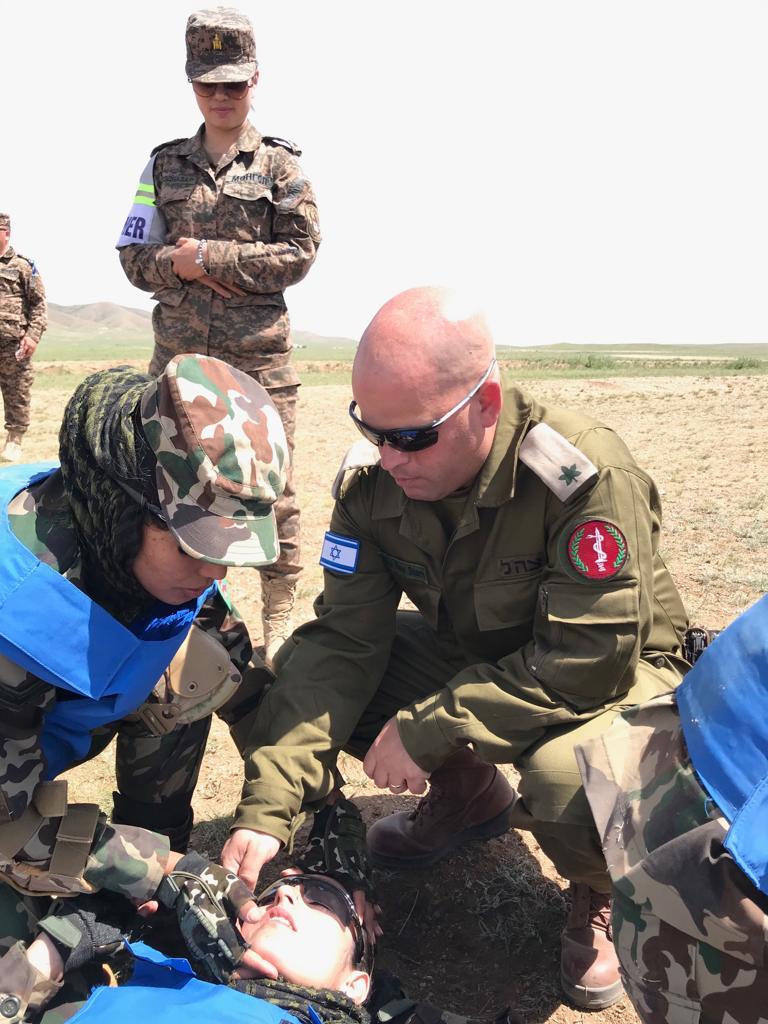
IDF Maj. Roy Stern trains United Nations peacekeepers during the Khaan Quest exercise in Mongolia in June 2019. (Israel Defense Forces)
They taught the recruits how to use tourniquets and bandages to stop bleeding, how to safely load someone onto a stretcher and move them, and numerous other aspects of combat medicine and first aid.
“We gave them basic, important tools to treat casualties,” Stern said.
Stern said they also tried to learn from the peacekeepers who participated in the exercise, asking them to demonstrate their military’s first aid methods.
“How we do it is good, but how they do it is no less good,” he said.
Stern said some of the UN peacekeepers had previously served on missions along Israel’s borders with Lebanon and Syria or were due to be stationed there shortly, notably the delegation from Fiji.

Weissmehl, 30, noted that besides the professional aspects of the exercise, Khaan Quest also gave him and Stern the opportunity to interact with and befriend military officials from around the world.
IDF Maj. Roy Stern and Cpt. Dr. Kobi Weissmehl train United Nations peacekeepers during the Khaan Quest exercise in Mongolia in June 2019. (Israel Defense Forces)
“It is an incredible feeling to make friends from Fiji, New Zealand, China,” he said.
Most of the countries that participated in the exercise maintain diplomatic ties with Israel, but not all.
Qatar, which often works closely with Israeli officials on issues related to the Gaza Strip but does not have formal relations with Jerusalem, took part in Khaan Quest, as did Malaysia, which often refuses to allow Israeli athletes to compete in tournaments held in the country.
Stern said they could not comment on any interactions they may have had with representatives from these countries.

In addition to the casual interactions, the organizers of the exercise — from the Mongolian and US militaries — also staged cultural events in which countries with larger delegations demonstrated traditional dances, songs and practices, Weissmehl said.
IDF Maj. Roy Stern and Cpt. Dr. Kobi Weissmehl train United Nations peacekeepers during the Khaan Quest exercise in Mongolia in June 2019. (Israel Defense Forces)
As there were only two of them, the Israeli delegation did not make such a presentation.

IDF Maj. Roy Stern and Cpt. Dr. Kobi Weissmehl train United Nations peacekeepers during the Khaan Quest exercise in Mongolia in June 2019. (Israel Defense Forces)
Share:

MONGOLIA'S ABSENCE AT UN ISRAEL VOTES SIGNALS WARMING TIES

Surprisingly, the massive, land-locked Asian country's interests align with Israel's.


By Herb Keinon

A look at Mongolia’s voting record on Israel over the last few months shows an interesting pattern – the land-locked country sandwiched between Russia and China does not, like it’s two giant neighbors, reflexively vote against Israel in the UN.
Nor does it vote for Israel or abstain. Mongolia simply does not show up to vote.

If this had happened once, then it could be chalked up to the Mongolian envoy to the UN getting tied up in traffic. The same could be true if it happened twice. But if it happens again and again then it reveals a pattern apparently born of a conscious decision, and is seen in Jerusalem as a manifestation of warming ties between Israel and Mongolia.

Mongolia – a country of just over three million people – was not in the room when the UN General Assembly passed its anti-Israel resolution on Gaza last week. It was not in the room in May when the UN Human Rights Committee in Geneva voted to establish an investigative committee into violence at the Gaza fence. And it was not in attendance in December when the General Assembly condemned the US for moving its capital to Jerusalem.

Hagai Shagrir, deputy head of the Foreign Ministry’s Asia-Pacific department, said Israel very much appreciates this pattern, and that Jerusalem is working hard to change the voting patterns in Asia.

“Mongolia is very friendly, like-minded, democratic country with whom it is important for Israel to strengthen ties,” he said. Shagrir said these friendly ties will manifest themselves in two weeks time when the two countries hold a diplomatic dialogue.

Israel does not have an embassy in Mongolia, nor does Mongolia have one in Israel, and Jerusalem’s interests in the country are represented by Israel’s ambassador in China, who travels to Mongolia three times a year.


Mongolia’s foreign minister visited Israel last August, and Z. Enkhbold – the chief of staff of President Khaltmaa Battulga – attended the AIPAC annual policy conference in Washington in March. Shagrir said, however, that Mongolia’s interests in stronger ties with Israel are not part of efforts to draw closer to the United States.

Battulga wrote a letter to President Reuven Rivlin on the occasion of Israel’s 70th anniversary earlier this year, wishing his “heartfelt congratulations” on the “historic occasion.”

“Mongolia and Israel are nations with ancient history and culture, and I am delighted to note that, presently, the cooperation between the two countries and the close relations between our two people are growing,” he wrote.

Mongolia’s interests in ties with Israel are believed to be based on three pillars. 

First – as reflected in Battulga’s letter – there is a deep respect in Mongolia for a civilization that has maintained its traditions for thousands of years.

Secondly, the Mongolians have border security concerns, primarily on the Chinese border, and are interested in learning from Israel expertise about border security issues.

Finally, former US secretary of state John Kerry once referred to Mongolia as an “oasis of democracy” in a very tough neighborhood, and the Mongolians are looking to learn from the experience of Israel, which they recognize is a country very much in a similar predicament.


Source:The Jerusalem Post

Share:

Facebook page

Powered by Blogger.

Categories

Advertising in Mongolia An Asian Development Bank Culture Editorial of the Mongolianviews education Environmental protection Famous Mongolians Foreigners in Mongolia Inner Mongolia Ivanhoe Mines Mongolia Adventure Mongolia agriculture Mongolia air pollution Mongolia analysis Mongolia and Armenia Mongolia and Asian Development Bank Mongolia and Australia Mongolia and Azerbaijan Mongolia and Belorussia Mongolia and Bulgaria Mongolia and Cambodia Mongolia and Canada Mongolia and central Asia Mongolia and China Mongolia and Cuba Mongolia and Czech Mongolia and donors Mongolia and EU Mongolia and Germany Mongolia and Hongkong Mongolia and Hungary Mongolia and IFC Mongolia and IMF Mongolia and Ind Mongolia and India Mongolia and Indonesia Mongolia and Inner Mongolia Mongolia and Iran Mongolia and Israel Mongolia and Italy Mongolia and Japan Mongolia and Kazakhstan Mongolia and Korea Mongolia and Kuwait Mongolia and Kyrgyzstan Mongolia and Malaysia Mongolia and Nato Mongolia and North Korean Mongolia and Poland Mongolia and Qatar Mongolia and Russia Mongolia and Russia and Mongolia and China Mongolia and Singapore Mongolia and South Korea Mongolia and Taiwan Mongolia and Thailand Mongolia and the world Mongolia and Tibet Mongolia and Turkey Mongolia and UK Mongolia and Ukraine Mongolia and UN Mongolia and US Mongolia and USA Mongolia and Vietnam Mongolia Banking Mongolia blind Mongolia Cashmere Mongolia Christianity Mongolia civic society Mongolia Corruption Mongolia crime Mongolia diplomacy Mongolia Economy Mongolia Education Mongolia Energy Mongolia environment Mongolia Finance Mongolia Health Mongolia History Mongolia holiday Mongolia in international media Mongolia Industries Mongolia investment Mongolia Joke Mongolia law Mongolia LGBT Mongolia medical Mongolia military Mongolia Mining Mongolia Mining Developments Mongolia Mortgage Mongolia natural disaster Mongolia news media Mongolia Nuclear Mongolia Petroleum Mongolia Politics Mongolia Poverty Mongolia public announcements Mongolia railways Mongolia Religion Mongolia slums Mongolia society Mongolia Sports Mongolia Stamp Mongolia Sumo Mongolia telecommunication Mongolia tourism Mongolia trade Mongolia Transportation Mongolia Urbanization Mongolia Wild Life Mongolian Agriculture Mongolian and Cuba Mongolian Archeology Mongolian Climate Mongolian Food Mongolian Gay Mongolian Government news Mongolian History Mongolian Kazakh Mongolian Meat Mongolian Military Mongolian Mining Development Mongolian Movie Mongolian News Mongolian Parliament Mongolian Political news Mongolian Press Mongolian Songs Mongolian Sumo Mongolian Women Mongolian Youth Mongolians abroad Moninfo Opinion Oyu Tolgoi Investment Agreement Photo news Press Release Rio Tinto Tavan Tolgoi coal mine Ulaanbaatar development Weird expatriates in Mongolia World bank and Mongolia

Blog Archive

Followers