Showing posts with label Mongolia Wild Life. Show all posts

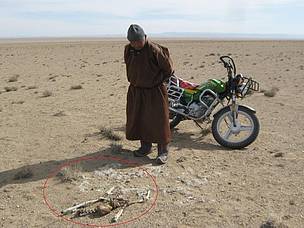
Two poachers of endangered snow leopard arrested in Mongolia

ULAN BATOR, July 25 (Xinhua) -- Two men involved in poaching an endangered snow leopard have been arrested, the Mongolian police said Thursday.
The two suspects in their 50s were arrested on Monday while attempting to sell the hide of the snow leopard in the Songino Khairkhan district of Ulan Bator, the National Police Agency said in a statement, noting that the investigation is still underway.
If convicted of poaching and killing endangered animals, each man faces at least two years imprisonment and a fine of 10 million tugriks (3,752 U.S. dollars) or more.
Poaching snow leopards has been increasing in Mongolia in recent years, as perpetrators covet their bones to sell them in traditional Asian medicine markets, Mongolia's director of World Wide Fund for Nature told Xinhua in March.
It is estimated that only 800 to 1,200 snow leopards remain in Mongolia, while the exact figure of the elusive animal is difficult to determine.
Share:

Fewer than 3,800 Mongolian Saiga antelopes remain in Mongolia: WWF

ULAN BATOR, March 19 (Xinhua) -- Merely 3,800 Mongolian Saiga antelopes, a critically endangered species, existed in Mongolia at the end of 2018, down nearly 40 percent year on year, according to the World Wide Fund for Nature (WWF)-Mongolia on Tuesday.
The decline is mainly due to drought-related food shortage, WWF-Mongolia Director Dorjgurkhem Batbold told Xinhua.
"The Saiga antelope population of Mongolia has been very unstable for many years. Several factors, including infectious diseases, harsh weather conditions and poaching, have negatively affected the growth of the population," said Batbold.
The species' population has suffered a roller coaster since 2001 when its number declined to only 750 following a summer drought and a harsh winter, he said.
Due to continuous efforts by the WWF-Mongolia and MAVA foundation, it had risen to 14,000 by 2016, he added. However, a combination of an outbreak of goat plague and the extreme wintry weather locally known as "dzud" in 2017 reduced the number to 5,000.
To help the species overcome harsh winters, experts from the WWF have been taking desperate emergency actions, including putting a ton of additional hay or 400 bundles in the animal's ranges over the past winter, according to Batbold.
In addition, the WWF-Mongolia started implementing an initiative called "GG-6" (Great Gobi's or Gobi's Gracious Six) since 2016 to sustain the Gobi's ecosystem using six iconic species, among which are the Mongolian Saiga antelopes, he said.
"Joint efforts are needed to protect endangered species," Batbold said, urging governments and international non-governmental organizations to protect the Saiga antelopes and others.
To prevent the extinction of the antelopes that currently live in western Mongolian provinces, including Govi-Altai, Khovd and Uvs, it is necessary to relocate them, according to the WWF-Mongolia.
This year, the WWF-Mongolia is planning to conduct studies on relocation within Mongolia, and more funding is required for the endeavor in the years ahead, said Batbold.
Share:

Plastic waste is a threat to Mongolian saigas

Plastic waste is a threat to rare species of Gobi Desert, not just marine animals. A ranger from Bayan-Uul soum, Gobi-Altai province of Mongolia found a saiga carcass in Khuisiin Gobi of Altai Sayan Ecoregion. According to him, the Mongolian saiga had eaten a plastic bag and the stomach still wasn’t decomposed. In recent years, rural people have been using plastic bags a lot and it’s common to see plastic waste in the Gobi desert. Unfortunately, it is clear that rare animals, such as Mongolian saigas are eating plastic waste due to scarce food.

Plastic waste is a threat to rare species of Gobi Desert, not just marine animals. A ranger from Bayan-Uul soum, Gobi-Altai province of Mongolia found a saiga carcass in Khuisiin Gobi of Altai Sayan Ecoregion. According to him, the Mongolian saiga had eaten a plastic bag and the stomach still wasn’t decomposed. In recent years, rural people have been using plastic bags a lot and it’s common to see plastic waste in the Gobi desert. Unfortunately, it is clear that rare animals, such as Mongolian saigas are eating plastic waste due to scarce food.
In the meantime, WWF-Mongolia initiated “Plastic free rivers” initiative to engage stakeholders in the process of reducing plastic waste from rivers. The start of this initiative has begun in July 2018 to remove plastic waste from the Kherlen River from the eastern part of the country. Within the scope of this work, the community organized large cleanings along the Kherlen River and actively promoting the public awareness of plastic wastes.

Source:WWF
Share:

FOUR PRZEWALSKI HORSES TRANSPORTED TO MONGOLIA

A Czech military plane has transported four Przewalski mares to Mongolia for reintroduction into the wild, part of Prague Zoo’s long-standing programme to save the endangered species. The horses arrived in Mongolia on Wednesday morning. 
Przewalski horse is a rare subspecies native to Mongolia, which became extinct in the wild in the 1960s. Prague Zoo has played a major role in saving the horse, breeding it and gradually returning it to its natural environment. 
To date, the zoo has sent 31 horses to a nature reserve in the Mongolian steppe, where they have started breeding successfully.
Share:

Rare Gobi bear-Mazaalai has been spotted drinking water from water well in Mongolia because of drought

Gobi bear known as Mazaalai has been spotted in desolate desert in Western Mongolia, according to Mongolian social media.

Several pictures of Gobi bear at a water well in a place called Muhariin Khudag, Khongor tolgoi, Bayanbuural bagh, Delger county of Gobi-Altai province on June 7, 2018 was posted on facebook.

The pictures show a lone Gobi bear hanging around a water well and drinking water. The pictures show the bear is not that emancipated considering current almost  drought like situation in Mongolia.

No rain has fallen in Mongolia until now. If this continues, drought is expected this summer. This means, no grass for the livestock animals and no wheat and basic vegetables such as potato, carrots, cabbages will grow.

Most likely this bear is forced to come to water well because there is no other water source or spring in his habitat. 

Mazaalai is almost on edge of extinction and mostly habitat  Gobi areas of Mongolia and People's Republic of China.

Image may contain: sky, cloud, outdoor and nature


Image may contain: outdoor


Image may contain: cloud, sky, outdoor and nature
Share:

Critically Endangered Mongolian Saiga Antelope Population Drops by 40 Percent, WWF Survey Shows

Ulanbaatar, Mongolia – WEBWIRE – 
Populations of the critically endangered Mongolian saiga antelope (hereinafter ‘saiga’), which occurs only in Mongolia, have plummeted by 40 percent following large die-offs due to a harsh winter, World Wildlife Fund (WWF) announced. The findings of a population survey show around 3,000 saiga remaining after the brutal winter kept them from their food source of natural hay.
“Mongolia’s saiga antelope population has been suffering for several years now from a combination of disease and harsh weather conditions, so this news is extremely worrying,” said Chimeddorj Buyanaa, WWF-Mongolia Conservation Director.  “WWF and the Government of Mongolia are doing everything they can to prevent them going extinct but urgent action and support is needed.” 
The saiga population has suffered a roller coaster ride since 2001 when the numbers dropped to only 750 animals following a summer drought and a heavy winter. However, thanks to continuous conservation efforts by WWF and the Government of Mongolia, the population increased to 14,000 and its range increased by 13 percent in 2014. But then an outbreak of goat plague reduced the numbers to 5,000 in 2017. Poaching has also reduced the saiga population.  
To help conserve the species over the winter, WWF-Mongolia specialists and officers took emergency actions such as putting additional hay, forage food and salt licks in saiga distribution ranges. They monitored the results of their emergency actions through automatic cameras placed in the field and found that the saiga individuals were feeding on the hay. 
The survey of the saiga populations was performed by WWF-Mongolia in April 2018 in order to identify the current population size and compare it to those in the previous year, in addition to assessing their mortality rates. The team used a transect method for the survey within the saiga distribution range and counted about 3,000 saiga individuals, resulting in a 40 percent reduction from the March 2017 data.
According to the researchers, the saiga distribution areas are still lacking natural hay to be eaten, forcing the populations to travel large distances in search of food. This means that strategic conservation actions are needed, including setting aside breeding and calving areas for conservation and preservation of the saiga herds. In addition, detailed studies on saiga genetic survivability/capability are required to prevent this unique, globally important species from going extinct in Mongolia.


Source:WWF
Share:

Mongolian antelopes heading towards extinction

2,500 Mongolian saiga antelopes have died since December 2016 due to a livestock virus


Wildlife species usually go extinct due to various reasons like climate change, global warming and development related to a better life for humans but, in the case of the Mongolian #Saiga Antelope, the reason is a disease that has come from other animals.

For more,
go to:

Share:

A Deadly Virus in Mongolia Threatens Cashmere and Local Food Supplies

The plague-like virus is killing thousands of animals, including sheep, Cashmere goats and the endangered saiga.

By Jen Viegas

Thousands of animals have suddenly died in western Mongolia due to a virus that is afflicting sheep, Cashmere goats and the endangered saiga, which is an Asian antelope.
Wildlife Conservation Society (WCS) veterinarians have raced to the area in hopes of containing the epidemic, which is threatening not only these and other animals, but also the welfare of people living in the region.
The cause is believed to be a virus known as "Peste des Petits Ruminants," or PPR. People are not thought to be at risk for the viral disease that most commonly sickens goats and sheep. It can cause fever, digestive problems, pneumonia and sometimes death. The virus was first reported in 1942 at Africa's Ivory Coast, but has since spread to other countries around the globe.
"PPR is a serious disease of domestic small ruminants," WCS Mongolia country director Enkhtuvshin Shiilegdamba told Seeker. Ruminants are hoofed mammals that chew cud. "Mongolia's food security — sheep — and a significant component of its economy — Cashmere goats — are dependent on livestock."
While resulting food shortages would likely only impact locals, the luxurious cashmere wool is transported all around the world, so the epidemic could affect its supply.
Shiilegdamba and her colleagues believe that the virus was transmitted from China through goats and sheep. There is a vaccine, so it is being given to as many animals as possible now.
It is difficult to vaccinate wildlife, however, which are dying by the thousands. An estimated 2,500 saiga have recently perished, taking out a quarter of the local population of this already endangered antelope, according to WCS.
This die-off suggests that saiga antelope are highly susceptible to the disease and it is likely that over half of the population will be lost in this initial wave of disease transmission," Shiilegdamba said.
PPR is also believed to infect gazelle, ibex, endangered wild Bactrian camels, wild boars and other animals. The deaths of these animals are expected to hurt apex predators, such as wolves and snow leopards, which are endangered and on the IUCN Red List of Threatened Species.
"All of the currently affected species are snow leopard prey, and mass mortalities may lead to depletion of snow leopard food resources and may increase the livestock and wildlife conflict, as snow leopards are likely to attack livestock if their major prey species are depleted," Shiilegdamba said.
"Herders may shoot if wildlife attacks their livestock or their herd, and may create a big conflict," continued Shiilegdamba. "All of this becomes evidence of ecosystem disturbance."
Even birds of prey are expected to be affected, since they feed on young saiga and Mongolian gazelle during calving season.
During breeding and calving seasons, Mongolian gazelle form large groups, which Shiilegdamba suspects "makes it very easy for the virus to move quickly through an entire population."
As of now, the virus continues to spread and has not been contained. The current scene is quite grim, with veterinarians in protective clothing incinerating piles of dead animals, hoping to prevent the virus' spread.

Close-up of a saiga. Credit: WCS Mongolia

Burning saiga carcasses. Credit: WCS Mongolia


Source:Source:http://www.seeker.com/a-deadly-virus-in-mongolia-threatens-cashmere-and-local-food-supplies-2245495098.html
Share:

Mongolia To Create New Protected Area for Snow Leopards

Mongolia’s Parliament declares Tost a State Protected Area. The mountain range is home to a stable, breeding population of snow leopards.

A new dawn in Tost. Photo by SLCF Mongolia/SLT
The Great Ikh Hural, Mongolia’s parliament, has approved a proposal to turn the Tost Mountains, a prime snow leopard habitat in the country’s South Gobi province, into a Nature Reserve, one of four categories of State Protected Areas under Mongolian law. Under this designation, only traditional economic activities such as livestock grazing that aren’t harmful to nature will be allowed, while mining, construction, and hunting will be prohibited.
The Snow Leopard Trust would like to express its gratitude and appreciation to the Mongolian parliament, and in particular to Members of Parliament Erdenchimeg Luvsan and Oyungerel Tsedevdamba, who led a Parliamentary delegation with 5 fellow members who championed the proposal.
We would like to congratulate the local government at Gurvantes and the provincial government of South Gobi – and most of all Tost’s local communities, who have championed the idea of protecting this important snow leopard habitat for many years.

One of the largest protected habitats in the world

“This is a huge step forward for the protection of the endangered snow leopard in this part of its range”, says Charu Mishra, the Snow Leopard Trust’s Science & Conservation Director. “This Nature Reserve will be a bridge between two existing Protected Areas, the Great Gobi and the Gobi Gurvansaikhan National Park. The resulting landscape will be one of the world’s largest continuous protected snow leopard habitats.”
Under Mongolian law, the government will now appoint a working group, consisting of members of several relevant government agencies and public sector partners, to work out the specifics of the new National Park, including its precise boundaries. The Government has 60 days to complete this task.
A map of Mongolia, showing the proposed area for Tost Nature Reserve (red) and existing Protected Areas (dark grey).
“Within the 8163 square kilometers that are being considered for the National Park, there are currently around 12 licenses for mining exploration, and 2 active mining sites”, says Bayarjargal Agvantseeren, the leader of Mongolia’s Snow Leopard Conservation Foundation and Director of SLT’s Mongolia Program.
As mining activities won’t be permitted within the park boundaries, the working group now has to come up with a solution for the land affected by mining licenses. The licenses can either be revoked, in which case the companies holding them would be compensated, or the licensed land be kept out of the National Park. To protect the ecological integrity of the area, it would be important to revoke licenses that fall inside the boundary.

Site of the most comprehensive snow leopard study to date

Tost is the site of the world’s most comprehensive long-term snow leopard research study, being conducted by the Snow Leopard Conservation Foundation, Snow Leopard Trust, and the Mongolian Academy of Sciences since 2008. The conservation organization Panthera was also a partner in the study until 2012.
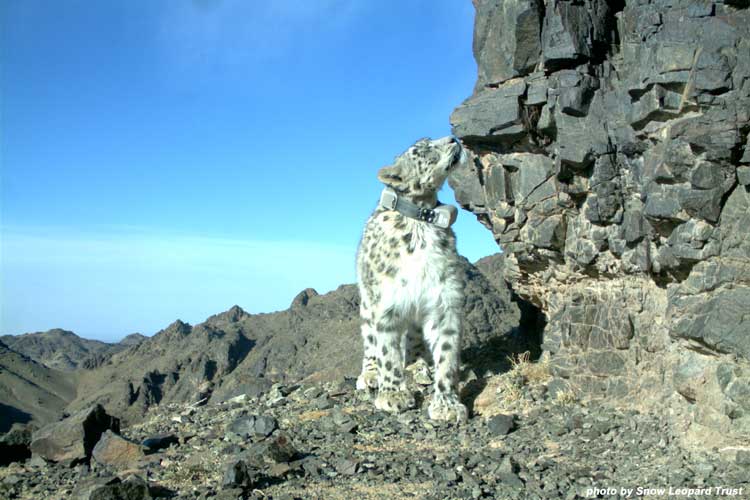
In this study, scientists have so far tracked 20 snow leopards with GPS satellite collars, gaining unprecedented insights into the behavior and ecology of these cats, and monitoring wild snow leopard cubs in their dens for the first time ever.
Lasya, one of the female snow leopards we've been tracking
A total of 20 snow leopardshave been tracked with a GPS collar in the long-term study in Tost to date.
Remote-sensor camera data collected over a span of five years has shown Tost’s snow leopard population to be stable and reproducing, with at least 12 adult cats using the area at any given time.

A win that was years in the making

Given the importance of this ecosystem both to the endangered snow leopard and the local pastoral community,the Snow Leopard Conservation Foundation and local people began making efforts for its protection in 2008In 2010, the community achieved a major breakthrough, as both the provincial and central governments agreed to give Tost and Tosonbumba the status of a Local Protected Area. This offered some level of protection from further expansions of mining in the area, but could not guarantee the ecosystem’s long-term future.
Our team recognized this early on, and began working with the local community and leadership toward achieving State Protected Area status in 2012. Now, 4 years, this collective effort has paid off, and Tost should remain a safe haven for snow leopards.

Great news after a tragedy

The good news comes on the heels of a tragedy of immense magnitude: In 2015, we lost our friend and colleague Lkhagvasumberel “Sumbee” Tomorsukh, who dedicated his life to studying and protecting snow leopards and other wildlife of Tost. An investigation into his death is ongoing.
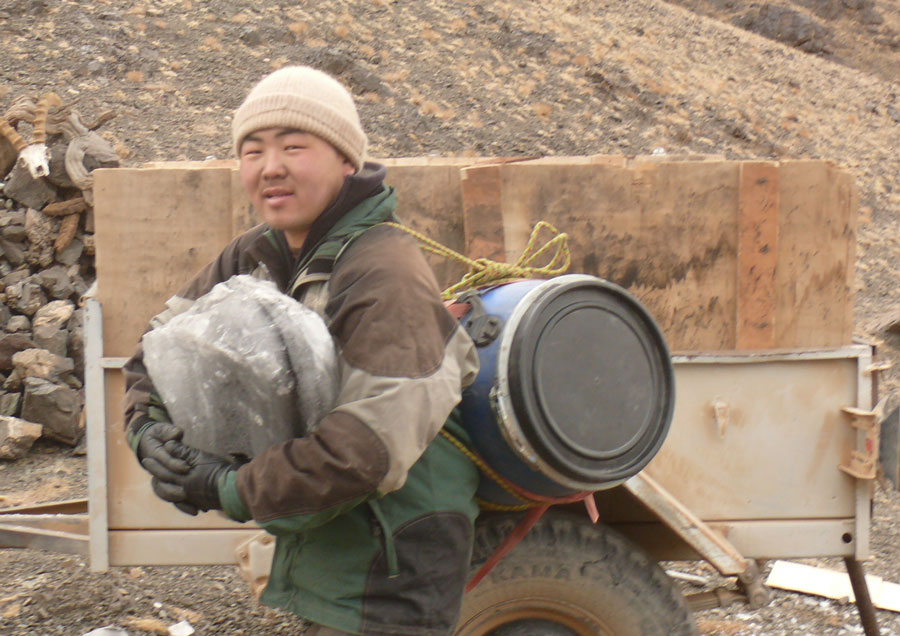
Sumbee's dedication to the wildlife of Tost knew no boundaries. When water holes froze over during a harsh winter, he carried several hundred pounds of ice up the mountain, so the animals would have enough to drink.
Sumbee’s dedication to the wildlife of Tost knew no boundaries. When water holes froze over during a harsh winter, he carried several hundred pounds of ice up the mountain, so the animals would have enough to drink.
“Sumbee lived for Tost and its snow leopards. If he were among us today, he’d be the happiest person on earth. The new Nature Reserve is a fitting tribute to this amazing young man”, says Bayarjargal Agvantseeren.

Snow Leopard Trust

Snow leopards are one of the most endangered big cats in the world. Founded in 1981, the Snow Leopard Trust is the largest and oldest organization devoted to protecting the endangered snow leopard. The Snow Leopard Trust has been active in Mongolia for over a decade conducting grassroots conservation, education and research. Snow Leopard Trust: www.snowleopard.org

Snow Leopard Conservation Foundation

Snow Leopard Conservation Foundation is the Snow Leopard Trust’s partner organization based in Ulaanbaatar, Mongolia; working together on the conservation of the endangered snow leopard since 1998.

Acknowledgments:

A very large group of funders and donors have supported our work in Mongolia over the last several years. We’re grateful to each of them for their generosity and their perseverance.
Thank you to the following for partnering with us to support Tost LPA and advocacy for Tost:
People’s Trust for Endangered Species
David Shepherd Wildlife Foundation
Disney Conservation Fund
Partnership Funding by Fondation Segre, managed by Whitley Fund for Nature
S.L. Gimbel Advised Fund at The Community Foundation
Snow Leopard Network
Thank you to the following for partnering with us on special conservation and research projects important to Tost:
Acacia Conservation Fund
AZA Conservation Grants Fund (formerly Conservation Endowment Fund)
BBC Wildlife Fund
Bioparc Zoo de Doue la Fontaine
Cat Life Foundation
CGMK Foundation
Columbus Zoo & Aquarium
Conservation Research & Education Opportunities International
Dakota Zoo
Darwin Initiative through UK Government, via University of Aberdeen
David and Amy Cohn
Dynafit
Eco-Sys Action
Edrington Group & Edrington Americas
Elizabeth Hoopes
Elmyra Felburn Schiller Irrevocable Trust
Felburn Foundation
Fondation Ensemble
Global Colors
Helsinki Zoo
Indiegogo
International Fund for Animal Welfare
International Society for Endangered Cats
Joan Poor
Jolkona Foundation
Juniper Foundation
Keidanren Nature Conservation Foundation
Kolmarden Zoo
Laguntza Foundation
Lawrence Foundation
Moore Family Foundation
Niabi Zoo
Norcross Wildlife Foundation
Nordens Ark
Nysether Family Foundation
Panthera
Parco Zoo Punta Verde
Regina Bauer Frankenberg Foundation
Rufford Small Grants Foundation
Safari Club International Foundation
Seattle International Foundation
Snow Leopard Trust UK
South Lakes Safari Zoo
Stephen Gold at the WCN Solar Power Project
Trust for Mutual Understanding
Tulsa Zoo
Turner Foundation
Utah’s Hogle Zoo
Woodland Park Zoo

Source:http://www.snowleopard.org/
Share:

Prague Zoo plans transports of Prezwalski's horse for Mongolia

Prague, March 14 (CTK) - The Prague Zoo is preparing to transport four Przewalski's horse mares to Mongolia in the middle of July, zoo director Miroslav Bobek told CTK yesterday, adding that a military CASA plane will again be used.
The Prague Zoo has kept a world stud book on the species since 1959.
"We are planning to take four mares from Prague to [the Mongolian national park] Gobi B," Bobek said.
The CASA has room for just four horses, he said and added that chief-of-staff Josef Becvar has already agreed with the use of the military plane.
"At the same time, he approved the use of the CASA for the flight from Bulgan Sum to Ulaanbaatar, where four horses from Khustain Nuruu, which is also a national park, will be loaded and taken to Gobi B," Bobek said about a project he has planned for long.
He said last autumn he agreed with the Mongolian environment minister on that Mongolia will invest in the building of enclosures and catching of the horses.
In cooperation with the Czech military, the zoo has transported 19 Przewalski's horses from the Czech Republic to Mongolia. Seventeen of them are still alive, which is a "very good result," Bobek said.
One stallion died during transport in 2011 and one mare died last autumn when it got stuck in mud during torrential rains in Gobi B.
Twelve offspring of the transported horses live in the protected area.
"This means that we transported there 19 horses, but 29 horses from our transports live there," Bobek said.
A total of 500 Przewalski's horses live in three localities in Mongolia, including 130 in Gobi B, where the last four transports from Prague were headed. In the wild, the Przewalski's horse became extinct more than 40 years ago.
Bobek said the task and duty of the zoological gardens that are members of world and European associations is to participate in the protection of biodiversity.
"Prague has played a key role in the salvation of the Przewalski's horse from extinction. In 2011 [when the first horses were taken to Mongolia], we started something which no one else was capable of doing. It was thanks to our zeal and also to that we succeeded in enlisting the military and the defence ministry's support and that we can use the CASA aircraft," Bobek said.

Source:Czech News Agency (ČTK)
Share:

Prague zoo to release further Przewalski horses in Mongolia

Prague, July 18 (CTK) - The Prague zoo will transfer another four mares of the Przewalski horse, a rare species on the brink of extinction, to Mongolia next year so that they can reunite with the horses that were taken there from Prague and released in the wild in the past years, Miroslav Bobek has told the media.
Four mares were flown to the Gobi B protected nature area earlier this month.
The next four will follow in June 2016, Bobek said.
In the meanwhile, another foal was born in the Przewalski horse herd in the Prague zoo on Sunday, July 12, he added.
In cooperation with the Czech military, the zoo has taken a total of 19 Przewalski horses to Mongolia in five transfers so far. One horse has died in Mongolia, but those surviving have 10 offspring already.
Bobek said the zoo wants to initiate an extension of the Gobi B reserve and possibly also to launch a closer cooperation with China on the Przewalski horse salvation.
The Prague zoo has been the world leader in breeding the rare horse species that was killed out in the wild 40 years ago and is being returned to its former habitats now.
"We do not focus on the transfers only. We also support a long sustainability of the wild horses' return. We have reconstructed a hospital in the area, constructed haylofts, and we support the activities of the environmentalists and the nature wardens in Gobi B," Bobek said.
At present, a total of about 500 Przewalski horses live in three localities in Mongolia, including 139 in Gobi B, the destination of the last four Prague transports.
This brought the wild horse population to the level before the winter 2009-2010 when almost two-thirds of the animals died as a result of unusually hard frosts.
The new foal in Prague is the 226th born in the zoo. Its mother is Jessica, from the Prague Przewalski horse family. Its father is Leon, a stallion from Ukraine.

Source:Czech News Agency (ČTK).
Share:

China and Mongolia clash over how to exploit the Gobi desert

Mongolia and China are separated by world views as well as by a border across the Gobi desert, writes Troy Sternberg. In Mongolia the idea that nature has intrinsic value is readily accepted, while China is more interested in resources for trade, industry and profit. Can a clash of interests be avoided?


The Gobi Desert in East Asia conjures images of a remote landscape, with nomads riding across the steppe.
In fact, today it is home to herders and farmers, the world's fastest-growing economy, vast copper and gold mines and is China's main domestic energy source.
The imagined expanses and agro-pastoral livelihoods exist alongside mountains of coal, modern cities, desert agriculture and environmental challenges to its viability and future well-being.
Following Chinese president Xi Jingping visit to Mongolia to discuss a series of trade and energy deals that would give Mongolia better access to global markets, it is worth looking at the shared desert that lies between Beijing and Ulaan Baatar.
As the two nations work together, reconciling differences in the Gobi will be a major challenge.
Human development versus natural fragility
At 2.3 million square kilometres the Gobi is the world's third largest desert, covering most of Mongolia and much of northern China. Yet 25m people live in an area that stretches from the edge of Beijing to the Kazakh and Russian borders in the west and north.
Across the Gobi, conservation reflects a shifting balance between human development and natural fragility.
Home to the world's highest sand dunes (more than 300 metres), most of the Gobi is a dry gravel plain and sparse rangeland. The landscape challenges residents with extreme cold (to -40C), hot summers (to 40C), periodic droughts and minimal surface water.
Humans drive the need for extensive groundwater use, particularly in China, where the government encourages farming even though annual precipitation is often less than 200mm.
This leads to competition for limited environmental resources between agriculture, cities such as Hohhot, Baotou and Urumqi (each more than 2m people), mining and traditional herding (Mongolia) and settled livestock-raising (China).
Today the vast majority of water in Inner Mongolia - the autonomous Chinese province that borders Mongolia itself - goes for coal extraction and processing to meet China's energy demands.
Worlds apart - yet a shared environment
Conservation of the tenuous desert environment and rural livelihoods encounter several socio-economic forces and physical challenges. Though a shared landscape, the issues differ greatly between China and Mongolia as policy, culture, history and democracy / autocracy separate the neighbours.
In Mongolia water is essential for animals and household needs yet supply is obscured in shallow and deep aquifers that are difficult for locals to tap. Groundwater, essential for the desert's new copper, gold and coal mining, requires money and technology to exploit and thus is pursued by regional and international mining companies.
This results in conflict between local residents and businesses for limited water and raises issues of land use and livelihood viability among mobile herders, still the dominant lifestyle in rural Mongolia.
In China strong state control and intervention has resulted in a manipulated water system where farmers need swipe-cards to get allocated water, use of natural pastures for animals is restricted and ecological resettlement sees once-mobile herders settled in villages by government decree.
Removal of livestock opens land for farming and most importantly, for profitable mining that often is owned, or directly benefits, local governments. Mining in the region has led to economic growth, jobs, pollution, land degradation, dust generation and settlements that lack basic infrastructure.
The notion of conservation and the role of nature in everyday life is integral to the Mongolian conception of the world whereas the Chinese model is focused on economic and infrastructure development irrespective of environmental impact.
The stark divide reflects deep differences
This splits the Gobi at the border. On one side roads, fencing, settlement, degradation and policy has ended free movement in China and sees the environment as something to be managed and exploited to ultimately benefit the several layers of government.
This leaves one to ask "what conservation?" as water, land and vegetation are used for financial benefit, not as an inherent social good to protect.
In Mongolia national parks comprise 13% of the country and species such as the Gobi bear, gazelle, marmot and Saker Falcon benefit from social conceptions of nature's importance and varying degrees of protection.
Though a vast area, the Gobi's harsh environment and intricate ecosystem make wide swathes of open land and limited human use of nature key to conserving flora and fauna. This means creating non-financial value for wild steppe and desert regions.
Without care the environment can become less productive and potentially experience desertification. Preserving nature takes insightful policy, sustainable land use, recognition of environmental benefits and the support of rural and mining communities.
In the Gobi this takes place against Mongolia's weak institutional framework and China's all-powerful bureaucracy. While the Communist Party remains in power conservation will be sacrificed for perceptions of growth and social stability.
The picture in Mongolia is more optimistic as history and cultural preferences favour a strong role for nature in Mongolia's conception of the world.
 Source:the ecologist


Troy Sternberg is a Researcher in Geography at the University of Oxford. He does not work for, consult to, own shares in or receive funding from any company or organisation that would benefit from this article, and has no relevant affiliations.
Share:

Prague zoo to send more Przewalski’s horses to Mongolia

Prague, March 31 (ČTK) — The Prague zoo plans to transfer four more Przewalski’s horses to Mongolia, their country of origin, in June and release them to the wild, the zoo’s director, Miroslav Bobek, told journalists today.
The zoo, which focuses on breeding the dramatically endangered Przewalski’s horse, has released a total of 12 of them in Mongolia since 2011.

The institutions assisting in the project are the Czech Environment Ministry and the military, which provides its transport planes.
Mongolia’s Environment and Green Development Minister Sanjaasürengiin Oyuun, a graduate of Prague’s Charles University, expressed her appreciation at a joint press conference with Bobek in the Czech Capital.
The four horses to be flown to Mongolia in June have been chosen from a Czech center to which they were brought from several European zoos.
The military plane will land directly in the Gobi Desert, outside regular airports, so that the horses need not undergo a many-hour journey to the acclimatization enclosure.
“The transfer will cost between 1.2 million and 1.4 million Kč,” Bobek said.
The zoo is gathering the money in a public fund raising campaign, from sponsors and partly from its revenues from the sale of entrance tickets, he said.

The Prague zoo is one of the main organizers of the transfers of the Przewalski’s horse, which was killed out in the wild 40 years ago, back to its original homeland.
The transfers from Western Europe started in the 1990s and more than a hundred horses have returned to Mongolia since.
At present, about 1,900 Przewalski’s horses live all over the world, including some 300 heads in two national parks in Mongolia.
Bobek said the horses returned to the wild are doing well and they have reproduced.
He said the project includes support to the local Mongolian population such as the reconstruction of a hospital, creation of new jobs, removal of environmental burden, handling of wastes and securing of drinking water sources.
The Prague zoo started breeding the Przewalski’s horse in 1932. It has kept the international pedigree book of this species since 1959.


Share:

From Mongolia to Tirunelveli

The avian guest spotted in Kaadankulam pond.


Bar-headed goose makes long journey for the winter

A bar-headed goose with a neck collar, spotted in Koonthankulam bird reserve in Tirunelveli district, has flown in all the way from Mongolia.The adult female, wintering at Kaadankulam pond, was spotted by Nagercoil-based school teacher and environmental educator S.S. Davidson, during his routine visit to the bird reserve.
The collar was bright orange with the English letter ‘S’ and number ‘6’ written on it, visible in the photo. Mr Davidson wrote to ornithologists in other countries seeking information about the bird.
On Wednesday, he received a mail from Robert L. Thomson, Section of Ecology, Department of Biology, University of Turku, Finland, confirming its origin and the date of collaring.
According to Dr Thomson, the bird was collared on July 10, 2009, in the Darkhad valley of Huvsgul province in northern (and slightly western) Mongolia.
“We have had previous sightings of this individual. In December 2010, she was wintering at Magadi Tank in Karnataka province. Later in the same season she was seen at Devi Kere lake, Ratnapuri, in Karnataka,” Dr Thomsan said in his email response.
The bar-headed goose is one of the world’s highest flying birds, capable of reaching 29,000 feet.
Share:

Saker falcons get new lease of life

Abu Dhabi: The Environment Agency - Abu Dhabi (EAD) said on Tuesday it signed a memorandum of understanding with the Ministry of Nature, Environment and Tourism, Mongolia, for the conservation of wild Saker falcons.

The five-year agreement aims to increase the breeding capabilities of the wild Saker falcons (Falco cherrug) by monitoring artificial nests placed throughout Mongolia for the birds, and by conducting comprehensive research and monitoring of the species.

The memorandum was signed by Mohammad Ahmad Al Bowardi, Secretary-General of the Executive Council and Managing Director of EAD and Minister Luimed Gansukh, Head of the Mongolian Ministry of Nature, Environment and Tourism, in the presence of EAD's Secretary-General Majid Al Mansouri.

The main aim of the agreement is to advance an ongoing project to increase the numbers of wild Saker falcons and help develop a regulatory system to govern the harvest and trade in wild Saker falcons in line with existing Convention on International Trade in Endangered Species (Cites) regulations.

Locally known as Hurr, meaning free, this species is the second largest falcon in the world. The Saker falcon is an important symbol of an Emirati heritage, and has sadly undergone a rapid global population decline.

There are currently an estimated 2,000 to 5,000 breeding pairs in the world.

Al Mansouri said: "In line with our commitment to promote sustainable falconry and falcon conservation, the agreement's objectives have been defined to allow us to learn more as well increase the population of Saker falcons in central Mongolia."

"By studying this species' habits and by creating nest sites where none existed previously, we are optimistic that the new population will support a sustainable harvest of Saker falcons for Arabic falconry and contribute to increasing the Saker population in Mongolia. We hope that this programme becomes a global example of how two government entities can work together for a joint cause."

The second objective of the agreement is to conduct research on the biology of the Saker falcon, to survey its population number and distribution, and to set up a long-term monitoring programme of the population in order to conserve this species for the future.

Finally, the agreement would also allow research and monitoring programmes on other raptor species, particularly those that are important to Arab falconry in line with the Convention on Migratory Species.


This memorandum is to expand a previous five-year agreement between the two parties which saw the EAD provide funding for biologists to conduct research on experimental artificial nests placed in 2006.

Fast facts: Endangered

- The Saker falcon is classified as endangered on the IUCN Red List and is listed in Appendix 2 of Cites.

- The Mongolian population is currently estimated at 2,000- 5,000 breeding pairs.

Source:Gulfnews.com
Share:

Mongolia's wild horses have come home

Published on : 2 December 2009 - 3:17pm | By Dheera Sujan
For decades they were extinct in the wild, but the Przewalski horse is back on the Steppes of Mongolia. And that’s largely thanks to three Dutch people who made it their life mission to save this small pale-gold pony.

Twenty years ago, couple Jan and Inge Bouman, together with their lifelong friend Annette Groeneveld, realised the dangers faced by the Przewalski horse.


The horses were discovered on the Mongolian Steppes a century ago by a European expedition headed by Nikolai Przhevalsky (the name of the horse is the Polish variant of the name). After they realised that they were the last living ancestor of our domestic horses, 55 foals were shipped back to Europe.

It was a move that saved the species. Within 60 years, they had been eradicated from the Steppes. But years of inbreeding had taken a terrible toll. There were only a few sorry specimens left in zoos around the world and most of the foals born to them died within a couple of years.

Fund raising
The Boumans and Groeneveld mounted a formidable fund raising campaign to buy the horses from zoos and cross bred the pairs to refresh the stock. But the ultimate goal was clear – the Przewalski should return to its natural home.

They were lucky. In the 1990s Mongolia was emerging from seven decades of Soviet rule. And the Przewalski horse was a powerful symbol of Mongolian identity. They had always been known to Mongolians as takh – holy. The Mongolian government responded to the call of the Boumans and Groeneveld by offering the Hustai National Park as a refuge to the takhs coming home.

To a nation of horse lovers, the return of the takh was an emotional moment. Nowadays, 200 of these pale ponies graze peacefully on the grass sea that fed their ancestors for centuries.

Source:Radio Netherlands Worldwide
http://www.rnw.nl/nl/node/43123
Share:

Four Chinese citizens hunted wild animals illegally

Today, four Chinese citizens which illegally hunted with a saiga and an eagle were arrested when they attempted to enter Ulaanbaatar from countryside.

Police checkpoint at Yarmag or Chinggis Khaan airport stopped a "Hummer" Jeep with
the Chinese citizens and found the hunted wild animals along with two rifles and sixty bullets. Saiga antelope is a rare species of antelope which numbers less than 5000 in Mongolia.Its horns are used in Chinese traditional medicine.

Share:

Wild Horses in Mongolia


National Geographic TV produced a spot on Wild Horse Takhi also known as Przewalski horse.... The spot includes footages shot in Khustai National park where wild takhi horses are successfully reintroduced. They are magnificient animals. Freely roaming the area on their own. Nothing but wind on their back. Free and Wild....


Share:

Facebook page

Powered by Blogger.

Categories

Advertising in Mongolia An Asian Development Bank Culture Editorial of the Mongolianviews education Environmental protection Famous Mongolians Foreigners in Mongolia Inner Mongolia Ivanhoe Mines Mongolia Adventure Mongolia agriculture Mongolia air pollution Mongolia analysis Mongolia and Armenia Mongolia and Asian Development Bank Mongolia and Australia Mongolia and Azerbaijan Mongolia and Belorussia Mongolia and Bulgaria Mongolia and Cambodia Mongolia and Canada Mongolia and central Asia Mongolia and China Mongolia and Cuba Mongolia and Czech Mongolia and donors Mongolia and EU Mongolia and Germany Mongolia and Hongkong Mongolia and Hungary Mongolia and IFC Mongolia and IMF Mongolia and Ind Mongolia and India Mongolia and Indonesia Mongolia and Inner Mongolia Mongolia and Iran Mongolia and Israel Mongolia and Italy Mongolia and Japan Mongolia and Kazakhstan Mongolia and Korea Mongolia and Kuwait Mongolia and Kyrgyzstan Mongolia and Malaysia Mongolia and Nato Mongolia and North Korean Mongolia and Poland Mongolia and Qatar Mongolia and Russia Mongolia and Russia and Mongolia and China Mongolia and Singapore Mongolia and South Korea Mongolia and Taiwan Mongolia and Thailand Mongolia and the world Mongolia and Tibet Mongolia and Turkey Mongolia and UK Mongolia and Ukraine Mongolia and UN Mongolia and US Mongolia and USA Mongolia and Vietnam Mongolia Banking Mongolia blind Mongolia Cashmere Mongolia Christianity Mongolia civic society Mongolia Corruption Mongolia crime Mongolia diplomacy Mongolia Economy Mongolia Education Mongolia Energy Mongolia environment Mongolia Finance Mongolia Health Mongolia History Mongolia holiday Mongolia in international media Mongolia Industries Mongolia investment Mongolia Joke Mongolia law Mongolia LGBT Mongolia medical Mongolia military Mongolia Mining Mongolia Mining Developments Mongolia Mortgage Mongolia natural disaster Mongolia news media Mongolia Nuclear Mongolia Petroleum Mongolia Politics Mongolia Poverty Mongolia public announcements Mongolia railways Mongolia Religion Mongolia slums Mongolia society Mongolia Sports Mongolia Stamp Mongolia Sumo Mongolia telecommunication Mongolia tourism Mongolia trade Mongolia Transportation Mongolia Urbanization Mongolia Wild Life Mongolian Agriculture Mongolian and Cuba Mongolian Archeology Mongolian Climate Mongolian Food Mongolian Gay Mongolian Government news Mongolian History Mongolian Kazakh Mongolian Meat Mongolian Military Mongolian Mining Development Mongolian Movie Mongolian News Mongolian Parliament Mongolian Political news Mongolian Press Mongolian Songs Mongolian Sumo Mongolian Women Mongolian Youth Mongolians abroad Moninfo Opinion Oyu Tolgoi Investment Agreement Photo news Press Release Rio Tinto Tavan Tolgoi coal mine Ulaanbaatar development Weird expatriates in Mongolia World bank and Mongolia

Blog Archive

Followers