Showing posts with label Mongolia and USA. Show all posts

Why Mongolian Democracy Is Worth Defending

America’s allies in Asia will draw lessons from how nations like Mongolia fare in the new era of U.S.-China competition.


China’s challenge to the United States has, at last, led American officials to change the way they view the PRC. Addressing the Hudson Institute at its New York gala in October, Secretary of State Mike Pompeo rejected decades of U.S. policy that “accommodated and encouraged China’s rise . . . even when that rise was at the expense of American values, Western democracy, and security, and good common sense.” For their part, Chinese leaders took advantage of that approach, avoiding confrontation with Washington while building up economic and military power.
Now, however, China’s ambitions are on full display, particularly around its borders where, according to the Pentagon, it is engaged in “military modernization, influence operations, and predatory economics to coerce neighboring countries to reorder the Indo-Pacific region to their advantage.”
Mongolia is on the front line. The most sparsely populated sovereign state in the world, it shares China’s longest border. (Its only other border is with Russia.) Mongolia receives little attention in the United States, overshadowed by America’s longstanding alliances with Japan and South Korea. But ever since America’s relationship with Mongolia began in the late 1980s, the United States has stressed the importance of Mongolia’s sovereignty and democracy to a free and open world order. Today, its democracy, Tibetan Buddhism, and history under the Qing empire, not to mention its proximity and vast natural resources, make it an inexorable target of the PRC’s agenda to restore its dominance in Asia and challenge American leadership in the region. As the competition between the PRC and the United States in Asia plays out in Mongolia over the coming years, America’s other partners and allies will draw lessons from how Mongolia fares, and what Washington does.


It is often said that the Mongols have ruled and been ruled by China. The reality is more complicated. China was part of the Mongol empire from 1271-1368. Later both Inner and Outer Mongolia came under the Manchu Qing dynasty, the non-Han dynasty that ruled China from 1644 to its collapse in 1911. Sovereign, democratic Mongolia is the former “Outer Mongolia” north of the Gobi Desert. (The distinction between Inner and Outer Mongolia, writes Morris Rossabi, “was due partly to the different times the Qing brought them under its control and partly due to the Gobi Desert separating the two.”) When the Qing dynasty collapsed in 1911, Outer Mongolia declared independence under a theocratic government led by the patriarch of the Mongolia’s branch of Tibetan Buddhism, a reincarnate lama known as the Bogd Khan. The Mongols had adopted Buddhism, specifically the Gelug school of the Dalai Lamas, from Tibet in the 16th century, establishing close bonds that continue to this day, much to Beijing’s displeasure. After a tumultuous decade, a communist faction took control, and the country fell under Soviet sway for nearly seven decades.

Published on: December 10, 2019
Ellen Bork is a visiting fellow at The Project 2049 Institute and a contributing editor at The American Interest.


Share:

First responders, volunteers train with Mongolian partners during Gobi Wolf 19

SAINSHAND, Mongolia – There are several important pieces of equipment firefighters wear that make up their Personal Protection Equipment (PPE) or "turnout gear.” Of all the specialized pieces, the most distinct for Cheyenne Sanchez is a photo of his sister inside his fireman's helmet.

“When I suit-up to go into a building that is on fire, the helmet is the last piece of equipment to go onto my head, and her picture is the last thing I see as I go into a life-threatening situation,” Sanchez said, describing how essential a 'safety first' approach is heading into harm's way.

“It's that final reminder that I need to return home safely to the people that I love and who care about me.”

Sanchez, a firefighter with Capital City Fire and Rescue in Juneau, Alaska, is one of many key first responders and volunteers, from both the U.S. military and civilian sectors supporting the Gobi Wolf 2019 exercise taking place in Sainshand, Mongolia from Sept. 9 -21, 2019. He was specially recruited by the Alaska State hazardous materials (HAZMAT) team coordinator, Megan Kroller to instruct firefighter and HAZMAT response training.

“At the international level, I've never done anything like this before coming here,” he said, describing how the range of experience with his Mongolian counterparts differed from person to person. “We had folks with just six-months all the way up to 20 years of experience, and it added to the challenges, but in many ways, it helped us move quickly through drills where 'everyone got it,' so we could focus on more specific group needs.”

The two-week exercise was designed to bolster the Mongolian civil authorities and national defense response to potential disaster situations while employing vital strategic communication and integrating foreign humanitarian assistance into emergency-management positions.

“I really wanted to hammer home this idea of safety and HAZMAT response,” Sanchez said, contrasting his rural Alaska background where fewer numbers of first responders play a vital role to ensure mission success.

“As the week went on, I got the impression that if there was a major catastrophic event, they would send as many bodies as they can to fix the problem,” he said. “We [in Alaska] don't have an unlimited amount of resources and personnel – so if one firefighter or rescuer gets injured, that is a failure of the event for us; emphasizing personal safety it something I wanted each of them to get, so that they could go home to their families too.”

The Mongolian Armed Forces and the Mongolian National Emergency Management Agency (NEMA) as part of the United States Army Pacific’s humanitarian assistance and disaster relief “Pacific Resilience” series hosted the Gobi Wolf exercise. Mongolia has an ongoing State Partnership with Alaska and during this year's exercise, the Oregon National Guard played a key role in supporting all groups during the training.

Whether it was rope rescue, search and extraction, or collapsed structures, the Oregon CERFP members quickly discovered that their Mongolian partners were curious in the teaching techniques and hands-on experience offered throughout the exercise.

“They [NEMA members] had limited experience with shoring and structural collapse but they quickly adapted to the techniques and equipment we use to build structural collapse systems,” said Oregon National Guard Sgt. Joseph Duchscherer, assigned to the 1186th Military Police Company and CERFP Search and Extraction team leader.

With a team of five other Guardsmen, they worked through a full week of training in an abandoned facility that proved to be an ideal exercise site for multiple scenarios. Often the location had two and three training projects taking place at the same time; from rope teams rappelling from the rooftops to jackhammers noisily cutting through concrete, and search and rescue dogs curiously roving through the old factory floors.

“In many ways, this exercise was a little more 'real-world' in nature because lumber is scarce in this part of the country – to do this work you have to make the best of what resources are available,” Duchscherer said.

“It was also great to compare and contrast other best practices techniques because the NEMA rescue unit members are seasoned professionals too.”

The planning for the exercise started months in advance and included subject-matter experts to meet the specific request made by local NEMA officials.

“In February of this year we started planning this exercise and had a large window of time to build it, but it wasn't until the end that we had all of the specialized experts in place to meet the program,” said Lt. Col. Eric Slayter, U.S. Army Pacific Director, Northeast Asia Civil-Military Operations and exercise director.

The Gobi Wolf 2019 exercise had 21 different training classes up from just eight during the previous year's exercise. Slayter said that this greatly expanded the need for both the quality and quantity of instructors to fill the large agenda.

“Many of these aspects for Gobi Wolf 19 pin-pointed technical exchange and in-depth course work, which is why we brought in groups like the Forestry Service to talk about incident command systems, and other specialized areas in disaster management systems, public affairs, and medical treatment.”

This year's Gobi Wolf exercise also hosted a conference on Women's Peace and Security, highlighting the need to focus on vulnerable populations where women are primarily responsible for children and elderly members of the family.

The engagement is a critical part of the Government of Mongolia’s ability to prepare for an unforeseen crisis. However, these crises are not only unique to Mongolia but are prevalent throughout the Indo-Pacific.

“We do this to build lasting relationships with partner nations, not just military and government agencies – but to foster broader cooperation to effectively respond to disasters,” Slayter said, all the while emphasizing other non-governmental organizations integral role in the exercise.

“The Alaska civilians and other first responder filled critical areas and were incredible subject-matter experts.”

One of those experts was Don Werhonig, assistant fire chief of Fairbanks North Star Bureau HAZMAT Team. After serving in the U.S. Army for 10 years, he transitioned to working hazards materials for the past 18 years. The training was not far from his heart, working alongside American military members and their Mongolian counterparts.

“I loved everything about being a squad leader (in the Army) and working with my troops and supporting their specific needs,” he said, recalling his prior service experience working with uniformed personnel. “So it was easy for me to share and relate to their (NEMA) unit structure and needs.”

The training allowed NEMA rescue unit members to go in-depth on many hazards chemicals that could impact large portions of the population in the Dornogovi Province in the event of earthquakes, train derailments and the various destructive effects from random sand storms in the Gobi Desert.

“This has been one of the best real-world experiences I've ever done, and I enjoyed the interaction with our NEMA host members and their engagement in the classroom,” he said.

These agency-to-agency interactions strike at the core of the exercise; comparing similar disaster response capabilities, yet providing a platform for NEMA to further develop and manage environmental and hazardous material disaster responses in specific areas around the country.

On the final day of the Gobi Wolf exercise, an after-action review allowed participants to provide feedback on the complexity of the training and develop improvements for future training.

Addressing the participants, Col. Nuganbayar Batmunch, deputy chief of NEMA highlighted the training between the two nations.

“This has been 14 days of amazing training where we could organize and gain great knowledge with our American colleagues,” he said, speaking through an interpreter. “During Gobi Wolf, we were able to share and build on a common desire; where we strive to meet the needs of others when disaster and recovery operations are critically needed.”

Share:

Mongolian FM meets U.S. Assistant Secretary for Economic and Business Affairs

Minister of Foreign Affairs of Mongolia Damdin Tsogtbaatar met with a delegation led by United States State Department Assistant Secretary for Economic and Business Affairs Manisha Singh, Montsame reports.
Emphasizing the country’s valuable contributions to Mongolia's transition to democracy and a market economy and to coping with problems arose during the transition process, Foreign Minister D.Tsogtbaatar voiced his views on bilateral relations, including trade and economic issues.
It was also noted that approval of the Mongolia Third Neighbor Trade Act is greatly significant for Mongolia diversifying its economy, increasing export volume, and developing its processing industry. The Foreign Minister then underlined the importance of U.S. being a key trade partner and a major investor to Mongolia, while mentioning the announcement made during a visit of President of Mongolia Kh.Battulga to U.S. about relations between the two countries being elevated to strategic partnership.
Concurring with the Minister’s views about bilateral relations and trade and economic issues, Ms. Manisha Singh expressed her willingness to expand cooperation further and support Mongolia’s initiatives.
Share:

Mongolia’s Petro Matad resumes drilling post-dispute

Mongolian oil explorer Petro Matad said Wednesday it will resume operations at block XX in eastern Mongolia, Kallanish Energy learns.
The company had to halt operations Aug. 5, due to a land use dispute. The authorities gave verbal approval to resume while the necessary paperwork is completed. Standby costs to-date totaled $150,000.
The drilling campaign started in March, targeting the Heron, Gazelle and Red Deer prospects, with total recoverable resources of 38 million barrels of oil and 48 million barrels of hydrocarbons.


Share:

U.S., Mongolian forces improve crisis response capabilities

ULAANBAATAR, Mongolia --
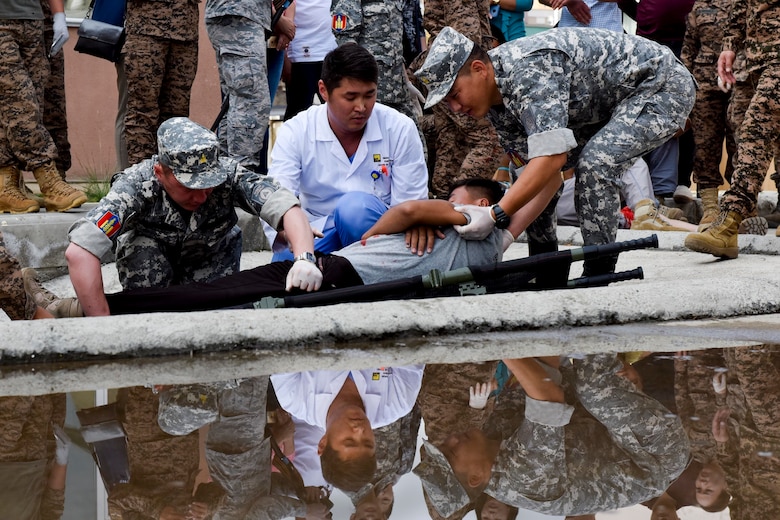
Members of the U.S. Air Force and Mongolian Armed Forces conducted a mass casualty exercise Aug. 1, 2019, during Pacific Angel 19-3, a joint and combined humanitarian assistance engagement, enhancing participating nations’ humanitarian aid and disaster relief capabilities while providing beneficial services to people in need throughout South and East Asia.
The exercise was the final phase of emergency medical practice exchanges occurring between U.S. Air Force, MAF, and Nepali Army subject-matter experts during PAC ANGEL 19-3 and gave teams a chance to employ skills they’d learned.

Six teams worked together providing emergency medical care to simulated casualties to test the lessons they learned during the previous three days of classroom training.
“Today’s exercise was to bring different disaster relief organizations together to talk and improve communication and to teach an efficient triage process, which allows them treat of hundreds of patients while using as few resources as possible,” said U.S. Air Force Master Sgt. Scottie Eubank, a 673rd Medical Group paramedic. “This exercise used a lot of the concepts from the tactical combat casualty care we teach back home.”
The teams were required to quickly assess the status of the casualties and triage the simulated patients all while being observed and evaluated on their performance. Following each iteration of the exercise, teams discussed ways to improve and were given a second attempt.
“I learned that communications between participants is very important,” said Maj. Nergui Sodnom, a MAF anesthesiologist who participated in the hands-on training. “The first time we did the mass casualty exercise it was very confusing but when we did it the second time we were much more comfortable.”
The exercise provided many learning opportunities to participants, which will improve their ability to respond to crisis situations in the future.
“Most doctors’ specialties are different, so improving each participants knowledge is very important, which is beneficial because it provides more precision when treating patients,” she said.
The humanitarian assistance and disaster relief exchanges employed during PAC ANGEL 19 strengthen relationships between Mongolia, the U.S. and other regional nations, promoting military-civilian-nongovernmental organization cooperation.
Share:

US-Mongolia relations lack healthy balance

Mongolian President Khaltmaa Battulga met US President Donald Trump at the White House on July 31. During the state visit, the White House said, "The US and Mongolia have agreed that their relationship has reached the level of a 'strategic partnership.'" On Thursday, US Secretary of Defense Mark Esper was in Mongolia where he met high-ranking Mongolian leaders. Why have Ulaanbaatar and Washington become closer recently?

As tension increases with China and Russia, US frequent interactions with Mongolia could be regarded as an attempt to create more pressure for Beijing and Moscow.

Following its democratic transition, Mongolia has shown a willingness to become a liberal and democratic country with the US as its role model. This is in line with US strategy and provides room for Washington to export its ideology and values to Ulaanbaatar, which aimed at Beijing and Moscow.

As the China-US trade war continues to escalate, reports say that China could slash its rare-earth exports to the US as a countermeasure. According to the US Geological Survey in 2009, Mongolia had 31 million tons of rare-earth resources, 16.77 percent of the world's total and second only to China. 

Boosting ties with Mongolia could be a way for the US to show China it has found an alternative country that can meet its rare-earth demands. This would reduce US reliance on China in this regard. 

By strengthening ties with Mongolia, the US is also attempting to upgrade Mongolia's status in Northeast Asia, giving Washington another channel to deal with the Korean Peninsula nuclear crisis. Mongolia has maintained solid relations with all countries in the region including North Korea, with few historical or territorial issues. Ulaanbaatar wants stronger ties with Washington to earn more respect in the region, at least from Tokyo and Seoul.

Moving closer to the US, Mongolia can reduce its security reliance on China and Russia. 

Mongolia proposed a "third neighbor" policy in 1990, aiming to build relationships with countries other than Russia and China, and formalized its foreign policy and legislation. Mongolia has been seeking to reduce its political, economic, and security reliance on the two giant neighbors by this "third neighbor" foreign policy. 

As a superpower, the US has been Mongolia's most valuable "third neighbor." In Northeast Asia, Japan and South Korea are Mongolia's "third neighbors" in an economic sense. 

Since Mongolia's democratic transition, China has been Mongolia's biggest partner in trade and investment. By cooperating with Japan and South Korea in investment, technology and trade, Mongolia wants to make its economy less reliant on China and Russia. 

Beginning in 2000, the US began attaching great importance to Mongolia through people-to-people exchange and cooperation. Washington will continue to infiltrate Ulaanbaatar with its ideology, grooming officials in line with US values. 

In the short term, however, it will be difficult for Mongolia to change its interdependent ties with China. As long as the two countries respect the core interests of each other, their bilateral cooperation in politics, economy, culture and military under the framework of China-Russia-Mongolia Economic Corridor and the China-proposed Belt and Road Initiative (BRI) will advance steadily. The border region between the two countries will remain stable and usher in continued development.

The US-launched trade war against China has influenced global economic development. 

Washington's unilateralism has not received widespread approval from the international community, while China's BRI and proposal for a community of shared future for mankind have gained global acceptance. 

The US development model has encountered multiple challenges and now Mongolia must make a rational stance between the two giants.  

The author is director of the Russia and Mongolia research institute of the Inner Mongolia Academy of Social Science. opinion@globaltimes.com.cn
Share:

U.S., Mongolian forces improve crisis response capabilities

ULAANBAATAR, Mongolia (AFNS) --
Members of the U.S. Air Force and Mongolian Armed Forces conducted a mass casualty exercise Aug. 1, during Pacific Angel 19-3, a joint and combined humanitarian assistance engagement, enhancing participating nations’ humanitarian aid and disaster relief capabilities while providing beneficial services to people in need throughout South and East Asia.

Mongolian Armed Forces medical personnel move a simulated casualty patient onto a litter Aug. 1, 2019, during Pacific Angel 19-3 in Ulaanbaatar, Mongolia. PAC ANGEL is a multilateral humanitarian assistance civil military engagement, improving military-to-military partnerships in the pacific through medical health outreach, civic engineering projects and subject matter expert exchanges between U.S. service members, multinational militaries, nongovernmental organizations, and Mongolian military and civilian participants. (U.S. Air Force photo by Senior Airman Eric M. Fisher)

The exercise was the final phase of emergency medical practice exchanges occurring between U.S. Air Force, MAF and Nepali Army subject-matter experts during PAC ANGEL 19-3 and gave teams a chance to employ skills they learned.

Six teams worked together providing emergency medical care to simulated casualties to test the lessons they learned during the previous three days of classroom training.

“Today’s exercise was to bring different disaster relief organizations together to talk and improve communication and to teach an efficient triage process, which allows them to treat hundreds of patients while using as few resources as possible,” said U.S. Air Force Master Sgt. Scottie Eubank, a 673rd Medical Group paramedic. “This exercise used a lot of the concepts from the tactical combat casualty care we teach back home.”

The teams were required to quickly assess the status of the casualties and triage the simulated patients all while being observed and evaluated on their performance. Following each iteration of the exercise, teams discussed ways to improve and were given a second attempt.

“I learned that communication between participants is very important,” said Maj. Nergui Sodnom, a MAF anesthesiologist who participated in the hands-on training. “The first time we did the mass casualty exercise it was very confusing but when we did it the second time we were much more comfortable.”

The exercise provided many learning opportunities to participants, which will improve their ability to respond to crisis situations in the future.

“Most doctors’ specialties are different, so improving each participant’s knowledge is very important, which is beneficial because it provides more precision when treating patients,” Sodnom said.

The humanitarian assistance and disaster relief exchanges employed during PAC ANGEL 19-3 strengthen relationships between Mongolia, the U.S. and other regional nations, promoting military-civilian-nongovernmental organization cooperation.
Share:

Mongolia: the next global power player?

US Defence Secretary given horse during visit to Ulaanbaatar - but Washington appears to be seeking bigger rewards


A stopover in Mongolia by the new US secretary of defence during his first foreign trip since taking on the role has prompted questions over Washington’s interest in the region.

Mark Esper - who replaced James “Mad Dog” Mattis in July - met senior Mongolian leaders in the country’s capital of Ulaanbaatar on Thursday, in a bid to “deepen US ties with the nation”, according to the The Washington Post.
“It is my deep privilege to be here, to be with you and to have the opportunity to look at different ways we can further strengthen the ties between our two countries,” Esper said prior to the meeting.
Mongolia leaders proved equally conciliatory, welcoming the new US defence chief with a ceremony during which he was gifted a seven-year-old horse - “the ultimate status gift for a warrior”, says Business Insider.
But the Trump administration appears to be seeking a lot more than a stallion in courting closer ties with Mongolia: Washington sees the central Asian nation, sandwiched between China to the south and Russia to the north, as a key strategic ally in the region.
When it comes to resisting the ever-reaching hands of Beijing and Moscow, Mongolia has form. Following the overthrow of its authoritarian communist regime in 1990, the country has sought to maintain independence from China and Russia by developing its relations with other world powers, strongly favouring United Nations sanctions against North Korea and once describing the US as a “third neighbour”.
But if Washington already has a friend in Ulaanbaatar, what is behind the recent rekindling of the US-Mongolia love affair? And could the Trump administration help Mongolia become the world’s most unlikely superpower?
How are Mongolia-China relations?
Despite their geographical closeness, Mongolian leaders have worked hard to distance themselves from Moscow and Beijing.
In 2017, businessman Khaltmaa Battulga - often described as “Mongolia’s Trump” - was elected to the presidency on a “populist and sometimes anti-Chinese platform”, signally the country’s increasingly disillusionment with “Beijing’s growing regional dominance”, says Reuters
All the same, Mongolia remains somewhat hamstrung by its location, with more than 90% of its trade currently going through China, according to Foreign Policy magazine.
Ulaanbaatar is understood to be seeking alternative trade routes and production methods, including “help developing cashmere wool, one of its main exports, into finished products so that it doesn’t have to be shipped to China for processing”, says Bloomberg.
Mongolia has also risked China’s wrath by teaming up with the US in military operations. During his visit this week, Esper noted that Mongolia “has been a reliable contributor to operations in Afghanistan and provides unique cold-weather training opportunities for US troops”, Foreign Policy reports.
What is the US doing?
This growing tension between China and Mongolia has set the stage for a US diplomatic charm offensive.
Washington looks eager to fill the trade gap left by Mongolia’s shift away from Beijing, and President Battulga has expressed similar enthusiasm, hinting that his government is seeking investment from its “third neighbours”.
The US seems likely to fulfil this hope as it wages an escalating trade war with China that has seen both countries using investments in infrastructure to cement their ties with global allies. While China and Russia throw money around in the South PacificSoutheast AsiaAfrica and the Middle East, Mongolia would be a strategic coup for the US, acting as a key economic ally in central Asia.
However, some regional experts have questioned what Mongolia really stands to gain from such an economic partnership.
In an article on the website of Seoul-based think-tank the Asan Institute for Policy Studies, Sergey Radchenko of Cardiff University says that “US-Mongolia trade relations failed to clear even $100m in 2017. Meanwhile, 87.8% of Mongolian exports went to China in 2017, and 41.8% of imports came from China.”
 The “real money” lies in China, and to a lesser extent in Russia, and “the opportunity to profit comes from being sandwiched between the two”, he continues.
That is “why Mongolian policymakers have long been attached to the idea of building ‘economic corridors’ connecting China and Russia”, while Ulaanbaatar’s ongoing fling with the US appears to amount a diplomatic exercise exemplified by the so-called Mongolia Third Neighbour Trade Act, Radchenko argues.
The US bill, which has yet to appear before Congress, claims that Washington can help rescue Mongolia from “the overwhelming influence of its much larger and more populous neighbours” simply by waiving duties on Mongolian cashmere exports.
What about Russia?
Despite their stormy relations during the Cold War, Mongolia now enjoys a relatively amicable - if distant - relationship with Russia.
However, the current US administration takes a dimmer view of Moscow, and last year put Russia at the centre of a new national defence strategy, “shifting priorities after more than a decade and a half of focusing on the fight against Islamist militants”, Reuters says.
From a purely military stance, Mongolia’s strategic location could prove useful the US, with a senior Pentagon official recently commenting that as the landlocked East Asian nation “lives in a tough neighborhood surrounded by Russia and China”, it can be a “major contributor to peacekeeping”, reports Foreign Policy.
Meanwhile, Russia is keeping a close eye on the relationship between Trump and Battulga. Reporting on the recently signed Declaration on the Strategic Partnership between the United States of America and Mongolia, Russian state news agency TASS says that “experts” claim such agreements are largely meaningless and merely designed to demonstrate growing international support for Mongolia.
“There will be no significant consequences [for Mongolia’s relations with Russia and China] after this declaration,” Valdai International Discussion Club chair Andrey Systritsky told the agency. “It is rather a demonstrative political gesture aimed at showing to Mongolia’s neighbours that Mongolia has some additional real or imaginary political support.”
Systritsky also claimed that Mongolia has nothing to fear from its neighbours, insisting that Ulaanbaatar “is somewhat cautious about China, not because there is a specific reason for that, but just because China is so big and strong”.
Will Mongolia become a superpower?
It’s unlikely but possible.
Mongolia has a wealth of natural resources and, according to Wired, spent much of the 2000s “in the midst of an epic gold rush spawning the modern equivalent of the forty-niners who rushed to California in 1849”. The country also boasts vast deposits of coal and copper - two resources needed by China and Russia for housing construction and energy.
Indeed, in the early 2010s pundits were predicting that a mining boom would make Mongolia one of the fastest-growing economies in the world by 2020. 
Yet instead, the country’s debt has surged, currency value has plummeted and the national budget deficit has widened alarmingly, while “foreign investment has dried up and economic growth all but ceased”, Bloomberg reported in 2017. 
The news site blamed this downturn, in large part, on over-reliance on mining and on trade with China, which saw its economy slow significantly in the mid-2010s - another reason why Mongolia wishes to form trade relations with other nations.
Another slightly more problematic hurdle to claiming superpower status is Mongolia’s standing in the eyes of the international community, argues Cardiff University’s Radchenko. Previous Mongolian governments have tried to deepen diplomatic ties with the West multiple times, with “very limited results”, he writes on the Asan Institute website.
As recently as last year, Radchenko notes, Ulaanbaatar’s offer to host the first meeting between North Korea’s leader Kim Jong Un and Donald Trump was snubbed in favour of Singapore, demonstrating that the Mongolians had “overrated themselves” as global powerbrokers - at least for now.

Share:

Mongolia Third Neighbor Trade Act Could Diversify Cashmere Sourcing for U.S.

By Dorothy Crouch


Following the Trump administration’s declaration of raising tariffs by 10 percent on $300 billion of Chinese goods come Sept. 1—not including the $250 billion subjected to the existing 25 percent tariff—exports from China to the United States rose according to the General Administration of Customs earlier this week.
As the United States trade war with China escalates, businesses in this country’s apparel industry are learning to either diversify sourcing along the supply chain or navigate through higher tariffs on goods imported into this country. While these professionals must make decisions that will be in the best interest of their companies’ bottom line, shifting partnerships out of China could be challenging.
“All these [U.S.] companies already have relationships with Chinese suppliers, and they are probably good relationships, which is the reason China is our greatest trading partner,” explained Deanna Clark-Esposito, founder of New York City’s Clark-Esposito Law Firm, P.C.
With a large amount of finished cashmere products arriving into the United States from China, there is room to consider alternative sourcing options for these goods. To offer more diverse avenues for sourcing, Florida Representative Ted Yoho (R-FL-3) introduced in April H.R. 2219, also known as the Mongolia Third Neighbor Trade Act. If passed, the legislation would afford a five-year duty-free exemption for certain types of products, such as cashmere, imported from Mongolia into the United states.
Yoho revealed that Mongolia’s cashmere production is equivalent to approximately 45 to 50 percent of the world’s supply, yet 85 percent of this product is exported from China. With the potential passage of this legislation, the job market in the United States could grow with more positions in manufacturing cashmere goods from raw Mongolian wool.
“There are going to be more jobs created here from this,” he said. “There is no real cashmere industry in this country.”
The legislation would also benefit job growth in Mongolia. By affording duty-free status to Mongolia for certain products until Dec. 31, 2025, an opportunity arises to forge a stronger relationship through trade and job creation of potentially 50,000 positions—many for women—in that country.
“This will diversify raw product that could be brought into this country,” he said. “Instead of the finished product being produced in Mongolia, it could be brought here for our textile industry. It would be positive for jobs, our market and the cashmere industry.”
With bicameral support, the next step for the bill is to go through a hearing or pass on the floor of the House, which would lead to it being brought to the Senate. Supporters would like to have the legislation passed by the end of 2019. For the apparel industry, this is viewed by some as an opportunity to bypass China’s finished cashmere products and work directly with Mongolia for raw materials to produce goods here.
“The supply chain runs through China; therefore, Mongolia is very dependent on what happens with China,” said Steve Lamar, executive vice president of the American Apparel & Footwear Association. “We are in the middle of a trade war with China, so taxing the China supply chain is taxing the Mongolia supply chain.”
Some apparel companies that rely on China for its sweater products hail the legislation as a move in the right direction to ease the challenges in sourcing for cashmere. Los Angeles premium apparel brand Vince is a major source of cashmere products for the United States luxury-apparel market.
“A very large portion of our business is centered on cashmere,” said Mark Engebretson, executive vice president of operations for the company. “Recent events with China show anything that is China made is risky and continues to be risky until we have a deal made. Our ability to diversify in cashmere is extremely limited. The argument can be made that Mongolia is the only other place [to source cashmere].”
While Engebretson is a supporter of the legislation, he does have his reservations. Despite hopes that imports of Mongolia’s cashmere could occur six months following a potential passage of the legislation, the country must prepare in terms of capacity to accommodate demand from the United States.
“We’ll need time to prepare them for the U.S. market with the quality levels, restrictions and compliance, but the base is there,” explained Engebretson. It’s a really interesting opportunity that I haven’t seen in a long time.”
To quell these concerns from potential partners in the United States, Mongolia’s officials are exploring ways to prove that it will be ready for demand from the United States.
“The Mongolian government is providing various subsidized programs, including a mobile ‘bathing’ of livestock and ‘sources tracking,’ among many others,” explained Erdenebat Tseveendorj, economic and industrial policy adviser to the Mongolian president. “A few international and local nonprofits are working to educate herders to improve livestock health, breeding and cashmere quality.”

Source:www.apparelnews.net
Share:

Facebook page

Powered by Blogger.

Categories

Advertising in Mongolia An Asian Development Bank Culture Editorial of the Mongolianviews education Environmental protection Famous Mongolians Foreigners in Mongolia Inner Mongolia Ivanhoe Mines Mongolia Adventure Mongolia agriculture Mongolia air pollution Mongolia analysis Mongolia and Armenia Mongolia and Asian Development Bank Mongolia and Australia Mongolia and Azerbaijan Mongolia and Belorussia Mongolia and Bulgaria Mongolia and Cambodia Mongolia and Canada Mongolia and central Asia Mongolia and China Mongolia and Cuba Mongolia and Czech Mongolia and donors Mongolia and EU Mongolia and Germany Mongolia and Hongkong Mongolia and Hungary Mongolia and IFC Mongolia and IMF Mongolia and Ind Mongolia and India Mongolia and Indonesia Mongolia and Inner Mongolia Mongolia and Iran Mongolia and Israel Mongolia and Italy Mongolia and Japan Mongolia and Kazakhstan Mongolia and Korea Mongolia and Kuwait Mongolia and Kyrgyzstan Mongolia and Malaysia Mongolia and Nato Mongolia and North Korean Mongolia and Poland Mongolia and Qatar Mongolia and Russia Mongolia and Russia and Mongolia and China Mongolia and Singapore Mongolia and South Korea Mongolia and Taiwan Mongolia and Thailand Mongolia and the world Mongolia and Tibet Mongolia and Turkey Mongolia and UK Mongolia and Ukraine Mongolia and UN Mongolia and US Mongolia and USA Mongolia and Vietnam Mongolia Banking Mongolia blind Mongolia Cashmere Mongolia Christianity Mongolia civic society Mongolia Corruption Mongolia crime Mongolia diplomacy Mongolia Economy Mongolia Education Mongolia Energy Mongolia environment Mongolia Finance Mongolia Health Mongolia History Mongolia holiday Mongolia in international media Mongolia Industries Mongolia investment Mongolia Joke Mongolia law Mongolia LGBT Mongolia medical Mongolia military Mongolia Mining Mongolia Mining Developments Mongolia Mortgage Mongolia natural disaster Mongolia news media Mongolia Nuclear Mongolia Petroleum Mongolia Politics Mongolia Poverty Mongolia public announcements Mongolia railways Mongolia Religion Mongolia slums Mongolia society Mongolia Sports Mongolia Stamp Mongolia Sumo Mongolia telecommunication Mongolia tourism Mongolia trade Mongolia Transportation Mongolia Urbanization Mongolia Wild Life Mongolian Agriculture Mongolian and Cuba Mongolian Archeology Mongolian Climate Mongolian Food Mongolian Gay Mongolian Government news Mongolian History Mongolian Kazakh Mongolian Meat Mongolian Military Mongolian Mining Development Mongolian Movie Mongolian News Mongolian Parliament Mongolian Political news Mongolian Press Mongolian Songs Mongolian Sumo Mongolian Women Mongolian Youth Mongolians abroad Moninfo Opinion Oyu Tolgoi Investment Agreement Photo news Press Release Rio Tinto Tavan Tolgoi coal mine Ulaanbaatar development Weird expatriates in Mongolia World bank and Mongolia

Blog Archive

Followers