British heritage in Mongolia

Written by G.Chingis

During socialist times, Britain had the first Western embassy in Mongolia.
Therefore, the life of British diplomats was very boring and depressing. There were no air flights to Beijing, Seoul or even Moscow. Access to the entire world was only by train to Beijing. Mongolian relations with China were strained for a lone time since the Cultural Revolution. Therefore, Mongolia had only one train per week to Beijing, which was the Moscow-Ulaanbaatar- Beijing train. The British Embassy was surrounded by a district which was occupied by Soviet/Russian civil and military personnel. Maybe this is the reason why the sign on the embassy was in Russian. Maybe British diplomats were worried about some unexpected intrusion of Russian soldiers.

The relationships between Mongolia and the United Kingdom were very fragmental. It was mostly limited to cultural and some small economic cooperation. Mongolians bought cap technology for the state owned vodka factory from them. Therefore, the Mongolian export version of vodka had a completely different cap than the local version. It was very difficult to find some Mongolian who spoke English in Ulaanbaatar. Russian was the only foreign language in schools and universities. Only high school # 23 had English as a second or third foreign language. Maybe this is the reason why their alumni were successful later in their studies in the United Kingdom and the United States. Mongolia also was sending a tiny number of Mongolians, mostly diplomats, for language studies to the United Kingdom. Therefore, our third President, Mr. N. Enkhbayar went to study at Leeds University in 1985/1986. Then, in 1990/1991 the current Prime Minister Mr. S. Batbold went for Master’s study either to the London Business School or to Middlesex University. After him, another Mongolian Prime Minister, current Member of Parliament, Mr. R. Amarjargal did his Masters in Economics at Bradford University in 1994/1995. Then, current Member of Parliament, Mrs. S. Oyun received her Ph. D. from Cambridge University in 1996. Then she joined the Rio Tinto Company. The sudden death of her brother, Member of Parliament, Minister of Infrastructure, Mr. S. Zorigt did not allow her to continue her career with that mining company and Mrs. S. Oyun took his seat in the Mongolian Parliament. By the way, the former President of Mongolia, Mr. N. Enkhbayar and current Member of Parliament Mrs. S. Oyun both graduated from high school # 23.

Until now, Mongolian-British relationships have been very stable and nice. Of course, Mongolia is not a Commonwealth country. Therefore, we do not expect to see Her Majesty in Mongolia. Other members of the royal family frequently visit us. Probably, being stationed in Mongolia for Foreign and Commonwealth personnel is still boring, unless you like hardships and extreme conditions along with other features of wild life. Of course, if you like driving a Russian SUV in the Mongolian steppes or you like hiking, Mongolia is a great destination. Otherwise, it is a very hard place to live, especially in winter. There is a relatively small British community, mostly of them old British gentlemen, who married relatively young Mongolian ladies. Two people are some exception from the entire local British community. One gentleman is putting enormous efforts to spread British English here, he even invited his brother hereto help. Another gentleman is busy with mismanaging a cashmere business in Mongolia along with promoting Mongolian whiskey/Scottish vodka.

The suddenly arrest of Mongolian intelligence official Mr. B. Khurts at Heathrow devastated the relationship between the United Kingdom and Mongolia at least in the Mongolian mass media. There has been much speculation in Mongolian newspapers and on Mongolian TV. In the end, Her Majesty’s Ambassador Mr. William Dickson went back to London, and Charge d’Affaires Miss Lynne Falconer was representing Her Majesty in Mongolia. Now, the Foreign and Commonwealth Office sent Miss. Thorda Abbott-Watt again. She took over from Mr. Christopher Osborne, when he left Mongolia due to health problems. Now, Miss Thorda Abott-Watt back after she left on July 2009. Now, the Mongolian media enjoys writing about the postponing of an official visit of the Prime Minister of Mongolia to the United Kingdom, and it connects this with the recent arrest of Mr. B. Khurts. Of course, the Ministry of Foreign Affairs cannot say directly that the main reason for that postponement is the incident with Mr. B. Khurts.

There is an Oxford tradition to give honorary degrees to all Prime Ministers who had been educated there. Maybe, the Prime Minister of Mongolia, S. Batbold was planning to receive his honorary degree from some mysterious London university or London Business School, or London School of Economics. Why is this so mysterious? In the Mongolian language version of the official Mongolian parliament website, it says London City Business Administration University. There is no such university in London, at least in London, United Kingdom. Unfortunately, the English version of the official Mongolian parliament website is still under construction. Probably, it will be finished by the end of this parliamentary term. Anyway, his Alma Mater Moscow State Institute of International Relations should give him his honorary degree during his upcoming official visit to Russia.

Another Mongolian Prime Minister, Mr. R. Amarjargal was luckier. He managed to receive his honorary degree from the University of Bradford during his official visit to the United Kingdom in 1999.

There is no doubt that Miss Thorda Abbott-Watt and her Deputy Miss Lynne Falconer will restore normal relations between the United Kingdom and Mongolia. Usually female foreign Ambassadors are more successful in Mongolia, even though it must be a huge challenge for any woman to live through the harsh Mongolian winters.
source: The UB Post
Share:

Mongolia’s subtle mark on campus

By Lívia Fialho

Among UA's diverse international population, Mongolia is a minority, with only three students currently on campus.

The Asian country, landlocked between Russia and China, sent the first Mongolian student to the department of mining and geological engineering's graduate program this fall.

Khas Mariaviisenge, 27, saw an ad in the paper from Peabody Energy in 2009, the coal company that develops projects in Mongolia, for bachelors in mining. When he attended the meeting, he also met Mary Poulton, the head of the department.
Khas Mariaviisenge, a first year masters student of engineering and mineral resources, is currently the only Mongolian graduate student at the University of Arizona. After graduating with his bachelor's degree in Moscow, Khas came to UA from Mongolia in August of 2010 with funding from the Peabody Company. Photo by Gordon Bates / Arizona Daily Wildcat

Khas received a full scholarship to seek his master's degree in mineral resources at the UA. Once he completes his degree, he'll go back to Mongolia and, depending on his performance here, be hired by the company.

"This is a once in a lifetime opportunity to a guy like me — get here and study," he said.

As part of Peabody's effort in expanding business in Mongolia, the company wanted to have employees trained in the U.S., Poulton said. Khas was the first to be selected, but she predicted more would come, including some undergraduates.

Khas, who majored in mining engineering in Moscow, had a hard time adjusting to the grade system and the way classes are set up at the UA, with shorter class periods but a lot more homework.

He said the biggest difference coming to the U.S. was in class.

"Every kid in the world — maybe — is raised on American movies and music, and American media, right? So nothing was really that shocking," he said. "Just in class, the teachers and students, the communication between each other. And everything's digital, like D2L."

He's among a handful of Mongolian students who came to the UA for a master's degree to date. When he arrived, he connected with astronomy senior Sukhbold Tuguldur, one of two Mongolian undergrads at the UA.

Tuguldur helped him learn his way around.

"At first, I had so many questions," Khas said.

Tuguldur also managed, by chance, to come to the U.S. to earn his degree.

Thanks to a meteor shower in Mongolia in 1999, faculty from UA's Lunar and Planetary Laboratory made a visit to the country, and made contact with local astronomers. This is how Tuguldur learned about the UA's program.

"When I applied, that's the only school I knew in the U.S.," he said.

With scholarships from the astronomy department and UA funding for international students, he plans to get his doctorate in the U.S., as his field isn't one that the Mongolian government invests in, unlike Khas' case.

From the countryside, where most families are nomadic and live in farms largely isolated from each other, Tuguldur now recounts awkward situations during his freshman year, as he tried to adjust to the culture here.

In his home country, "there's no toilet, the restroom is outside. In my freshman year I was peeing in the campus because it was after 5 p.m. and everything was closed. A police officer cited me," Tuguldur said.

Khas said the reason there aren't more Mongolian students at the UA is because of a language barrier, where most people don't speak a foreign language, and the country's developing stage, becoming a democracy 20 years ago. Also, most parents can't afford to send their children to study abroad.

"People in other countries, some were born rich, because their parents were rich and they inherited it," he said. "We don't have nothing like that.

"We were democratized from communism, where everybody's property is state property. Everybody works, but it doesn't matter how much you work, you get equal amount of salaries. So we don't have wealth inherited to the next generation."

Source:http://wildcat.arizona.edu/ (
Arizona Daily Wildcat -An independent news organization serving the University of Arizona)


Share:

Inner Mongolian Dissident’s Family Targeted

This undated handout photo shows ethnic Mongolian dissident Hada (center), his wife and fellow activist Xinna (left), and son Uiles (right). By AFP Photo/Ho
Police in Hohhot detain an imprisoned activist’s wife and question his son.

Authorities in China’s Inner Mongolia province have detained the wife of an imprisoned ethnic rights activist and raided their bookstore ahead of his release in an apparent bid to check any unrest.

Xinna, 55, was detained in a raid on the Mongolian Studies Bookstore in the provincial capital Hohhot on Saturday, six days before her husband Hada’s scheduled release.

Hada, 54, has served 15 years in prison on charges of “splittism” and “espionage.”

“Because Hada’s release date is approaching, the Chinese authorities are trying to silence any public opinion and so-called disturbance or possible unrest among Mongolians,” said Enghebatu Togochog, a spokesman for the Southern Mongolian Human Rights Information Center (SMHRIC), a New York-based group.

Police from Hohhot’s Saihan district carried out the raid, confiscating hundreds of books, CDs, souvenirs, and the store’s account book and computer. It was the third raid on the store in a week.

Xinna had opened the bookstore with her husband before his arrest. She has spoken out about her husband’s situation and in support of Charter 08, a manifesto co-authored by imprisoned Chinese Nobel Laureate Liu Xiaobo.

Police informed the couple’s son, Uiles, that Xinna is being held at the Inner Mongolia No. 1. Detention Center. The grounds given for her detention were “illegal management” of the bookstore.

Activist to be released this week

Xinna told AFP earlier this month that she had not been allowed to visit her husband since April.

Hada was imprisoned in 1995 after organizing peaceful protests in Hohhot for Mongolians’ ethnic rights. His sentence included a four-year ban on political activity after his release.

Hada was a founder of the Southern Mongolian Democratic Alliance, an organization which later set out its mission as “opposing colonization by the Han people and striving for self-determination, freedom and democracy in Southern [Inner] Mongolia.”

Some ethnic Mongolian rights activists refer to the province of Inner Mongolia as Southern Mongolia in reference to the People's Republic of Mongolia on its northern border. Mongolians are a recognized ethnic minority in China and number around 6 million according to government statistics.

Son “spread word”

While the police raided the bookstore, Hada and Xinna’s son Uiles left the bookstore’s warehouse where he had been working and went to an Internet café.

From there, he contacted the foreign media and overseas Mongolian rights groups.

According to the SMHRIC, police found Uiles at the Internet café and brought him to the local police station for questioning on Saturday.

The deputy director of the Hohhot police wanted Uiles to sign an agreement not to disseminate information about his family, to sever ties with his parents, and to not carry out “separatist” activities, according to SMHRIC.

The deputy director also promised to help find Uiles a nice job and various personal benefits in exchange for his cooperation.

Uiles was allowed to leave the police station later that evening, but the next day was brought to the local public security bureau, where authorities confiscated his cell phone while he was on the line with a foreign media outlet, according to SMHRIC’s spokesman.

“The authorities are just afraid of Xinna and Uiles because they were interviewed by foreign news media and they were talking about the situation to the news media and human rights organizations,” the spokesman said.

Supporters targeted

Authorities also recently held under house arrest an ethnic Mongolian dissident writer who had been working to organize a rally to welcome Hada upon his release.

Govruud Huuchinhuu, a writer, activist and member of the Southern Mongolian Democratic Alliance (SMDA), was detained by Horchin district police in the city of Tongliao on Nov. 11.

"I wrote on my blog that I planned to go and visit him, to meet him on his release," she in an interview.

"They probably detained me under house arrest ahead of time, for fear that I would spread the news around," she said.

Reported by RFA's Mandarin Service and Rachel Vandenbrink.

Source:Radio Free Asia
Share:

Mongolia Approves New Rail Project with Great Powers in Mind

By Munkh-Ochir Dorjjugder

On November 2, the Mongolian newspaper MN-Onoodor reported that the Mongolian cabinet had adopted a plan to extend the existing railway infrastructure. The plan envisages the construction of a 1,100 kilometer-long internal railroad to begin later this year.

The proposed railroad would connect Dalanzadgad, the capital of the country’s southernmost Omnogovi Province to Choibalsan, Dornod Province in northeastern Mongolia. Not surprisingly, the project will connect what would become the burgeoning industrial centers of an emerging resource-driven economy. Southern Mongolia is home to massive deposits of copper, gold and coking coal, conveniently located only 80 kilometers from its border with China, which is the largest consumer of these commodities. Northeastern Mongolia possesses large reserves of uranium and oil, which are still being estimated, but are strategically located close to both China and Russia (MN-Onoodor, November 2).

This represents a mixed blessing for the contemporary geo-economics of Mongolia. But this project also is an entirely mixed political puzzle. At first glance, constructing a railroad directly to China makes much more sense –it is economically feasible, cost-and time-effective in terms of transportation expenditure and immediate revenue. After all, as observed by Joshua Kucera in The Diplomat on March 19, this was the advice of mainstream international experts and financial institutions, the World Bank and the Asia Development Bank included. However, Mongolia leaves this option for the future and meanwhile it concentrates on expanding its domestic railroad infrastructure and connecting it to the Russian system. This decision seems to reflect a cohort of other-than-economic considerations –geopolitical calculations, aspirations for sustainable industrialization, and finally public opinion, which matters as the new electoral cycle unfolds.


Moscow’s influence and leverage in Mongolia’s railroad industry cannot be underestimated. Russia controls 50 percent of the state-owned Ulaanbaatar Tomor Zam company and uses it to practically block the unrelated project to renovate the existing Trans-Mongolia railroad using the large portion of the $285 million grant provided by the Millennium Challenge Account signed with the US. This fact alone shows that the railroad remains a Russian strategic asset in Mongolia and a source of potential leverage. Yet, this alone cannot be used as a single interpretation of the Mongolian overture. It is a strategic ambiguity that along with its existing dependence on Chinese imports, and even greater dependence upon the export market for its mineral resources Mongolia may be more vulnerable politically in making concessions to Moscow. Accepting Russia as the dominant partner in its infrastructure sector is rationalized by the need for geo-economic balance, which in the absence of a direct land route to other major economies Mongolia should seek an equal distribution of commodity export and transit. This is partly based on the temporary closure of the border post in Zamyn-Uud (Mongolia) - Erlian (China) in 2002, ostensibly for “technical reasons” that also “coincidentally” occurred during the visit of the Dalai Lama XIV to Mongolia. Moreover, Beijing’s recent decision to halt the export of rare earth elements to Japan prompted the latter to seek suppliers elsewhere; and Mongolia, as Asahi Shimbun reported on October 4, “has agreed to work with Japan to loosen China’s stranglehold on vital rare earth elements” (Asahi Shimbun, October 4).

Even if Mongolia were to foster such cooperation, it would have to recognize that its hypothetical exports of rare earth elements could be similarly blockaded and that this may not result from any mistake by Ulaanbaatar. Putting skeptical scenarios aside, there is also willingness to develop long-term, sustainable industrial growth in order to avoid becoming an economy based on mineral extraction. En route from Dalanzadgad to Choibalsan is the town of Sainshand where the Mongolian authorities plan to build a processing plant for coal and other minerals in anticipation that it could bring value added production into the nation’s export basket. The ideal destination for these finished commodities would be the Asia Pacific markets of Japan and South Korea. Russia has, according to Amarjargal Gansukh, Mongolia’s Deputy Minister for Roads, Transportation and Urban Development in an interview with the Mongolian new agency in early November (www.news.mn November 3), offered three of its seaports provided that Mongolia connects its railroad to their system. By adding uranium and rare earth elements to copper and gold to its exports, Mongolia will secure what it has always sought: stable export markets that complement the domestic industrial output and job creation.

Finally, few in Mongolia underestimate the importance of public opinion: the country remains, after all, a participatory democracy and the major parties now unwillingly look forward to the 2012 elections. Mongolian society has a sense of cultural alienation from China and fears that growing economic dependence on its powerful neighbor might evolve into political subservience; the Mongolian electorate is not sympathetic to any political force even vaguely perceived as “promoting a Chinese agenda.” This outweighs all rational calculations of the immediate economic benefit and dwarfs any advice or opinion of Western experts otherwise welcomed and respected in that society. In other words for Mongolia, Russia remains what it has always been –an unavoidable partner crucial in balancing China. This has been true since Tsarist times, the same was true, albeit at a high cost, with the Soviets, and this also seems to continue with contemporary Russia.

Munkh-Ochir Dorjjugder is an associate senior researcher at the Institute of Strategic Studies in Mongolia’s National Security Council.

Source:http://www.jamestown.org/programs/edm/

Share:

Inner Mongolian activist's son: China police took mother

By CARA ANNA

BEIJING -- Chinese police detained the wife of the co-founder of a Mongolian separatist movement and raided the family bookstore just days before the activist is to be released from 15 years in prison, his son said Saturday.

Unrest among ethnic Mongolians in China is not as well known as that among ethnic Tibetans and Uighurs, but the scheduled release next Thursday of Hada, who like many ethnic Mongolians uses just one name, has brought a round of complaints about police harassment.

Hada helped found the Southern Mongolian Democratic Alliance, seeking to establish an independent nation in China's Inner Mongolia region.

Hada's bookstore in the Inner Mongolia capital of Hohhot became the center of the movement, and more than 200 people demonstrated in front of the store on Dec. 30, 1995, singing and holding up images of Genghis Khan, the legendary 13th-century Mongolian conqueror.

Hada was sentenced to prison the next year after being accused of separatism and spying.

In the month leading up to Hada's scheduled release, his family has said they have not been able to contact him as before.

Just before noon Friday, more than 10 police officers raided the bookstore, confiscating the account book and computer, Hada's son Wei Lesi told The Associated Press by telephone Saturday.

He said police also detained Hada's wife, Xinna, who has been outspoken about her husband's treatment.

"I was surprised and very angry," Wei said.

Xinna has also spoken publicly in support of Charter 08, a statement co-authored by imprisoned Nobel Peace Prize winner Liu Xiaobo demanding more freedoms in China. Dozens of activists in China have reported greater police pressure in the weeks leading up to the Nobel ceremony for Liu next Friday.

Police in Hohhot's Saihan district, which carried out the raid, did not comment.

"People often hear how miserable people were during the Cultural Revolution and how bloody it was at Tiananmen Square, but the things that happened yesterday make me feel that after 30 years of reform and opening up, law and human rights in today's China are still wantonly trampled by those barbarian and lawless law enforcers," Wei said in a letter addressed to Zhou Yongkang, secretary of the ruling Communist Party's political and legislative affairs committee. Wei sent a copy of the letter to the AP.

"I hope you can bring these evil law enforcers to justice and let us enjoy a hard-won family reunion after 15 years," Wei's letter said.

The U.S.-based Southern Mongolian Human Rights Information Center has said another Mongolian activist, writer Govruud Huuchinhuu, was detained last month and put under house arrest for trying to organize a rally to welcome Hada's release

source: The Associated Press

Share:

Is Mongolia’s equity in OT shrinking?

In 2009, Mongolia’s Government established an agreement with Ivanhoe Mines Mongolia Inc, Ivanhoe Mines Limited and Rio Tinto International Holdings Limited to coexploit Oyu Tolgoi, the world-leading copper deposit. Mongolia expects to gain huge profits from this deposit. However, MP N. Batbayar informed that Mongolia’s equity holding in this deposit is decreasing by a significant percentage, and there has been a condition where Mongolia’s profit  will become lower as a result of this  decrease. It is attracting the attention
of MPs and citizens. Parliament resolved that the minimum of Mongolia’s State equity holding in OT’s special
license holder OT LLC will be 34 percent and authorized the Government to establish agreements with the investor. Accordingly, the Government established agreements. However, MP N. Batbayar explained that Oyu Tolgoi’s investor side issued preferential shares at capital market, causing Mongolia’s equity to decrease
from 34 percent to 6.8 percent. He explained so why he considers  that Mongolia’s stake will decrease at Oyu Tolgoi project by much percentage. ‘Following negotiations between the Government of Mongolia and the investors, Oyu Tolgoi deposit’s exploitation was asserted to be regulated by two separate agreements. Apart from an Investment Agreement that aims at ensuring a sustainable investment environment, an agreement named ‘Agreement of shareholders’ or an agreement between Mongolia’s government and Ivanhoe Mines Company on the percentage of equity they possess at Oyu Tolgoi and the  allotment of profits the sides will receive, was established.
It is strange that the agreement of shareholders has been in ‘secret’ classification with unknown reasons and has not been open for the public until today. Very serious clause in the agreement was about preferential share of OT LLC. The Mongolian side only has the right to own 34 percent of common shares in OT LLC, and it will not have a right to purchase preferential shares in case the company issues. It reads that Ivanhoe Mines Company has a right to make a resolution alone to issue preferential shares and Mongolia’s government does not have the right to intervene in this issue. This means, in case OT LLC issues preferential shares under the resolution of Ivanhoe Mines Company, Mongolia’s equity will decrease by much volume. OT LLC works with a plan to finance all its investments in 2010-2011 by means of issuing preferential shares. If the company issues preferential shares to gain money to invest approximately the USD4 billion required by Oyu Tolgoi deposit’s exploitation, Mongolia’s equity will drop down to 6.8 percent”.
As of his estimation, OT’s present capital is around at USD 1billion and its capital will reach USD5 billion
after issuing preferential shares. It will cause common shares which previously built 100 percent of the company’s capital to decrease to  20 percent in total capital of the company. If the preferential share is issued, Mongolia’s stake in OT LLC  will decrease to 6.8 percent because Mongolian side owns 34 percent
of common shares of the company and has not right to own preferential share.
MP N. Batbayar expresses his position that issuance of rights to Ivanhoe Mines only to issue preferential shares of OT LLC under the agreement of shareholders, seriously contravenes Mongolia’s interest. He claimed that Ivanhoe Mines Company already started a work to gain money by means of issuing preferential share of OT LLC. In other words, Mongolia’s stake starts diluting and payment of dividends for Mongolian people declines.
MPs D.Gankhuyag (L) and N.Batbayar (3rd) are apprehensive about the State’s interest in OT
On the contrary, OT LLC issued an open letter in which it denied a decrease in Mongolia’s equity. In the open letter, it asserted that certain  officials are distorting facts, alleging that the Government of Mongolia’s
equity interest has been diluted from 34 percent to 7 percent and this is clearly wrong. The open letter included some critical factors as follows:
• Clause 1.6 of the IA clearly states the Government shall own 34% of the common shares of the OT LLC and this ratio will remain at this level throughout the life of the project. Indeed, there is an option in years to come that the Government can increase its stake. The dividends, taxes and royalties from the Oyu Tolgoi project to the Government and people of Mongolia will add up to over 50 percent from the revenues generated by the OT Project.
• The non-Government shareholders have already committed at least USD 4 billion (Tgs 5.2 trillion) to getting this project to first ore, and are funding 100 percent of the investment needed to do so, pursuant to its obligations under the Investment Agreement.
• If and when extra capital is required to continue the development of the project, the required funding will be raised solely by the foreign shareholders.
• There is no requirement for cash contributions from the  Government of Mongolia as Ivanhoe Mines and Rio Tinto provide a lender of last resort financing facility to the  Government. Provision of this facility insures that the Government’s equity interest is not diluted. The Government  also has the option to source its own finance.
MPs S. Erdene, B. Bat-Erdene, D. Gankhuyag, G. Bayarsaikhan, Ts. Davaasuren and Ts. Shinebayar offered some inquiries to Prime Minister S. Batbold about implementation of some clauses in the Minerals Law, and legislations and inquiries include a few questions regarding the Oyu Tolgoi deposit. The Prime Minister was requested to give detailed answers to the following questions, for example;
1. About implementations of clauses in the parliamentary resolution #57 reads: “Setting minimum of State
equity in shares of special license holder for Oyu Tolgoi deposit at 34  percent” and “Government is given a duty to resolve by negotiation with an investor on an issue to increase a ratio of State equity to not lower than 50 percent by means of establishing a legal environment after recouping the first investment”, resolution #40 “To stipulate so that the Mongolian side can directly own 34 percent of stock in the company to be established relying on the OT deposit, and that the Mongolian side can make its investment in ratio of its equity by forms of taxation, payment, royalty, dividend and credits”, “To stipulate in the agreement that a certain part of royalties and taxation will be taken preliminarily”;
2. There is still information that the price of shares in OT LLC which holds ‘A’ license of Oyu Tolgoi deposit raised by some folds at the international stock market since the establishment of the agreement and the company gained worth USD10 billion. How this money affects Mongolian side that purchases to possesses 34 percent of equity from the company and how beneficial it will be for Mongolia; 
3. Beginning January 1, 2011, the windfall tax law is going to be annulled. With this tax, Tgs500 billion has come to State Budget from the Erdenet Mining Corporation only. Also, how is implementation of instructions, given by Parliament to government, by protocol when a draft OT Investment Agreement was discussed? Government submitted a Bill to parliament on raising a rate of royalty in connection with recent years’ increase of copper price and relatively stabilizing growth of this price. Whether or not the Oyu Tolgoi project will be involved to the new tax after the Bill is adopted by parliament. How much income is planned to accumulate in the State Budget with
this royalty?
4. About Minerals Law, preparation works of establishing a  copper smelting plant asserted in the Oyu Tolgoi Agreement, names, types and quantity of outputs to be produced by the plant, as well as clauses about employment of Mongolians in constructional works and exploitation of the deposit.
MPs have been making inquiries into the OT project and investmentrelated matters, including the number of Mongolian workers being employed at the Oyu Tolgoi deposit, whether a clause of the agreement about domestic companies who work as a supplier to OT Project is being implemented or the agreement’s statement about completing recoupment of investment in 30 years meets with the parliamentary resolution. However, a decrease of Mongolia’s equity is new information never heard before. Currently, Parliament has not officially discussed this issue regarding Mongolia’s equity and the issue was touched upon during discussions of other laws.
source: The Mongol Messenger newspaper

Share:

Mullewa to Mongolia – children’s gifts close the gap

Photo Caption: The Mullewa ladies show the their knitted garments (left to right) Colleen Bone, Maureen Rowe,
Shirley Flynn, Noeleen Steele
It’s a long way from the small farming community of Mullewa in Western Australia’s mid-north to Mongolia, but the handiwork of a group of talented knitters has closed the gap. The Mullewa Arts and Craft group, which meets once a week and enjoys making a variety of handicrafts, including sewing, knitting and  embroidery, has completed a  labour of love for children living at Ulaanbaatar’s Lotus Children’s Centre and needs support to get their gifts to Mongolia. Five of the talented craftswomen and knitters, Colleen Bone, Maureen Rowe, Shirley Flynn, Noeleen Steele and Ena Morrissey have been busy over the past few months knitting rugs and jumpers with the finest of skills and the best quality wool. Now they need help to get their
woollies to Ulaanbaatar in time to warm the children during the country’s typically freezing winter. The total weight of the gifts is eight kilograms and sponsorship is being sought to cover the postage or freight of the box from Western Australia’s capital, Perth to Ulaanbaatar. The craftswomen have been supporting children in a rehabilitation centre on Flores, Indonesia with stuffed toys, blankets and other handicrafts since 2005 and now have stretched their reach to Central Asia. Between them they have 27 children, 63 grandchildren and three great grandchildren and find helping  other children in far away places an additional pleasure. Colleen Bone from Mullewa said, “I prefer knitting to other handicrafts and with the idea that the finished items will go to other needy countries,  it is even more rewarding.”  Noleen Steele from Geraldton, who’s specialty is knitting garments with patterns, said, “ knitting for children is special when you know it is going to warm children in such a cold climate  The knitting ladies provide all the supplies themselves and donate their time as an honorable act of goodwill. 
Potential sponsors for the freight can email Lee Campbell leecampbell@me.com for further details

source: The Mongol Messenger newspaper


Share:

German Mongolist’s work attracts growing interest

The adventurous life of the German Mongolia expert and traveler , Hermann Consten will be published next year in a biography written by the journalist and former President of the German-Mongolian Society Doris Götting. The book resulting from five years of research will give, among others, some accounts of Mongolia as experienced by Mr. Consten during the early 20th century, including some photographs.
The Mongol Messenger’s Editor-in-Chief Borkhondoin Indra interviewed Central Asia specialist Dr Michael Balk of the Berlin State Library and Doris Götting about the remarkable work of the relatively unknown German Mongolist Hermann Consten.
Adventurer and Mongolist Hermann Consten exploring Mongolia on horseback
MM: Dr. Michael Balk, when did you first find out about the German Mongolist and traveler Hermann Consten? What attracted you to this Mr. Consten?
Michael Balk – There were several Consten encounters on my part. Some years ago, I read his book ‘Weideplätze der Mongolen im Reiche der Chalcha’ published in Germany shortly after World War I. The English translation of the title is: ‘The Mongols’ Pastures in the Khalkha Empire.’ It is an account of Consten’s travels in Mongolia, which I found very exiting. It reads like an adventure story and partly, it is exactly that. It is not easy to stop reading once you have started. You learn a lot about Mongolian history because his travelogue gives you a vivid picture of the circumstances prevailing in Mongolia in those early years before World War I.
The next time Consten’s name crossed my path was when the journalist and private researcher Doris Götting visited our library to see his ‘encyclopedia,’ which has been kept on our shelves for decades. Doris Götting is writing his biography. It is no exaggeration so say that she is the world’s leading expert on Hermann Consten. She told me so many fascinating things about his life that I decided to take a closer look at his encyclopedia. Actually, it is not a book or manuscript but a collection of 32 boxes of cards containing some 50.000 notes on various subjects.
Consten knew the Mongolian script and language quite well but he also had a good command of Chinese and some knowledge of Tibetan. His handwriting shows that he had a real liking for Asian scripts. Sometimes he even used the Arab-Persian script for particular terms.
But there was a third instance that I came across the name of Hermann Consten. When former German President Horst Köhler was preparing his state visit to Mongolia in 2008, the President’s Office contacted our Library asking whether we had an idea about a suitable gift for Mongolia’s State President. We proposed making reproductions of some historical maps of Mongolia dating back to the early twentieth century. We own a collection of 182 maps from late Qing times, which have been digitalized in the meantime, and can be accessed on the internet (http://ogea.crossasia.org/ digital/mongolische-karten). President Köhler accepted our proposal and brought with him a number of reproductions and the whole set of maps on a CD. Well, it was Hermann Consten who bought these maps in Beijing about 75 years ago. And after his death they came into our library. 
MM: Have many studies been published about Mr. Consten?
Doris Götting – No, only a small handful of studies about Consten do exist. For many decades he has not been an interesting topic for scholars at all, and has been nearly forgotten in Germany. The first-ever articles about him and his life were published in 2002 in the annual magazine of Deutsch-Mongolische Gesellschaft (German-Mongolian Society) in Bonn, which, at that time, was edited by me. My interest in him, and also that of my colleague, Dr. Rita Mielke who wrote some biographical lines about him, was more journalistic. We found out that not only the Mongolian aspects of his life were interesting enough to write something about, but
also the ‘rest’ of his quite adventurous life. Since Consten’s wife was still alive at the beginning of this century, Dr. Mielke and I saw her from time to time and talked to her, and many more details came up after our first publication.
Consten’s collection of ancient Mongolia maps have now been digitized by the Berlin State library
Finally the old lady, a renowned scholar of Far Eastern art herself, remembered a suitcase full of photographs which she gave to us to us to look through. Most of these photos–all-in-all nearly 3.000–could be identified as taken in China, and about 150 or 200 only were from Outer as well as Inner Mongolia. Thus, in 2005 we organized a photo exhibition as a project of the German- Mongolian society and published a catalogue. In this catalogue you’ll find another few articles on Consten written by Dr Mielke, Barbara Frey and myself. That’s all that existed about him until now–except of course Michael Balk has meanwhile started to take a closer look into Consten’s unpublished Mongolian encyclopedia and published Consten’s wonderful map collection on the Internet. And myself, I have been doing international archival research for a book on his life for about five years now. 
Michael Balk – There was a conference in Saint Petersburg earlier this year, the 53rd meeting of the Permanent International Altaistic Conference devoted to ‘unknown treasures of the Altaic world in libraries, archives and museums.’ I delivered a lecture on the content of Consten’s notes.
MM: Mr. Consten traveled extensively throughout Mongolian territory between 1907-1913. As a result of this study, he published a two-volume book ‘The Mongols’ Pastures in the Khalkha Empire.’ Where was this book published and how many copies? How many  copies remain today? Do you think it is a valuable source of information about the Khalkh people? Do Germany’s Mongolists plan to republish this book?
Michael Balk – Consten’s book was published in Berlin in 1919 and 1920. What I found is that the two volumes were sold for 105 Reichsmark in those days. But I am not aware of the exact number of copies. As far as I know, there are no plans for a new edition in Germany. But I would suggest translating it into Mongolian. It would probably find its readers here. Yes, definitely, it is a valuable source of Mongolian history. Doris Götting–Unfortunately, the archive of the publishing house was been destroyed in World War II but the number of copies could not have been very high, maybe 500 copies or so, since there was only this one edition. If you are lucky, you might find one of the other copies even today in second-hand bookshops. They are very expensive because of the still excellent quality of Consten’s photos published in that book. 
Michael Balk amid Hermann Consten’s artifacts
It is only since 2005 that a less expensive facsimile reprint of the two volumes is available on the German market. Since it has been scanned, however, you can forget about the technical quality of the images. As for the quality of information about the Khalkh people, of course, I fully agree with Michael Balk.
Consten travelled in the country quite a lot between 1907 and 1913, he knew the language and the people, he was interested in Buddhism, and he also knew many Mongolian secrets. Although he himself was not a scholar in the academic sense at all, he collected all kinds of information, from geography to archaeology, history, economy and politics. Consten’s approach to Mongolia and the Mongols was a multi-facetted one. But I am speaking as a journalist and not as a scholar. Anyway, I think that the value of the book has been realized by a younger generation of  historians since it is one of the very few books on Mongolia written by a foreign observer who had closest contact with and was trusted by the decisive politicians of the Mongolian independence movement of 1911. By the way, as far as history is concerned I would, at least, like to mention  Consten’s three novels dealing with Mongolian history and published in Germany between 1925 and 1928.  Two of them, ‘Mysterien’ (Mysteries) and ‘Der Kampf um Buddhas Thron’ (The Struggle about Buddha’s Throne) deal with Galdan, and the third one, ‘Der rote Lama’ (The Red Lama) is about Jal Lama (also called Dambijantsan). These novels are not held in high esteem among German Mongolists. In their opinion there is too much fantasizing about these historical figures. And from the literary point of view, Consten’s novels are not masterpieces. Anyway, they allow quite interesting insights into Consten’s own perception of Mongolia as a country with a great imperial past and a declining role after Galdan.
MM: It’s alleged Mr. Consten was forced out of Mongolia after he arrived here on his trip in 1927. What was a reason for this? Is there any clear evidence about the reasons for this? Did Mr. Hermann write about it himself?
Doris Goetting
Doris Götting – May I offer a slight correction: Consten left Germany for Mongolia in 1927, that’s true, but he did not arrive there before late autumn of 1928, and had to leave the country in March 1929. The reason for his expulsion was because he crossed the Chinese-Mongolian border at a border post which was not open to the public, and he had no valid documents with him. So, quite understandably, he was suspected of being a spy. He was taken prison near  The Dariganga border section until his case was solved in Ulaanbaatar, which took more than two months. He spent the winter under the surveillance of the border post in a Ger, and was then permitted to come to Ulaanbaatar only to be informed that he had to leave the country for good. Maybe one should mention that Consten happened to enter Mongolia just at the time of the seventh MRP Congress, and that the official who had invited him, Batukhan, had been toppled during  this congress. A complete change of the political situation had taken place. Consten himself has written about this experience only in his diary and in some letters to his friends, but never published. Fortunately these private documents still do exist. So we know about his fate. 
MM: On his latest arrival to Mongolia, Mr. Hermann Consten had been living in China for over 20 years. Can you tell us how many articles he wrote about Mongolia’s Buddhism and culture and how many Mongolian maps and cultural items he collected during that period? Were the articles published in a newspaper or as a book in China or in Germany?
Doris Götting – It was only after his expulsion from Mongolia that Consten decided to return to China. He still hoped that the political situation might be more favourable in the near future and that there would be another chance for him to come back to Mongolia. He had also other reasons not to return to Germany immediately. But I think that he never expected to stay in China for 20 years. Since he lost all his fortune during the World Crisis of 1929, he was now confronted with the problem of making a living for himself, and he started to run a horse stable in Beijing. Only after getting married to a young German scholar in 1936 and encouraged by her, Consten started to write some articles about  Mongolian Buddhism and began his Enyclopedia project. All-in-all he wrote five articles on Buddhism in Mongolia. Four of them have been published between 1939 and 1941 in a Christian Jesuit Monthly with a Latin Title: ‘Collectanea Commissionis Synodalis in Sinis’ (Collection of the Synodical Commission in China). They mainly dealt with the administration and religious life in Mongolian Monasteries. Another  one about Lamaism in Mongolia appeared in 1943 in a German English language monthly called ‘The Twentieth Century’ in Shanghai. As far as Consten’s Mongolian art and map collections are concerned, it is difficult to give exact figures about numbers and size. As far as I know, he started these collections from 1907 onwards. Since he lived in Moscow until 1914, a certain part of his collection was lost after the outbreak  of World War I and the October Revolution in 1917. Another part of
his collection he brought to Germany, and presented it in an exhibition in his home town Aachen in 1913. This
collection, including some precious gifts by Mongolian princes and high lamas given to Consten in 1911/12,
still does exist as a private collection in Germany. Consten later continued to collect Mongolian art items while
living in Beijing. Most of the old Mongolian maps which are now preserved in the Berlin State Library might have been bought in Chinese antique shops or second-hand book shops during the thirties and forties. Some of his maps Consten could sell  to Professor Heissig after coming back to Germany in 1950, and Heissig has written about them. The rest were given to the Library after Consten’s death in 1957. And another 50 years had to pass by until somebody like Michael Balk took a serious scholarly interest in this unique collection.
Michael Balk – Well, my contribution is relatively small and I was definitely not the first one to take a scholarly interest. Consten’s maps were catalogued together with the rest of the Mongol holdings in Germany in a catalogue of Mongolian manuscripts, xylographs and maps (‘Mongolische Handschriften, Blockdrucke, Landkarten’) published in Stuttgart  in 1961. The catalogue goes under Heissig’s name, but the map section was actually completed by my former university teacher, Professor Klaus Sagaster of Bonn. The catalogue was further complemented by studies on Mongolian place names and other related aspects by Magadbürin Haltod, Hans-Rainer Kämpfe and others. 
MM: What did Consten do after returning to Germany in 1950? 
Doris Götting–Well, after coming back to Germany, Consten was already more than 70 years of age, and the Germans still suffered from the aftermath of World War II. It was his wife who cared for him on a monthly income, while he tried to continue his encyclopaedia project as long as he lived. He gave a few public speeches about Mongolia.
MM: How many photos about Mongolia were taken by him? Where are they now? A photo exhibition was held in 2005 in Bonn. Have been there any exhibitions since then?
Doris Götting–As far as Consten’s Mongolian photos between 1907 and 1929 are concerned, the exact number is unknown. Many of them might have been left behind in his home in Moscow and he never got them
back. And, I fear, quite a number of the old glass negatives simply broke or got lost during World War II. As
I have mentioned already, a number of the early ones (i.e. taken before 1913) were published in Consten’s book ‘Weideplaetze der Mongolen’. But you will find original copies of some of these photos, developed by Consten himself in Ikh Khuree in 1911 and 1912, in the Mongolian State Archive in Ulaanbaatar. For instance, the famous photo of the Mongolian cabinet members together with the Russian negotiator Korostovec and other members of the Russian delegation after the conclusion of the 1912 agreement were taken by Consten; or the portrait of Sajn Noyon Khan with his family, wonderful portraits of Jalkhants Gegeen or Diluv Khutagt, Damdinsuren, Khaisan Gung, Jal Lama, and so on. There might even be a photo or documentary of the Bogd Khan himself, because Consten was permitted to take photos of and to film his coronation in December 1912 with a camera, as we now know from Korostovec’s Diaries published  in Ulaanbaatar in 2009. Consten’s later Mongolia photos, taken in 1928 and 1929, were those which had been found in the Chinese suitcase I had mentioned above. These photos are still kept in private property in Germany, while some of his photos of  Mongolian Buddhist Art were given to the Seminar of Central Asiatic Culture and Languages at Bonn University immediately after Consten’s death.
These two latter groups were mainly used for our photo exhibition of 2005 which can still be seen from time to time at places in Germany. A second version of this exhibition does also exist in Mongolia. For many months one could see it at the German Embassy. It is now the property of the State Museum of Mongolian History, as a gift from the German-Mongolian Society. If you permit, there is one point which I would like to mention in this connection: I was quite surprised to find out that many of these Consten photos which have also been published in my catalogue, have reappeared as scans on Mongolian websites without any copyright permission. I was told that these photos are commercially used by a certain Mongolian Photo Agency. This disappoints me quite a lot, and I would like to appeal to that agency or individual who did it, to contact me in order to get a proper permission from Germany.
MM: Mr Consten was planning to publish an encyclopedia about Mongolia in the later years of his life. Unfortunately, he did not succeed.  How significant are his manuscripts for Mongolian studies?
Michael Balk – I went through all these card boxes. Of course it was not possible to read each and every slip of paper carefully. But I grew a bit doubtful of the scientific value  of Consten’s encyclopedia. I am not saying that there would not be one or the other interesting observations, but most of them are notes he took from books he read, excerpting whatever he found important. In other words, most of his notes are mere reproductions of information published up to the early fifties of the twentieth century. So his encyclopedia would be bound to be outdated if published today. I have roughly calculated that it would take a scholar three years to transcribe and capture Consten’s data in a database and check the information against his sources. Only if this could be done could we clearly say what exactly the significant benefit would be. I fear that a disproportionate amount of information would consist in things we already know and which can also be found elsewhere. It must also be stated that Consten was not an expert in the art of confinement. He wanted to cover not only the world of the Mongols but the whole sphere of Central Asian Buddhist culture. For example, his register of monasteries does not only include a (limited) number of Mongolian ones but also numerous monasteries in Tibet or Bhutan. In Tibetology, an enormous amount of literature on this subject has
been published over the past decades against which Consten’s notes are a bit few and far between. 
MM: You said it seems true, Mr Consten ‘was not a fully  accomplished scholar, being rather an adventurer and self-taught person, and that he was not always able to properly evaluate what he collected.’ Does this influence the credibility of his work for today’s  scholars as a resource for Mongolian history?
Michael Balk – This sounds as  if you are asking for an evaluation in more general terms. As far as I can see, Consten was an extremely gifted photographer. The photos he  left us bear witness of an exceptional eye for the ordinary and the special. He also had earned lasting merits as a collector. Regarding the reliability of observations he made in his book on the ‘The Mongol’s Pastures in the Khalkha Empire,’ I think they are basically correct. What he describes  re things he has seen himself and there is no reason to assume that he was spinning sailor’s yarns. The three other books Doris Götting has mentioned are mainly meant to be works of fiction. I must confess that I found them almost unreadable. His encyclopedia was planned as a work of scholarship. However, in spite of his remarkable diligence, I see some shortcomings with regard to his abilities as philologist and historian. Consten was a self-taught person without a solid university background. This is all too obvious. As a traveler and adventurer, however, he was a fascinating man. Like other Consten aficionados–a group of people which seems to be growing in constancy–I am very curious to read the biography Doris Götting is going to publish. 

The Mongol Messenger Note:
Photographs from Hermann Consten’s collection published in Doris Götting’s catalogue have been reproduced as scanned images on Mongolian websites for commercial use, without copyright permission. To retain the integrity of Mr Consten’s work, Dr Götting is willing to discuss copyright permission and acknowledgement and contact can be organized through The Mongol Messenger.

source: 'The Mongol Messenger' newspaper


Share:

New Sport’s palace opens in Yarmag

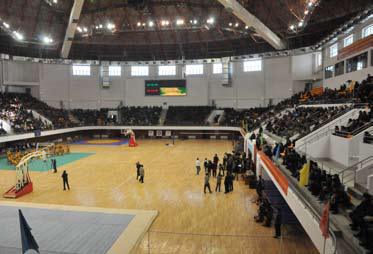
There are over 5,000 seats inside the domed arena
On December 2, the opening of a Sport’s Palace built in the Yarmag,Khan-Uul District with non-refundable aid of China’s government was held. An agreement of transfer of the new Sports Palace to the Mongolian side was signed by S. Bayartsogt, MP and member of the Government of Mongolia, and Yu Hongyao, Chinese Ambassador to Mongolia.
Spacious parking areas surround the new sports facility located near the airport
The Palace has 5,045 seats in total, a 2,950 sq.m arena for sports events, two smaller halls with 260sq.m each for sport training and a total of 104 rooms. In accordance with the Intergovernmental Economic and Technical Cooperation Agreements signed by the two governments on December 26, 2003, June 5, 2004, and May 24 and November 20, 2005, two sides agreed to implement construction of Sports Palace. China’s ‘Shanghai General Constructional Group’ was selected as an executor of construction work and established a cooperation agreement with Mongolia’s Finance Ministry and Physical Culture and Sports Department on December 24, 2007. Construction work was officially launched on June 20, 2008.
The Palace is not only dedicated to sports competitions, but to cultural events as well. Present at the opening ceremony were Prime Minister S. Batbold, Health Minister S. Lambaa and officials of sports organizations.
Mongolia finished the Guangzhou- 2010 Asian Games on November 28 with 2 gold, 5 silver, and 9 bronze medals. Mongolia ranked 21st in the official medal tally, which based pm the number of gold medals each country wins

source: 'The Mongol messenger' newspaper

Share:

PRIME MINISTER CANCELS VISIT TO BRITAIN

Deputy Minister of Foreign Affairs B.Bolor has said the Prime Minister canceled his visit to Britain scheduled to begin on November 27 as he could not leave the country when Parliament was to discuss the budget. This is going to fool no one as the date of the visit had been fixed with the full knowledge that the budget had to be passed before December 1. It has also been suggested that he wants to express Mongolia’s displeasure at the arrest of Mr. B. Khurts, Chief of Administration at the National Security Council, at Heathrow on September 17 and at the subsequent British refusal to release him despite Mongolian requests. It is difficult to understand why Mongolia should be displeased. After all, the Government has admitted that Mr. Khurts did forcibly abduct a man from French soil, and it is well known European nations value human rights. Can the real reason be that the Prime Minister was afraid the whole affair had given him a bad image and that he would not be able to answer questions in Britain? Official hints that the Prime Minister’s decision was meant to “assert our national dignity” hide the fact the real threat to this dignity lay in the fact that the Prime Minister would have been paying an official visit to Britain at a time when one of his seniormost officials was in prison there.
source:  Onoodor newspaper


Share:

MNCCI CHAIRMAN RUMORED TO BE ON WAY OUT

There is a move afoot to replace Mr. S.Demberel as Chairman of the Mongolian National Chamber of Commerce and Industry, a post he has held since 1998. Officials of the Marketing and Management Institute have said there are several allegations against Mr. Demberel misusing his position for personal gain. He is currently in his third term as MNCCI Chairman and has been vocal in demanding a bigger role for the private sector and has often been critical of the Government’s economic policies.
Among politicians and businessmen who have shown interest in succeeding Mr. Demberel are former President N.Enkhbayar, the Head of Ajnai Corp. Mr. D.Bat-Erdene, and the Director of Buyan LLC, Mr. B.Jargalsaikhan. The MNCCI has 700 members in Ulaanbaatar and its branches have a further 300. It works under a law passed by Parliament in 1995 and meets its expenses from membership fees. Members fall into four groups and annual fees range from MNT300,000 to MNT1 million.

source: www.news.mn

Share:

OYU TOLGOI LLC OPEN LETTER

We are writing regarding the mounting criticism of the Government of Mongolia’s equity holding in Oyu Tolgoi LLC and our Investment Agreement and we’d like to present this open letter in order to address these concerns and set the record straight.
Certain officials are distorting facts, alleging that the Government of Mongolia’s equity interest has been diluted from 34% to 7%. This is clearly wrong. The critical factors are:
• Cl. 1.6 of the IA clearly states the Government shall own 34% of the common shares of the OT LLC and this ratio will remain at this level throughout the life of the project. Indeed, there is an option in years to come that the Government can increase its stake.The dividends, taxes and royalties from the Oyu Tolgoi project to the Government and people of Mongolia will add up to over 50% from the revenue generated by the OT Project.
• The non-Government shareholders have already committed at least US$ 4 billion (MNT 5.2 trillion) to getting this project to first ore, and are funding 100% of the investment needed to do so, pursuant to its obligations under the Investment Agreement.
• If and when extra capital is required to continue the development of the project, the required funding will be raised solely by the foreign shareholders.
• There is no requirement for cash contributions from the Government of Mongolia as Ivanhoe Mines and Rio Tinto provide a lender of last resort financing facility to the Government. Provision of this facility insures that the Government’s equity interest is not diluted. The Government also has the option to source its own finance.
Oyu Tolgoi and its foreign shareholders, Rio Tinto and Ivanhoe Mines, are concerned that distortion of this important facts is not just unjustified bad news for Oyu Tolgoi project and its shareholders, but also for the reputation of Mongolia. This occurs at a time when other companies are trying to raise finance for important projects and are considering doing business here.
Since the Investment Agreement was signed 12 months ago, a huge part of the construction process is underway and over 3600 Mongolians are employed at the project. And further 3300 as a start being funded by us to train for future jobs both at Oyu Tolgoi and elsewhere in the Mongolian economy at the cost of 110 billion tugrugs. As per the Investment Agreement we have over 60% workforce of Oyu Tolgoi project who are Mongolian and this will increase to 90% by the time we become operational in 2013.
Helping us develop the project are over 2420 Mongolian companies who are supplying us with essential Mongolian products and services to the value to date of 360 billion tugrugs.
Because of the Mongolian support, a huge amount has been achieved in a short space of time including:
• Laying the foundations of 100,000 tonne-per-day copper concentrator with a total budget of US$ 1.2 billion
• The construction of Shaft #2 and its 31 storey concrete head-frame
• A 20 megawatt diesel power station and 35 kilovolt distribution system
• Initial earthworks for the open pit
• The underground development of Shaft #1
• The construction of 105 km highway Oyu Tolgoi – Gashuun sukhait
• Construction of a regional airport and concrete runway to accommodate Boeing 737 sized aircraft
We’ve worked for 5.7 million man hours with no loss time injuries.
We will continue to press ahead with this most important project for Mongolia and are committed to delivering what was agreed in the Investment Agreement and to further contributing to the socio-economic development of Mongolia and to the South Gobi region.


OYU TOLGOI LLC
COMMUNICATIONS DEPARTMENT

source: www.ot.mn


Share:

MPP not responsible for failures of MPRP

The real reason why the MPRP changed its name is that it does not want to answer any angry questions before the 2012 election on why the MPRP promise to give every citizen MNT1.5 million has not been kept. Many citizens still retain the paper with the promise for many had hoped to start a business with the money paid to all family members. The DP had said citizens would own MNT1 million worth of shares of the mining resources but newspaper articles of that period would reveal that the MPRP promised more and offered MNT1.5 million in cash.

Halfway through the four-year term of Parliament, citizens have got only MNT120,000. With the change of name, managing officials of the present MPP will claim the promise was made by the MPRP, and they cannot be held responsible. Keeping at least part of he promise has meant 1/3 of the combined budget will be spent on providing social welfare and cash allowances and tuition fees of the students. Similarly the blame for the July 1 disorder will be laid on the defunct MPRP.
But are Mongolian voters so easily duped?
source: www.news.mn


Share:

Wikileak materials on North Korea-Mongolia altered

One of the materials released by Wikileaks touches issue between North Korea and Mongolia. The document concerning meeting between Ministry of Foreign Affairs of Mongolia and North Korean Vice Minister of Foreign Affairs held in Aug, 2009 by US Embassy was put on the Wikileaks on 29 Nov, 2010. However, the document was altered a few days later or on 01 Dec and some names of persons and letters were marked with xxxxxxxx.

By research unit of mongolianviews.com
See below for altered and original version of the document.

ORIGINAL
O 130854Z AUG 09
FM AMEMBASSY ULAANBAATAR
TO SECSTATE WASHDC IMMEDIATE 2981
INFO AMEMBASSY BEIJING PRIORITY
AMEMBASSY MOSCOW PRIORITY
AMEMBASSY SEOUL PRIORITY
AMEMBASSY TOKYO PRIORITY
PACOM JIOC HONOLULU HI PRIORITY
SECDEF WASHINGTON DC PRIORITY
NSC WASHINGTON DC PRIORITY
Thursday, 13 August 2009, 08:54
S E C R E T ULAANBAATAR 000234
STATE FOR EAP/CM AND EAP/K; NSC FOR JEFF BADER
EO 12958 DECL: 08/13/2034
TAGS PREL, PGOV, MOPS, KNNP, MG
SUBJECT: MONGOLIA’S CONSULTATIONS WITH DPRK VICE FOREIGN
MINISTER KIM
Classified By: Political Counselor Andrew K. Covington, Reasons 1.4 (b) and (d)
¶1. (S) Summary: On August 12, Mongolian Ministry of Foreign Affairs and Trade (MFAT) Deputy Director for Asian Affairs J. Sukhee briefed poloff on the annual Mongolia-DPRK consultations that concluded on August 11. MFAT State Secretary Tsogtbaatar led the Mongolian side, and the North Koreans met with President Elbegdorj on the sidelines of the consultation. Sukhee noted DPRK delegation head Vice Foreign Minister Kim Yong Il spent much time on the nuclear issue and little on the bilateral relationship with Mongolia. Key themes on the part of the DPRK were the lack of criticism of the United States, indications that the DPRK is seeking bilateral talks with the USG on normalization of relations, that the recent travel of former President Clinton to Pyongyang has greatly improved the prospects for such talks, that Mongolia would be an appropriate venue for these talks, and that the Six Party Talks are no longer an option. End Summary.
¶2. (S) Poloff met with MFAT Deputy Director for Asian Affairs J. Sukhee on August 12 to discuss Mongolia’s annual bilateral consultations with the DPRK. Sukhee was present at the consultations and has been involved with Korean affairs as a diplomat since 1985. Sukhee was candid in his meetings with poloff, referring repeatedly and openly to his handwritten notes from the DPRK consultations.
-------------------------------------------
DPRK DELEGATION OFFERS NO CRITICISM OF U.S.
-------------------------------------------
¶3. (S) Sukhee indicated that VFM Kim met with MFAT State Secretary Tsogtbaatar for the consultations and also held a separate meeting with President Elbegdorj on the margins Monday. The Mongolian Deputy Foreign Minister was to lead this latter meeting but was unable due to an obligation. Sukhee said the meetings were notable for several reasons: the DPRK delegation did not read from a prepared script, they were not aggressive and made no criticism of the United States, and they criticized China and Russia “three or four times” for supporting recent UN Resolutions aimed at the DPRK. What follows in paras 4 through 12 is Sukhee’s description to poloff of the DPRK’s statements during the course of the consultations:
----------------------------
DPRK VFM ON DENUCLEARIZATION
----------------------------
¶4. (S) VFM Kim said the DPRK is spending too much on weapons rather than on its children, but that the current reality dictates that they cannot get away from weapons for now. Kim said the DPRK is not a threat and was only interested in self-protection. The Mongolian side expressed concern that a nuclear DPRK could lead to a nuclear ROK, Japan, Syria, and Iran, and urged that the Mongolian nuclear-free model could serve as an example. Kim stated the United States would not allow Japan or the ROK to go nuclear and that the DPRK is committed to peace and denuclearization.
¶5. (S) The Mongolians offered the example of the Soviet Union and the United States during the Reagan-Gorbachev era, when the two allowed for nuclear inspections, leading to improved trust and a reduction in the number of warheads. The Mongolians stated that if they were in the DPRK’s place now, they would allow inspections, which would lead to mutual confidence and improved relations. The DPRK side offered no reaction to the suggestion.
¶6. (S) The DPRK side said what is most important is for the United States and the DPRK to come up with a “common language,” a “non-aggression agreement,” and establishment of diplomatic relations. Kim stated if the sides can take such measures, then denuclearization will be possible and easy, and that relations with Japan and the ROK will normalize thereafter.
¶7. (S) The Mongolian side counseled that recent “provocations” (this is Sukhee’s word to poloff; another word may have been used in the consultations) such as the missile test meant that the present situation was very fragile, and that the DPRK should be careful not to present the wrong signal. Kim agreed that the DPRK must be careful and must build confidence. The Mongolians stated that even if one has peaceful intentions, one can be seen as provocative.
--------------------------------
ON BILATERAL TALKS WITH THE U.S.
--------------------------------
¶8. (S) Regarding former President Clinton’s recent travel to the DPRK to secure of the release of the two journalists, Kim said this action had been prepared for a long time, meaning the groundwork for such a visit was already in place because of the progress the United States and the DPRK made during the Clinton presidency. Kim said forward motion stopped during the Bush Administration but was now able to proceed because of President Clinton’s recent involvement in a personal capacity, because President Obama is of the same party, and because former First Lady Clinton is now the Secretary of State. The North Koreans were expecting a dialogue with the United States to start soon as an extension of President Clinton’s visit.
¶9. (S) Kim asked the Mongolians to support a U.S.-DPRK dialogue (Sukhee described Kim as “enthusiastic” at this point), and he stated “there are no eternal enemies in this world.”
----------------------
ON THE SIX PARTY TALKS
----------------------
¶10. (S) Kim took a “very hard line” on the Six Party Talks according to Sukhee, stating that the DPRK will never return to the talks, that the talks were dead, but that the door has not closed on an opportunity for negotiations. During discussion of the Six Party Talks, Kim criticized Russia and China for their support of recent UN resolutions aimed at the DPRK. Kim said Japan and the ROK were natural allies of the United States during the talks, and that Russia and China ended up supporting the other three, so that the DPRK felt it was five against one. Kim stated the real intention of the Six Party Talks was to destroy the DPRK regime, and that at present the DPRK wants to talk only to the United States.
------------------------------------------
VFM KIM’S MEETING WITH PRESIDENT ELBEGDORJ
------------------------------------------
¶11. (S) Sukhee also provided insight into Kim’s meeting with Elbegdorj on August 10: Kim refrained from criticizing the United States and stated the DPRK would be happy if the GOM could support a U.S.-DPRK dialogue “in the international arena.” Kim said to Elbegdorj, “We are telling you all this because Mongolia understand us.” Kim reiterated the notion that there is a “good personal understanding” between former President Clinton and DPRK leader Kim Jong-Il.
--------------------------------------
HOW ABOUT U.S.-DPRK TALKS IN MONGOLIA?
--------------------------------------
¶12. (S) Sukhee further noted that a counselor named Choi from the DPRK Embassy in Ulaanbaatar told Sukhee on the way to the airport on August 11 that he had suggested to VFM Kim that it would be good to host U.S.-DPRK talks in Mongolia, but that Kim offered no reaction. Choi also told Sukhee that the timing was right to establish a regional security mechanism whose organization the Mongols should spearhead.
MINTON

ALTERED

O 130854Z AUG 09
FM AMEMBASSY ULAANBAATAR
TO SECSTATE WASHDC IMMEDIATE 2981
INFO AMEMBASSY BEIJING PRIORITY
AMEMBASSY MOSCOW PRIORITY
AMEMBASSY SEOUL PRIORITY
AMEMBASSY TOKYO PRIORITY
PACOM JIOC HONOLULU HI PRIORITY
SECDEF WASHINGTON DC PRIORITY
NSC WASHINGTON DC PRIORITY
<<220571>>
8/13/2009 8:54
09ULAANBAATAR234
Embassy Ulaanbaatar
SECRET

O 130854Z AUG 09
FM AMEMBASSY ULAANBAATAR
TO SECSTATE WASHDC IMMEDIATE 2981
INFO AMEMBASSY BEIJING PRIORITY
AMEMBASSY MOSCOW PRIORITY
AMEMBASSY SEOUL PRIORITY
AMEMBASSY TOKYO PRIORITY
PACOM JIOC HONOLULU HI PRIORITY
SECDEF WASHINGTON DC PRIORITY
NSC WASHINGTON DC PRIORITY
TAGS: PREL PGOV MOPS KNNP MG
SUBJECT: MONGOLIA"S CONSULTATIONS WITH DPRK VICE FOREIGN


S e c r e t ulaanbaatar 000234


State for eap/cm and eap/k; nsc for jeff bader

E.o. 12958: decl: 08/13/2034
Tags: prel, pgov, mops, knnp, mg
Subject: mongolia"s consultations with dprk vice foreign
minister kim

Classified By: Political Counselor Andrew K. Covington, Reasons 1.4 (b)
and (d)

¶1. (S) Summary: xxxxx. MFAT xxxxx led the Mongolian side, and the North
Koreans met with President Elbegdorj on the sidelines of the
consultation. xxxxx
little on the bilateral relationship with Mongolia. Key
themes on the part of the DPRK were the lack of criticism of
the United States, indications that the DPRK is seeking
bilateral talks with the USG on normalization of relations,
that the recent travel of former President Clinton to
Pyongyang has greatly improved the prospects for such talks,
that Mongolia would be an appropriate venue for these talks,
and that the Six Party Talks are no longer an option. End
Summary.

¶2. (S) xxxxx discuss Mongolia"s annual bilateral
consultations with the DPRK. xxxxx was present at the
consultations and has been involved with Korean affairs as a
diplomat since 1985. xxxxx was candid in his meetings with
poloff, referring repeatedly and xxxxx the DPRK consultations.

-------------------------------------------
dprk delegation offers no criticism of u.s.
-------------------------------------------

¶3. (S) xxxxx indicated that VFM Kim met with MFAT State
Secretary Tsogtbaatar for the consultations and also held a
separate meeting with President Elbegdorj on the margins
Monday. The Mongolian Deputy Foreign Minister was to lead
this latter meeting but was unable due to an obligation.
xxxxx said the meetings were notable for several reasons:
the DPRK delegation did not read from a prepared script, they
were not aggressive and made no criticism of the United
States, and they criticized China and Russia "three or four
times" for supporting recent UN Resolutions aimed at the
DPRK. What follows in paras 4 through 12 xxxxx
description to poloff of the DPRK"s statements during the
course of the consultations:

----------------------------
dprk vfm on denuclearization
----------------------------

¶4. (S)xxxxx
said the DPRK is not a threat and was only interested in
self-protection. The Mongolian side expressed concern that a
nuclear DPRK could lead to a nuclear ROK, Japan, Syria, and
Iran, and urged that the Mongolian nuclear-free model could
serve as an example. xxxxx stated the United States would not
allow Japan or the ROK to go nuclear and that the DPRK is
committed to peace and denuclearization.

¶5. (S) The Mongolians offered the example of the Soviet Union
and the United States during the Reagan-Gorbachev era, when
the two allowed for nuclear inspections, leading to improved
trust and a reduction in the number of warheads. The
Mongolians stated that if they were in the DPRK"s place now,
they would allow inspections, which would lead to mutual
confidence and improved relations. The DPRK side offered no
reaction to the suggestion.

¶6. (S) The DPRK side said what is most important is for the
United States and the DPRK to come up with a "common
language," a "non-aggression agreement," and establishment of
diplomatic relations. xxxxx stated if the sides can take such
measures, then denuclearization will be possible and easy,
and that relations with Japan and the ROK will normalize
thereafter.

¶7. (S) The Mongolian side counseled that recent
"provocations"xxxxx; another word
may have been used in the consultations) such as the missile
test meant that the present situation was very fragile, and
that the DPRK should be careful not to present the wrong
signal. xxxxx The Mongolians stated that even if one has
peaceful intentions, one can be seen as provocative.

--------------------------------
on bilateral talks with the u.s.
--------------------------------

¶8. (S) Regarding former President Clinton"s recent travel to
the DPRK to secure of the release of the two journalists, Kim
said this action had been prepared for a long time, meaning
the groundwork for such a visit was already in place because
of the progress the United States and the DPRK made during
the Clinton presidency. Kim said forward motion stopped
during the Bush Administration but was now able to proceed
because of President Clinton"s recent involvement in a
personal capacity, because President Obama is of the same
party, and because former First Lady Clinton is now the
Secretary of State. The North Koreans were expecting a
dialogue with the United States to start soon as an extension
of President Clinton"s visit.

¶9. (S) Kim asked the Mongolians to support a U.S.-DPRK
dialogue xxxxx stated "there are no eternal enemies in this
world."

----------------------
on the six party talks
----------------------

¶10. (S) Kim took a "very hard line" on the Six Party Talks
according to xxxxx stating that the DPRK will never return
to the talks, that the talks were dead, but that the door has
not closed on an opportunity for negotiations. During
discussion of the Six Party Talks, Kim criticized Russia and
China for their support of recent UN resolutions aimed at the
DPRK. Kim said Japan and the ROK were natural allies of the
United States during the talks, and that Russia and China
ended up supporting the other three, so that the DPRK felt it
was five against one. Kim stated the real intention of the
Six Party Talks was to destroy the DPRK regime, and that at
present the DPRK wants to talk only to the United States.

------------------------------------------
vfm kim"s meeting with president elbegdorj
------------------------------------------

¶11. (S) xxxxx provided insight into Kim"s meeting with
Elbegdorj on August 10: Kim refrained from criticizing the
United States and stated the DPRK would be happy if the GOM
could support a U.S.-DPRK dialogue "in the international
arena." Kim said to Elbegdorj, "We are telling you all this
because Mongolia understand us." Kim reiterated the notion
that there is a "good personal understanding" between former
President Clinton and DPRK leader Kim Jong-Il.

--------------------------------------
how about u.s.-dprk talks in mongolia?
--------------------------------------

¶12. (S) xxxxx further noted that a xxxxx in Ulaanbaatar xxxxx on the way to the
airport on August 11 that he had suggested to VFM Kim that it
would be good to host U.S.-DPRK talks in Mongolia, but that
Kim offered no reaction.xxxxx that the
timing was right to establish a regional security mechanism
whose organization the Mongols should spearhead.


Minton


Share:

WikiLeaks: Mongolia passed North Korea message to U.S.

(CNN) -- North Korea attempted to reach out to the United States through Mongolia in 2009, suggesting that the Mongolians host disarmament talks between Washington and Pyongyang, American diplomats reported in a document obtained by the website WikiLeaks.

A Mongolian diplomat passed that information to the U.S. Embassy in Ulaan Baatar after an August 2009 meeting with Kim Yong Il, North Korea's vice foreign minister, a leaked embassy cable recounts. "There are no eternal enemies in this world," the Mongolian official quoted Kim as saying.

"VFM Kim said the DPRK is spending too much on weapons rather than on its children, but that the current reality dictates that they cannot get away from weapons for now," the cable states, using shorthand for the Democratic People's Republic of Korea. "Kim said the DPRK is not a threat and was only interested in self-protection."

The document is among the vast cache that the website WikiLeaks began releasing Sunday to widespread condemnation from the United States and its allies.

The Mongolian diplomat who recounted the meeting described it as "notable" since the North Koreans "did not read from a prepared script, they were not aggressive and made no criticism of the United States, and they criticized China and Russia 'three or four times' for supporting recent U.N. resolutions aimed at the DPRK," the cable states.

The North Koreans repeated their insistence that they would not return to the six-party regional talks aimed at convincing Pyongyang against dismantling its nuclear weapons program, according to the document. As they had in the past, they indicated that they wanted to discuss disarmament and the normalization of relations with Washington in one-on-one talks, which an embassy official suggested could be held in Mongolia, according to the Mongolian diplomat.

The cable quotes Kim as saying that former President Clinton's visit to North Korea "has greatly improved the prospects for such talks." Clinton had gone to Pyongyang a week earlier to retrieve two American journalists held on charges of entering the country illegally.

Source:CNN
Share:

Former World Bank country director appointed as President of Peabody Mongolia

ST. LOUIS, Nov. 30, 2010 /PRNewswire via COMTEX/ -- Peabody Energy /quotes/comstock/13*!btu/quotes/nls/btu (BTU 58.52, -0.29, -0.49%) today announced that Arshad Sayed has been named President - Peabody Mongolia and India. Sayed will have responsibility for managing all of Peabody's business development initiatives in Mongolia and India.

"Arshad has extensive experience in Mongolia and India, and he brings with him strong relationships in the region that will allow him to advance Peabody's Asian growth initiatives," said Peabody President and Chief Commercial Officer Richard A. Navarre. "His experience with The World Bank Group ensures he will advance our goals using the highest standards for ethics, operations and the environment."

Sayed recently completed a four-year appointment as Country Manager and Resident Representative for The World Bank in Mongolia, where he was responsible for policy and program negotiations; developing new lines of business for the bank relating to mining and mining infrastructure; and coordinating relationships with the private sector and government, including involvement in the development of mining projects in Mongolia. Sayed represented The World Bank in various positions for more than 15 years. He served in the bank's Corporate Strategy Group leading innovation and strategy initiatives, and as Senior Strategy and Operations Officer in the Office of the Vice President for Europe and Central Asia. His prior experience includes founding a start-up company and working for the Government of Maharashtra in India.

He holds a Bachelor of Commerce degree in Business Administration; a Master of Commerce from Sydenham College, University of Bombay, India; and as a National Scholar, a Master of Public Administration from the School of International and Public Affairs at Columbia University in New York.

Peabody Energy is the world's largest private-sector coal company and a global leader in clean coal solutions. With 2009 sales of 244 million tons and $6 billion in revenues, Peabody fuels 10 percent of U.S. power and 2 percent of worldwide electricity.
CONTACT:
Meg Gallagher
(314) 342-7963
Source:Peabody Energy
Share:

Facebook page

Powered by Blogger.

Categories

Advertising in Mongolia An Asian Development Bank Culture Editorial of the Mongolianviews education Environmental protection Famous Mongolians Foreigners in Mongolia Inner Mongolia Ivanhoe Mines Mongolia Adventure Mongolia agriculture Mongolia air pollution Mongolia analysis Mongolia and Armenia Mongolia and Asian Development Bank Mongolia and Australia Mongolia and Azerbaijan Mongolia and Belorussia Mongolia and Bulgaria Mongolia and Cambodia Mongolia and Canada Mongolia and central Asia Mongolia and China Mongolia and Cuba Mongolia and Czech Mongolia and donors Mongolia and EU Mongolia and Germany Mongolia and Hongkong Mongolia and Hungary Mongolia and IFC Mongolia and IMF Mongolia and Ind Mongolia and India Mongolia and Indonesia Mongolia and Inner Mongolia Mongolia and Iran Mongolia and Israel Mongolia and Italy Mongolia and Japan Mongolia and Kazakhstan Mongolia and Korea Mongolia and Kuwait Mongolia and Kyrgyzstan Mongolia and Malaysia Mongolia and Nato Mongolia and North Korean Mongolia and Poland Mongolia and Qatar Mongolia and Russia Mongolia and Russia and Mongolia and China Mongolia and Singapore Mongolia and South Korea Mongolia and Taiwan Mongolia and Thailand Mongolia and the world Mongolia and Tibet Mongolia and Turkey Mongolia and UK Mongolia and Ukraine Mongolia and UN Mongolia and US Mongolia and USA Mongolia and Vietnam Mongolia Banking Mongolia blind Mongolia Cashmere Mongolia Christianity Mongolia civic society Mongolia Corruption Mongolia crime Mongolia diplomacy Mongolia Economy Mongolia Education Mongolia Energy Mongolia environment Mongolia Finance Mongolia Health Mongolia History Mongolia holiday Mongolia in international media Mongolia Industries Mongolia investment Mongolia Joke Mongolia law Mongolia LGBT Mongolia medical Mongolia military Mongolia Mining Mongolia Mining Developments Mongolia Mortgage Mongolia natural disaster Mongolia news media Mongolia Nuclear Mongolia Petroleum Mongolia Politics Mongolia Poverty Mongolia public announcements Mongolia railways Mongolia Religion Mongolia slums Mongolia society Mongolia Sports Mongolia Stamp Mongolia Sumo Mongolia telecommunication Mongolia tourism Mongolia trade Mongolia Transportation Mongolia Urbanization Mongolia Wild Life Mongolian Agriculture Mongolian and Cuba Mongolian Archeology Mongolian Climate Mongolian Food Mongolian Gay Mongolian Government news Mongolian History Mongolian Kazakh Mongolian Meat Mongolian Military Mongolian Mining Development Mongolian Movie Mongolian News Mongolian Parliament Mongolian Political news Mongolian Press Mongolian Songs Mongolian Sumo Mongolian Women Mongolian Youth Mongolians abroad Moninfo Opinion Oyu Tolgoi Investment Agreement Photo news Press Release Rio Tinto Tavan Tolgoi coal mine Ulaanbaatar development Weird expatriates in Mongolia World bank and Mongolia

Blog Archive

Followers