Mongolian thieves arrested after shoplifting spree in Hongkong

A shoplifting suspect (inset) is taken away for questioning by security personnel. Police found around 500 pieces of stolen clothing items in a hotel room of a Mongolian group. Photos: tvb.com
Two Mongolian nationals, aged between 34 and 41, were arrested on Sunday after they were caught red-handed during an apparent shoplifting spree in Tsim Sha Tsui. 
The thieves, a man and his female companion, were apprehended outside an H&M store on Canton Road at about 5 pm, Sing Tao Daily reports.
Police were quoted as saying that the duo was using a specially made paper bag to steal brand name clothing items from shops in the area.
An inspection revealed 18 pieces of unpaid-for clothing items inside a paper bag that was in possession of the Mongolians, according to the report.
The stolen items were estimated to be worth HK$5,000 in total.
After intercepting the shoplifters, police took the couple to their hotel room at the nearby Mirador Mansion.
In the hotel room, officers found more than 500 other stolen goods worth over HK$300,000. Inquiries led to another Mongolian member of the gang being arrested later.
The three Mongolians were believed to have arrived in Hong Kong four days ago and engaged in a series of shoplifting capers.
According to the police, the trio used special paper bags with tin foil to avoid detection by anti-theft devices installed at fashion outlets.
It is suspected that they were preparing to ship the stolen goods to mainland China and sell them.
As the Chinese New Year approaches, police plan to increase patrols in the shopping areas to deter potential thieves, said Chan Yun-kam, assistant commander of the Tsim Sha Tsui district police.
The Mongolians who were caught were clearly experienced in their trade.
According to the police, one of the visitors would hold on to a bag while the other would snip off tags from the clothing items with a small pair of scissors when shop personnel were not watching.
It is believed that the group was involved in at least 20 thefts after they arrived in Hong Kong, Ming Pao Daily News reports.
In just three days, the Mongolians stole at least 500 pieces of clothing goods, pointing to a well-planned racket.
Police are looking for possible accomplices after holding the three persons in custody.

Source:http://www.ejinsight.com/20170117-mongolians-arrested-after-shoplifting-spree-in-tsim-sha-tsui/
Share:

UN Population Fund preserves dignity first for women and girls affected by the near Dzud

UNFPA hands over 2,465 Dignity Kits to NEMA for immediate distribution
Ulaanbaatar, Mongolia - According to the Water, Climate and Environmental Research Institute reports dated on 03 January 2017, the winter conditions have become difficult in 127 soums of 17 aimags and 2 districts of Ulaanbaatar city, directly affecting the lives of nomadic, herding households in Mongolia. In response, UNFPA takes the lead in addressing the special needs of women and girls in the affected communities by procuring 2,465 Dignity Kits, worth 160,000,000MNT. These Dignity Kits were handed over by UNFPA today to NEMA for immediate distribution to the aforementioned areas.
The UNFPA signature Dignity Kits are designed and assembled to help women and girls maintain an acceptable level of hygiene, sanitation, health and well-being within the context of humanitarian situations. Dignity kits include such items as sanitary supplies, clothes, socks and underwear; laundry soaps and bath soaps; towels; and toothbrushes and toothpaste. Additionally, they also include a torch with batteries so that women will have the ability to travel or move about safely at night, as well as an emergency whistle in cases of distress – it has been proven that women and girls are particularly vulnerable to gender-based and sexual violence in the wake of natural disasters among other challenges.
“Unfortunately, the needs of women and girls are often not prioritized and even forgotten in the Dzud. The needs of women and girls might be secondary when affected families face economic pressures from the loss of livelihood and have to cope with limitations of resources such as the lack of disposable income. Further, environmental impediments to mobility due to the heavy snow, bars access to necessary everyday items that women and girls need,” says Naomi Kitahara, UNFPA Representative. “However, UNFPA believes that women are the backbone of Mongolian society and that preserving their dignity, their sense of well-being and their health should come first. This is essential to surviving such a disaster and to successfully moving forward."
The hand-over of these Dignity Kits to NEMA for its distribution to the affected areas is part of the efforts aimed to strengthen the capacity of the NEMA and broaden its experience in responding to the specific needs of the women and girls during the emergency.

Source:UN Population Fund
Share:

Interview with Chairman of cabinet secretariat of Mongolian government: There are three options to pay back the 580 million Euro loan

Mongolia is due to pay back 580 million euro bond in coming March. However, government doesn’t have this money. Therefore, it is said that authorities are going to borrow money from other countries and pay back this big debt. 

However, so far, there are no countries that agreed to lend soft loan to our country. We interviewed Munkhbat Jamiyan, chairman of the cabinet secretariat.


-Mongolia is due to pay back 580 million Euro loan in March. What are possibilities to pay back this debt?
-Mongolian economy is experiencing difficulties. It will be hard to make cash payment. There are three options to pay back this loan. First, cash payment, secondly, to postpone it in some way, third, officially announce that can’t pay back. Of course, it is understandable that first and third options are hard for Mongolia.
/Mongolian/ economy have little capacity to bear the cash payment. If /we/ announce that can’t pay back the debt, it will create most difficult condition for any country. Therefore, /we are/ discussing that second option is most appropriate option that suits current economic condition of Mongolia.
However, currently, no final decision has been made. Soon, Head of IMF will come and official meeting will be held. Then, decision whether to accept IMF program will be finally made within this month.
-How this 580 million Euro loan was spent?
-You’ve seen results of recent inspection of Development bank and its situation.The loan was spent for financing of programs and projects of last 4 years. The result of checks at Development bank are presented to the Parliament and disclosed to public through media.
Government disclosed the 200 page inspection report for the public.

-          So, is it correct to understand that the 580 million euro is misspent?

-Actually, /spending of/ bond money and loans of Development bank are serious issues that violated laws. Working group set up by the parliament are checking the results. According to our information, , working group of law enforcement agencies to investigate the Development bank and the ministry related bond and other loans have been set up. Therefore, the issue will be resolved under this framework.
There were many issues at the Development bank that violated laws and related to poor discipline during last 4 years. Because of these issues, Mongolian economy is as it is now. Ended up unable to pay back the loan.

-Recently, Speaker of the parliament visited Russian Federation and Arabian countries. Russia said “ loan purpose is unclear and therefore, can’t give loan” to Mongolia’s request of loan?

-I don’t know about this issue.Media is writing about it in various ways.  However, needs foreign investment, loan and assistance in order to improve the economy. Therefore, Government is working through its channel in many directions. It is true that we accepted a country with much debt burden such as repayment of Chinggis Bond, loan of Chinese People’s bank. Now we are working on to solve this issues.

-So, are talk about about delaying the loan already started?

-This issue can’t be decided by one day talk. Probably will be decided after many meetings, talks and negotiations.


Source:Mongoliin Medee newspaper and Ikon.mn 
Share:

A Crisis in Two Parts: Mongolia’s Buddhism Question and its Economic Failings

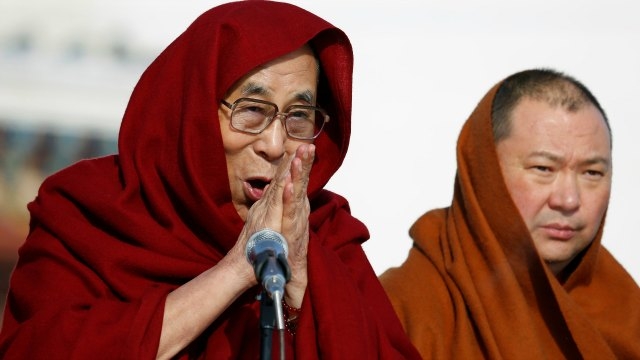
On Friday, November 18, 2016 the 14th Dalai Lama arrived in Ulan Bator to begin a four-day pastoral visit in Mongolia, a Buddhist-majority country. During his visit, he spoke to followers at the Gandantegchinlen monastery on the topic of materialism. According to the Mongolian government, his visit and teachings contained no overtly political content, and was largely spiritual in nature. On the same day that the Dalai Lama arrived, the Chinese Ministry of Foreign Affairs put out a statement urging Mongolia to refuse the Lama’s entrance in the interest of their “sound and steady” bilateral tie development. Similar to past instances, the Mongolian government ignored the Chinese protests and allowed the lama a visa.
The 14th Dalai Lama speaks to a crowd of thousands at Gandantegchinlen monastery. http://www.dnaindia.com/world/report-dalai-lama-preaches-in-mongolia-risking-china-s-fury-2275112
T
The reaction from the Chinese government was more forceful than in the past years. During the 2002 visit, China briefly closed its borders to Mongolia and during the 2006 visit Beijing cancelled its flights to Ulambataar. This time, the stakes have changed and leverage firmly favors China. Beijing promptly cancelled the planned bi-annual, bilateral meeting between Mongolian and Chinese foreign ministers. They also cancelled a meeting  which had the intended goal of resolving Mongolia’s balance-of-payment dilemma through a 4.2 billion dollar loan. Additionally, they placed a tariff on goods exported from Mongolia to China at a border crossing with the most traffic. The border crossing in question, the Gashuun Sukhait pass, is the largest commercial point between China and Mongolia for Mongolia’s export market of copper and coal—including coal coming from a large mine which the Chinese state-ownedShenhua Group has its eyes on for development. The new transit fee is 10 yuan per truck and an additional 8 yuan per tonne. Independent mining analyst Dale Choi estimates that 900 trucks and 133,000 tons pass through daily. The Chinese foreign minister Geng Shuang has denied any knowledge of whether the new tariffs and diplomatic blocks are in response to the Dalai Lama’s visit. He stated that he was not aware of the tariff situation.
On December 21, the Mongolian Foreign Minister Munkh-Orgil Tsend told the Onoodor newspaper, “The government feels sorry for this.’’ He went on to say that the Dalai Lama “probably won’t be visiting Mongolia again during this administration.’’
Many have taken the statement to be an indication of an irrevocable censure on the Dalai Lama. Bloomberg politics entitled their report, Mongolia Vows No More Dalai Lama Visits After China Turns Screws. At a news briefing on the same day China’s foreign affairs spokesman Hua Chunying stated, “We hope that Mongolia will truly learn lessons from this incident, truly respect the core interests of China, honour its promise and make efforts to improve the relations between China and Mongolia.”
However, the administration will be changing this summer after the July Mongolian Presidential elections. The current president, even if he weren’t suffering in popularity, is no longer eligible, having already served his maximum second term in office. Despite the ambiguity of its duration and its fait accompli nature, the apology and censure is a dramatic change for Mongolia. Mongolia is 53% Buddhist, and it was the Mongolian Altan Khan who bestowed the title Dalai upon the visiting lama in 1577; Dalai is, in fact, a word from the Mongolian language meaning ocean.

The Economic Crisis
Mongolia is no longer as powerful as it once was; the age of the khans has disappeared into history, and even the success of 2012 is illusory. For Mongolia, the status-quo of this controversial conflict between religion and economy may be unsustainable in the face of pressure from Beijing, because its economy is in serious trouble and is dependent on China. In 2009, Mongolia resorted to the IMF for funds. The IMF agreed and supplied 242 million USD as a bailout. They toasted the deal with champagne, and indeed, the following several years seemed to prove their celebration to be well-founded; the government deficit and inflation rates went down, foreign debt arrears were paid, and there was a restoration of confidence in the Mongolian market which saw a 17.3% economic growth in 2012.
The good economic times did not last. By 2014, growth was down to 8% and then 2.3% in 2015. The Mongolian government invested massively in mining and other projects in the last couple of years. However, in the face of a world-wide decline in demand for copper (largely caused by China), Mongolia has yet to see a return on their expenditures which more than doubled their national debt this year to one billion. Attempts to help the matter by raising interest rates have done nothing but harm to the Mongolian economy. In August this year, Standard & Poor’s Global downgraded Mongolia’s long-term rating from B to B-.
Also important is that Mongolia’s economic complexity ranking has undergone a gradual but drastic decrease. This reduces their ability to handle a downturn in a specific global market and limits the breadth of interested international trading partners. 43% of Mongolia’s economy is copper, 29% is coal, and 27% is gold. China accounts for 80% to 90% of Mongolia’s export economy over the past six years.
Mongolia is in economic pain. To make matters worse, their dependence on China is not reciprocated by the latter to the same degree. The economic slowdown in Mongolia has roots in the declining commodities market in China. Another factor is that Chinese domestic copper production and processing have increased in the last several years. Any pressure that China might exert on Mongolia and any broken ties or stalled trade routes might marginally hurt China’s economy but it would destroy the financial sector in Mongolia. In this light, Mongolia’s question of whether to choose to heal the crisis of faith or the economic crisis is easy to answer.
The Crisis of Faith
China has long been in dispute with the Dalai Lama, whom the Chinese government views as a separatist and an enemy to the PRC. Following a failed uprising in 1959, the Dalai lama fled Tibet and found refuge in India. The PRC government has not allowed the Dalai Lama to return to the country since that time.
This is not the first time that the Chinese government has used political and economic pressure to sway third parties in the ongoing debate. The host country for the 2014 Nobel summit moved from South Africa to Rome, after South Africa refused the Dalai Lama an entrance visa.
A secondary factor beyond the economic and political imbroglio is that while in Mongolia the Dalai Lama announced that he was convinced that the Jebtsundampa Khatagt (Reverend Noble Incarnate Lama) had been reborn. This is the traditional name attached to the patriarchs of Buddhism in Mongolia which traditionally follow the same Yellow Hat Buddhist practice as the Dalai Lama. In Mongolia this patriarch is seen as the third most senior lama following the Dalai and then Panchem Lama. The rebirth of the Jebtsundampa Khatagt would ensnare China, Mongolia, and India in a theocratic and political difficulty. Following an imperial decree in 1758 all patriarchs of this line had to be born in Tibet, overseen by the Chinese Qing court and finally approved by them before the Dalai and Panchem Lama could approve them.

Source:http://mironline.ca/crisis-two-parts-mongolias-buddhism-question-dalai-lama-card/


Share:

Taiwan aims to disband Mongolia and Tibet Affairs Body, without transfer of duty

By Luo Tien-pin and William Hetherington  /  Staff reporter, with staff writer

The Taiwanese Mongolian and Tibetan Affairs Commission is to be dissolved as part of a restructuring plan and its administrative businesses will not be transferred to the Mainland Affairs Council (MAC), a draft bill submitted by the Executive Yuan said.
During former president Ma Ying-jeou’s (馬英九) administration it was proposed that the commission be combined with the MAC, but the Democratic Progressive Party (DPP) government has disagreed.
A draft submitted to the Legislative Yuan made no mention of Mongolia or Tibet in outlining the administrative responsibilities of the MAC.
DPP Legislator Lee Chun-yi (李俊俋) said there is a consensus within the government regarding the dissolution of the commission, adding that the bodies different responsibilities would be divided among various departments.
Lee said the commission’s cultural affairs should be handled by the Ministry of Culture, and exchanges with overseas Mongolians and Tibetans by the Ministry of Foreign Affairs or the Overseas Community Affairs Council.
The dissolution of the commission was proposed by former president Chen Shui-bian’s (陳水扁) administration, but it was never implemented, Lee said, adding that the Chen administration proposed establishing a cultural and tourism department that handled the commission’s cultural exchanges, while the foreign ministry would be responsible for Tibetan affairs.
The Ma administration in 2012 proposed merging the commission and the MAC, with a separate office for Tibetan affairs and Mongolian affairs within the council. That proposal was never passed.
Lee said that part of the restructuring involves issues concerning Tibetan political refugees and the likely establishment of a refugee act that would include provisions for Tibetans, adding that further discussions are also needed to clarify who would act as the representative for Mongolians and Tibetans living in Taiwan.
A government official said the dissolution of the commission is an established goal, adding that the government must now figure out whether Tibetan and Mongolian affairs should be handled in conjunction with Chinese affairs or separately.
Each administration has a different way of thinking about the issue, the official said, adding that President Tsai Ing-wen (蔡英文) has rejected the idea of tying the commission’s responsibilities with those related to China.

Source:www.taipeitimes.com
Share:

The Mongolian stamps that are gaining popularity

By Henry Gitner and Rick Miller 

Mongolia’s 1943 People and Scenes set of eight (Scott 75-82) is in demand and is a good buy in unused hinged condition at the 2017 Scott Standard Postage Stamp Catalogue value of $297.
Mongolia lies in Central Asia between China and Russia. There is little arable land. The landlocked country is extremely arid, hot in the summer and very cold in the winter, with the result that most of its area is either desert, mountain or steppe.
The 18th largest country by land area, with a population of just 3 million, it is the most sparsely populated independent country in the world. About 30 percent of the population is nomadic with another 45 percent living in the capital city, Ulan Bator.

Mongolia was dominated sporadically by China until the Russian Bolsheviks established it as a buffer state against China in the 1920s. Communist domination ended in 1990 when the Soviet Union collapsed.
Mongolia issued its first stamps in 1924. With virtually no immigration from Mongolia to the United States and little cross-cultural contact between the two nations, there are not many American collectors who specialize in Mongolia. Most interest in Mongolian stamps has been from topical collectors because the country has been a prolific issuer of topical stamps both during and after the Communist period.
However, there is growing interest in stamps issued from 1924 up through the late 1950s, especially among collectors of Russia and China. A good set to look for is the set of eight issued in 1943 (Scott 75-82). The stamps feature Mongolian people and scenes.
The 2017 Scott Standard Postage Stamp Catalogue values the set in unused hinged condition at $297. This is not an easy set to find, and you might have to buy the stamps one at a time. All are worth full Scott catalog value and perhaps a bit more for those in a strict grade of very fine. 

Source:http://www.linns.com/
Share:

Mongolia and FAO set sights on South-South Cooperation to boost agricultural development

The new agreement is designed to boost Mongolia’s agriculture with innovative approaches and tools from around the world.

Mongolia and FAO will work more closely together to promote international partnerships and exchanges that support sustainable agriculture in the East Asian country, the UN agency said today.
A new agreement, signed by FAO Director-General José Graziano da Silva and Mongolia’s agriculture minister Purev Sergelen today, will strengthen the partnership between FAO and Mongolia on South-South and Triangular Cooperation — a form of development partnership that boosts countries’ agricultural capacity by linking their policy makers and producers with experts and technologies from around the world. This includes other emerging economies that have built special expertise in specific agricultural sectors.
FAO will support Mongolia in working with a wider array of global partners, such as international organizations, research institutions, governments and the private sector, to make Mongolia’s food production more sustainable, strengthen its agribusiness and ensure lasting food security.
By bringing innovative approaches and tools to the country, these knowledge exchanges will benefit Mongolia’s National Livestock Programme and other high priority national agricultural development programmes, along with policies that aim to improve farmers’ incomes and living standards.
Building on previous success
The new agreement builds on two previous successful South-South exchanges between China and Mongolia that FAO helped establish between 2010 and 2016.
In the last two years alone, some 775 producers, traders and policy makers across Mongolia received in-country training from Chinese experts, and more than 20 high-level Mongolian officials and experts participated in study tours to China, where they visited agricultural institutions, relevant farms and enterprises.
These multi-year exchange projects improved animal breeding, beekeeping, crop production and agribusiness, and introduced new technologies to the Mongolian agriculture sector – a sector that builds strongly on animal husbandry, potato farming and intensive vegetable farming.
Mongolian farmers also benefited from new varieties of fodder crops and improved cultivation technologies, which offer livestock keepers more options to keep their animals strong and healthy and will make animal husbandry overall more resilient against climate change.
In the area of crop farming, new vegetable and fruit varieties, along with effective greenhouse technologies, resulted in increased yields.
Local agricultural companies also expanded marketing and sale channels thanks to South-South exchanges and trade between China and Mongolia. 
Share:

China-Mongolia-Russia economic corridor: the next step towards a Eurasian highway

The ‘Plan on establishing the China-Mongolia-Russia economic corridor’ signed by China, Mongolia and Russia in June 2016 can be considered a follow-up to the memorandum of mutual understanding the three countries signed in July 2015. The aim of this plan is to build an economic corridor (jingji zoulang – 经济走廊) which will enhance the trade between these three countries, accelerate the economic development of the area involved and, at the same time, increase the competitive power on the international markets as allies. Mongolia only borders China and Russia and therefore has many contacts with these two countries. China is the main recipient of Mongolian export, amounting at 4.92 billion USD. Moreover, China is also the main exporter to Mongolia (1.65 billion USD). The relationship between Russia and Mongolia is also strong, Russia is the fourth destination of Mongolian exports (55.5 million USD) and the second import origin (1.46 billion USD).

How will the economic corridor work?


China, Mongolia and Russia will cooperate through the construction of better transportation routes expanding the current land, sea and air connections. However, this project is not limited to a transportation corridor. The three countries will also cooperate in other areas, such as cultural exchange, resources, agriculture, environmental protection, information flow, tourism, intellectual property and investments. The China-Mongolia-Russia economic corridor will be financially backed by national and private investments, as well as AIIB, BRIC Development Bank, Shanghai Cooperation Organisation Bank and the Silk Road Fund.
This agreement comes short after China ratified the Convention on International Transport of Goods Under Cover of TIR Carnets which can be considered as the international standard for cross-border freight custom transit, which has been effective for China since the 5th of January 2017. The TIR convention could also mean support for the BRI project, as it facilitates good transportation to more than 70 countries, including Mongolia and Russia which are part if the convention as well. The convention makes possible to go through a single custom check within the countries which signed it, making custom clearance faster and easier.

How is BRI implied?


The China-Mongolia-Russia economic corridor has the ultimate goal of increasing the economic ties between the three countries, as well as the political relationships which could lead to future cooperation in infrastructure building. An aspect often left aside is how the China-Mongolia-Russia economic corridor will bring together the Belt and Road, the Russian roads and railways that connect Asia and Europe and Mongolia’s Prairie Road Project. The Prairie Road Project has the goal of improving the connections within Mongolia and towards neighbouring countries. Connecting three colossal transportation infrastructures such as BRI, Prairie Road Project and Russian roads and railways will create an effective network for cross-border trade. In August 2016, China, Mongolia and Russia have sent out a ceremonial delegation of trucks to test the proposed economic corridor. The trucks started their journey in Tianjin (China) and made their way through Mongolia, only to end their journey in Ulan-Ude (Siberia, Russia). The trial run also included eleven stops in key cities along the corridor.
The effort China is making towards establishing economic corridors shows how the goal is not a network of transportation infrastructures, but a complete system that can balance out trade, transportation and synergy.  The strategic location of the economic corridors, particularly the China-Mongolia-Russia economic corridor could lead to the establishment of free trade zones or special economic zones that will facilitate communication and trade between Europe and Asia.


Elisa Gambino

Elisa Gambino
Elisa Gambino is a Master’s candidate in Chinese Studies at the University of Edinburgh, UK. She has published the essay “The People’s Republic of China’s Pro Status Quo Approach in Cross-Strait Relations” on the peer-reviewed journal Global Politics Review. Her areas of academic interest include Chinese Economy, low-carbon economies, East-Asian international relations, Emerging Markets, ODI from China, Chinese SOEs and energy markets.

Source:http://chinadevelopmentagenda.com/
Share:

Hundreds of endangered saiga antelopes die from disease in Mongolia

ULAN BATOR, Jan. 11 (Xinhua) -- About 900 saiga antelopes, a critically endangered species, have died in western Mongolia from a contagious disease, the Mongolian government said Wednesday.
The bodies of the dead saiga antelopes were found in the two western provinces of Khovd and Govi-Altai. Experts said the wild animals died from "cattle plague," also known as Rinderpest, according to the country's National Emergency Management Agency.
As a disease affecting cloven hoofed animals, "cattle plague" has led to the mass deaths of goats and sheep in the country since March 2016. Experts believed that saiga antelopes caught the disease from sheep and goat herds sharing the same pastureland with the rare species.
Local authorities have banned the grazing of livestock animals in the areas where the dead saiga antelopes were found and imposed a quarantine to prevent the further spread of the disease.
During an emergency meeting held on Wednesday, the Mongolian government decided to ask for international assistance in combatting the plague.
Saiga antelopes currently live only in Mongolia and Kazakhstan. A 2014-2015 joint study by the Mongolian government and World Wildlife Fund (WWF)found that there were 13,500 to 14,600 saiga antelopes in western Mongolia.
Since March 2016, about 12,000 sheep and goats have died from "cattle plague" in the province of Khovd.

Source:Xinhua News Agency
Share:

Mongolia's president says air pollution in capital disastrous

ULAN BATOR, Jan. 11 (Xinhua)-- Mongolian President Tsakhia Elbegdorj on Wednesday said the air pollution and smog are disastrous in the capital while urging the strict enforcement of a recent ban on the inflow of migrants until next year.
During a public discussion, Elbegdorj said the pollution in Ulan Bator has reached a level of national disaster, and poses a health problem.
It is necessary to ban migration to the capital, he added.
Studies blame 80 percent of the local air pollution on the burning of raw coal, plastics and rubber tires by the about 300,000 households living in slum areas.
The city is currently home to a population of about 1.3 million, out of a national total of 3 million, putting its infrastructure under severe pressure.
Thousands of Mongolians swarm to Ulan Bator every year, and end up living in slum areas where there is little government control. They usually burn raw coal and other inflammables for heating and cooking, thus turning Ulan Bator into one of the world's most polluted cities.
Government and international efforts since 2000 to reduce the pollution have mostly been ineffective, including the discounted sale of fuel-efficient stoves to some 176,000 households.
In addition, many people already deem the migration ban as a failure.
"I doubt that the UB (Ulan Bator) mayor can actually stop the migration. It will be hard for police to check every car coming to the city and ask for their ID cards. Also, it is common for Mongolians to live in another place without registration," said Mongolian economist Damba Lkhagvasuren on social media.

Source:Xinhua News Agency
Share:

Mongolia seeks to crush fossil trades in black market

For years, herder Gelegrash had a side job of bringing tourists to see a dinosaur skull hidden near the Flaming Cliffs in Mongolia's Gobi Desert. Then, one day, it was gone.

It is one of thousands of ancient fossils that have disappeared from the country since American explorer Roy Chapman Andrews - supposedly the inspiration for the movie character Indiana Jones - discovered dinosaur eggs there nearly a century ago.

Paleontologists and smugglers alike have descended on the sands ever since.

Now the Mongolian government is mounting a campaign to reclaim the lost relics, hoping to bring home fossils long held in foreign museums and the curiosity cabinets of private collectors - such as Hollywood star Nicolas Cage - who pay hundreds of thousands of dollars for them on the open market.

In his yurt near the red sandstone cliffs, Gelegrash laughed about the skull's potential value, "If I had known it was worth so much, I would have sold it myself."

The dinosaur repatriation drive began when the husband of the country's then culture, sport and tourism minister Oyungerel Tsedevdamba learned a New York auction house was to sell a rare, nearly complete Tarbosaur bataar specimen - a ­smaller, fiercer cousin of ­Tyrannosaurus rex.

Paleontologists confirmed that all known specimens of the fearsome reptile had come from Mongolia's Nemegt Basin, raising the question of how it ended up in Manhattan.

Removing fossils from the country is illegal, but "nobody knew what to do exactly," Oyungerel said. "Nobody had claimed dinosaurs from abroad before."

Smugglers and thieves


Since Chapman Andrews' discovery, hundreds of expeditions have been made to Mongolia to look for fossils, some with official blessing, others digging them up illegally and smuggling them out of the country.

It is nearly impossible to prevent thefts from Mongolia's vast steppe, said Surenjav Munkhsaikhan, 31, who manages the national park where Chapman found the eggs.

She is the only full-time guardian of over 10,000 hectares of fossil-rich desert, working with police and her volunteer deputy Gelegrash to combat crimes ranging from illegal mining to the theft of rare plants.

She patrols the area on an old motorbike, but "really wants some drones," she said.

For now the only way she knows a fossil has been stolen is when customs agents catch a smuggler, or one of Gelegrash's fellow herders complains about losing their source of income. "We never caught or arrested any of those thieves," she said.

The Tyrannosaurus Bataar in New York, estimated to be 70 million years old, was far from the first fossil to leave Mongolia, but quickly captured the national imagination, and Mongolia's ­President Tsakhiagiin Elbegdorj took the case directly to the US.

In 2012, a US federal prosecutor filed a lawsuit seeking the forfeiture of the relic from the firm that auctioned it. The case ended in victory - two years after the suit was filed, the fossil headed home to Mongolia.

More importantly, the ruling was an important step toward undermining the entire underground trade, Oyungerel said. The US was the "end point where all fossils were going, we wanted to shut down that market."

National park ranger Surenjav Munkhsaikhan licks a stone to test if it's a fossil near the Flaming Cliffs in the Gobi desert in Mongolia on June 27, 2016. Photos: CFP
National park ranger Surenjav Munkhsaikhan licks a stone to test if it's a fossil near the Flaming Cliffs in the Gobi Desert in Mongolia on June 27, 2016. Photos: CFP


Lenin's footsteps


Mongolia has since recovered around 30 fossils "directly from the smugglers' hands," Oyungerel said. 

Some collectors have also begun to return their fossils voluntarily, among them Cage, who bought his T. bataar skull at auction for $276,000 before learning it had been smuggled out of Mongolia.

Authorities were once slow to recognize the value of Mongolia's paleontological heritage, according to Oyungerel, while Mongolians regarded dinosaurs as "just bones."

But last year, a museum dedicated to the recovered specimens opened in Ulan Bator's former Lenin museum, a holdover from the country's past. A monumental bust of the founder of the Soviet Union used to occupy ­center spot in the exhibition hall but now lies in pieces behind the building, with T. bataar standing in his place.

The museum has reserved space for more recoveries. Among those the most symbolically important targets are Chapman Andrews' specimens, now in the American Museum of Natural History (AMNH) in New York. When he took them, he signed a contract promising to return them to the country.

But AMNH officials are reluctant to give up their prized specimens, according to sources familiar with the matter, citing concerns about Mongolia's ability to manage the collection.

Similar arguments have been cited elsewhere over other demands for heritage restitution, such as Greece's Elgin Marbles, now in the British Museum in London, or the Benin Bronzes of Nigeria, now scattered ­between museums in Britain, Germany and the US. 

Surenjav and Gelegrash hope that the fossils can one day return to their original resting place in the Mongolian desert.

The herder admits the campaign has changed his perception of dinosaur remains. He used to value them for a different use. "They're good for health," he said, as he poked at a small, white fossil sticking out of the red earth. "I sometimes ground them up and gave them to my livestock."

Source:AFP
Share:

Mongolia bans migration to capital to reduce smog

(Xinhua)    22:33, January 10, 2017
ULAN BATORJan. 10 -- Mongolia's National Security Council (NSCon Tuesdayapproved Ulan Bator Municipality's move to prohibit migration to the capital as a measureto reduce air pollution.
Batbold Sunduimayor of Ulan Bator (UB), said: "My decisions are for the best interest ofUB residentsBecause of smogour right to live in a safe and healthy environment hasbeen violated."
"All migration to Ulan Bator from the countryside except those people that require long-term medical treatment and those who purchased apartments shall be prohibited untilJan. 1, 2018," Batbold said.
The mayor earlier presented the prohibition to the NSCmembers of which includeMongolia's presidentspeaker of the parliament and prime minister.
The council approved itwhile saying the prohibition can be extended if needed.
Under the banthe sale of stovesexcept those using biofuel and gaswill be bannednewsettlement areas for rural migrants will be established far from the capital cityand cityexpansion will be restricted.
The Municipal Office pledged to gradually replace stoves that burn raw coal.
About 300,000 households in Ulan Bator's slum districts burn raw coalplastics andrubber tires for heating and cooking in their homesThe smoke generated by thesehouseholds is the primary cause of the air pollution in Ulan Batorresearchers said.
"We are forced to make these decisions as the current air pollution violates our right to livesafely and healthily," Batbold said.
"We are hoping to reduce the current air pollution by 20 percentThose poor householdsthat burn raw coal will be given improvedefficient fuel to burn in their stovesIf peoplestop burning coalair pollution will be reduced," said the mayor.
New migrants will be banned from settling in the cityand the existing rural migrants inthe capital city will be given opportunities to return to the countrysideaccording to theMunicipal decision.
Mongolia has six months of winterand more than 300,000 householdsor 800,000 residentsof Ulan Bator's slum districts have to rely on raw coal and other inflammablematerials such as plastics and old rubber tires to keep warm and cook during this period.
As a resultUlan Bator is now one of the most polluted cities in the world with a PM2.5 density on average seven times higher than the World Health Organization (WHOstandards.
The Mongolian government and international donors and development organizationssuch as the World Bank and Asian Development Bankhave spent millions of U.Sdollarson programs and projects to reduce the city's air pollution since 2000.
Howeveranalysts said that these efforts didn't substantially reduce the air pollutionwhich remained about the same as it was in early 2000.

Source:Xinhua news agency
Share:

Mongolia seeks answers to killing of independence hero

Many believe Sanjaasuren Zorig’s 1998 murder was ordered by someone at the top  
By Lucy Hornby in Beijing
It is a grisly murder mystery that has cast a shadow over Mongolian politics for almost 20 years.

The east Asian nation has finally launched an investigation to identify who ordered the assassination of Sanjaasuren Zorig, a hero of Mongolia’s independence from the Soviet Union who was stabbed to death in 1998, hours after being nominated as prime minister.
Two men and a woman were last month convicted of the murder in a closed court but the secret four-day trial failed to reveal who hired them — stoking conspiracy theories that the killing was a politically motivated hit carried out at the behest of someone at the top.
Mongolian media outlets have alleged that the mastermind’s bodyguard was part of the gang who carried out the killing, before being murdered by one of the men sentenced last week. Amid mounting criticism over why the state has not revealed the names involved, Ulan Bator’s state general prosecutor on Wednesday announced an investigation into who ordered the assassination.
Mogi Badral Bontoi of the Cover Mongolia consultancy said: “People are not convinced by this trial. It seems weird to sentence someone and then look for the guy who ordered the killing.”
The bloody murder of Zorig, who was stabbed multiple times after he returned to his Ulan Bator home, is seen by many Mongolians as ending the idealism that accompanied the early years of their democracy. The secret trial, imprisonment of people suspected of involvement in the case, and even a state-sponsored kidnapping, have all fuelled the idea that a senior figure was behind the killing.
Oyun Sanjaasuren, Zorig’s sister and founder of the Civil Will party, said in an email: “Our family has asked for a declassifying of the case and we have been calling for [an] open hearing. The requests have not been met. We do not think the case has been fully solved or closed.”
Many in the landlocked country believe Zorig’s murderer hailed from among his fellow Democrats, an uneasy coalition of idealists, businessmen and pro-market politicians that came to power in the mid-1990s. Others suspect the Communists, now back in power as the Mongolian People’s Party after they defeated the Democrats in last year’s election. Officials from the country’s largest copper mine, Russian gangsters and common criminals have also been implicated.
Zorig’s widow, Bulgan, was imprisoned for several months last year, accused of giving false testimony during an earlier investigation into her husband’s murder. The assassins had tied her up in the bathroom while they waited for Zorig to come home.
Another unanswered question concerns a Mongolian man who was kidnapped in 2003 from a McDonald’s restaurant in France before being drugged, transported across Europe and flown home to stand trial for Zorig’s murder.
After those charges were dismissed, he and his lawyer were jailed for three years for leaking state secrets and the man died days after his release. A Mongolian intelligence agent was detained for several months in Germany on suspicion of ordering the kidnapping before Berlin dropped the allegations in 2011. He is now Mongolia’s top security official.
Analysts believe Tsakhiagiin Elbegdorj, Mongolian president and a veteran of the independence movement who was ousted as prime minister shortly before Zorig’s death, is keen to close the book on the long-running case before he leaves office this summer.
Twitter: @HornbyLucy

Source:Financial Times
Share:

Nomads no more: why Mongolian herders are moving to the city

Climate change and the end of Soviet state support have forced 600,000 to migrate to the capital, leaving it struggling to cope.


In Altansukh Purev’s yurt, the trappings  of a herder’s life lie in the plain sight. In the corner are his sadle and bridle. By the door, he has left a milk pail.

For more go to:

https://www.theguardian.com/world/2017/jan/05/mongolian-herders-moving-to-city-climate-change
Share:

Facebook page

Powered by Blogger.

Categories

Advertising in Mongolia An Asian Development Bank Culture Editorial of the Mongolianviews education Environmental protection Famous Mongolians Foreigners in Mongolia Inner Mongolia Ivanhoe Mines Mongolia Adventure Mongolia agriculture Mongolia air pollution Mongolia analysis Mongolia and Armenia Mongolia and Asian Development Bank Mongolia and Australia Mongolia and Azerbaijan Mongolia and Belorussia Mongolia and Bulgaria Mongolia and Cambodia Mongolia and Canada Mongolia and central Asia Mongolia and China Mongolia and Cuba Mongolia and Czech Mongolia and donors Mongolia and EU Mongolia and Germany Mongolia and Hongkong Mongolia and Hungary Mongolia and IFC Mongolia and IMF Mongolia and Ind Mongolia and India Mongolia and Indonesia Mongolia and Inner Mongolia Mongolia and Iran Mongolia and Israel Mongolia and Italy Mongolia and Japan Mongolia and Kazakhstan Mongolia and Korea Mongolia and Kuwait Mongolia and Kyrgyzstan Mongolia and Malaysia Mongolia and Nato Mongolia and North Korean Mongolia and Poland Mongolia and Qatar Mongolia and Russia Mongolia and Russia and Mongolia and China Mongolia and Singapore Mongolia and South Korea Mongolia and Taiwan Mongolia and Thailand Mongolia and the world Mongolia and Tibet Mongolia and Turkey Mongolia and UK Mongolia and Ukraine Mongolia and UN Mongolia and US Mongolia and USA Mongolia and Vietnam Mongolia Banking Mongolia blind Mongolia Cashmere Mongolia Christianity Mongolia civic society Mongolia Corruption Mongolia crime Mongolia diplomacy Mongolia Economy Mongolia Education Mongolia Energy Mongolia environment Mongolia Finance Mongolia Health Mongolia History Mongolia holiday Mongolia in international media Mongolia Industries Mongolia investment Mongolia Joke Mongolia law Mongolia LGBT Mongolia medical Mongolia military Mongolia Mining Mongolia Mining Developments Mongolia Mortgage Mongolia natural disaster Mongolia news media Mongolia Nuclear Mongolia Petroleum Mongolia Politics Mongolia Poverty Mongolia public announcements Mongolia railways Mongolia Religion Mongolia slums Mongolia society Mongolia Sports Mongolia Stamp Mongolia Sumo Mongolia telecommunication Mongolia tourism Mongolia trade Mongolia Transportation Mongolia Urbanization Mongolia Wild Life Mongolian Agriculture Mongolian and Cuba Mongolian Archeology Mongolian Climate Mongolian Food Mongolian Gay Mongolian Government news Mongolian History Mongolian Kazakh Mongolian Meat Mongolian Military Mongolian Mining Development Mongolian Movie Mongolian News Mongolian Parliament Mongolian Political news Mongolian Press Mongolian Songs Mongolian Sumo Mongolian Women Mongolian Youth Mongolians abroad Moninfo Opinion Oyu Tolgoi Investment Agreement Photo news Press Release Rio Tinto Tavan Tolgoi coal mine Ulaanbaatar development Weird expatriates in Mongolia World bank and Mongolia

Blog Archive

Followers